
Introduction
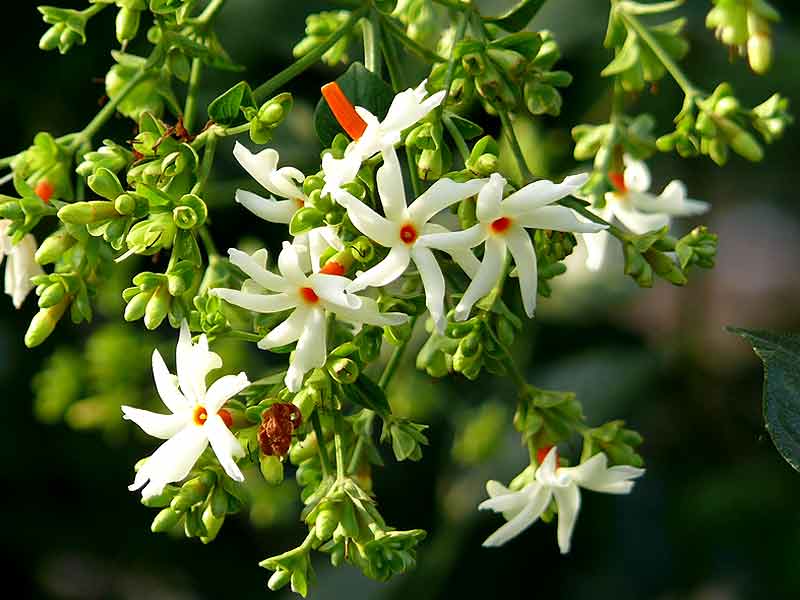
Parijat, also known as Harsingar or Night-Flowering Jasmine, holds a sacred place in Indian culture, Ayurveda, and spiritual practices. Its delicate white flowers with an orange center not only look stunning but also carry a divine fragrance. Beyond beauty, the plant is valued for its religious importance, vastu benefits, and medicinal properties.
📖 Mythological Story – Lord Krishna and Parijat
The legend of the Parijat tree is deeply rooted in Hindu mythology and is mentioned in the Puranas and Mahabharata.
During the great Samudra Manthan (Churning of the Ocean) by the Devas (gods) and Asuras (demons), many celestial treasures emerged. Among them was the Parijat tree, which was planted in Indralok (the abode of Lord Indra). Its divine fragrance and heavenly beauty fascinated everyone.
One day, Lord Krishna’s wife Satyabhama desired the Parijat flower. To fulfill her wish, Lord Krishna went to heaven and requested the tree from Indra. However, Indra refused to part with it. A battle ensued, and Lord Krishna emerged victorious. He then brought the Parijat tree to Earth and planted it in Satyabhama’s garden.
It is believed that this is why Parijat flowers bloom at night and fall to the ground in the morning, symbolizing that they should not be plucked by force but collected as divine blessings from the earth itself.
👉 Hence, Parijat is revered as the “Celestial flower brought to Earth by Lord Krishna.”

🌱 Plant Identification
-
Botanical Name: Nyctanthes arbor-tristis
-
Common Names: Parijat, Harsingar, Night-Flowering Jasmine, Shefali
-
Family: Oleaceae
-
Height: 2–10 meters
-
Flowers: White petals with an orange center, blooming at night and falling in the morning
-
Special Feature: Combines ornamental beauty with healing properties
🌞 Climate & Growing Conditions
-
Thrives in tropical and subtropical climates.
-
Prefers full sunlight for healthy growth.
-
Can tolerate partial shade.
🌿 Soil Requirements
-
Best suited to well-draining loamy soil.
-
pH: Slightly acidic to neutral (6.0–7.5).
-
Enrich soil with compost or organic manure for better flowering.
🌱 Planting Method
In Pots
-
Choose a 12–15 inch pot.
-
Prepare soil with 40% garden soil, 30% sand, and 30% compost.
-
Place the plant in the center and water lightly.
In Gardens
-
Maintain 2–3 meters spacing between plants.
-
Select a sunny location.
-
Irrigate lightly after planting.
💧 Watering Schedule
-
In summer: 3–4 times per week.
-
In winter: Only when soil is dry.
-
Avoid waterlogging to prevent root rot.
🌿 Fertilizers & Nutrition
-
Apply organic compost/vermicompost every 30–40 days.
-
Use potash-rich fertilizers to increase blooming.
-
Phosphorus-based fertilizers prevent premature flower drop.
✂️ Pruning & Maintenance
-
Remove dry, diseased, or excess branches.
-
Pruning after monsoon encourages heavy flowering.
-
Regular trimming keeps the plant bushy and attractive.
🌸 Tips to Get More Flowers
-
Plant in a sunlit area.
-
Provide regular organic manure.
-
Maintain controlled watering.
-
Add phosphorus-rich fertilizers like bone meal.
-
Prune regularly to stimulate fresh flowering.
🪔 Vastu Benefits
-
Planting Parijat in the northeast direction of the house brings positivity.
-
Considered a symbol of prosperity and harmony.
-
Believed to attract peace, wealth, and spiritual energy.
-
Flowers are highly auspicious in Hindu rituals and pujas.
🌿 Medicinal Benefits (Ayurvedic Uses)
1. Leaves
-
Used in treating fever, arthritis, and joint pain.
2. Flowers
-
Promotes mental relaxation and sound sleep.
3. Bark
-
Beneficial for abdominal pain and skin disorders.
4. Seeds
-
Strengthen the digestive system.
Major Healing Properties
-
Anti-inflammatory
-
Antipyretic (Fever-reducing)
-
Antiviral
-
Antioxidant
📊 Quick Care Summary
| Aspect | Details |
|---|---|
| Botanical Name | Nyctanthes arbor-tristis |
| Common Names | Parijat, Harsingar, Night-Flowering Jasmine |
| Family | Oleaceae |
| Climate | Tropical, subtropical |
| Sunlight | 5–6 hours daily |
| Soil | Loamy, fertile, well-draining |
| Watering | 3–4 times weekly (summer) |
| Fertilizer | Organic manure every 30–40 days |
| Medicinal Uses | Fever, arthritis, insomnia, digestion |
| Vastu Benefits | Positivity, prosperity, harmony |
❓ Frequently Asked Questions (FAQ)
1. Where should Parijat be planted for Vastu benefits?
In the northeast direction of the house.
2. Can Parijat be grown in pots?
Yes, it grows well in 12–15 inch pots.
3. When do Parijat flowers bloom?
They bloom at night and fall by morning.
4. Is Parijat used in Ayurveda?
Yes, leaves, flowers, bark, and seeds are widely used in Ayurvedic remedies.
5. How to get more flowers on Parijat?
Provide sunlight, organic fertilizers, controlled watering, and regular pruning.