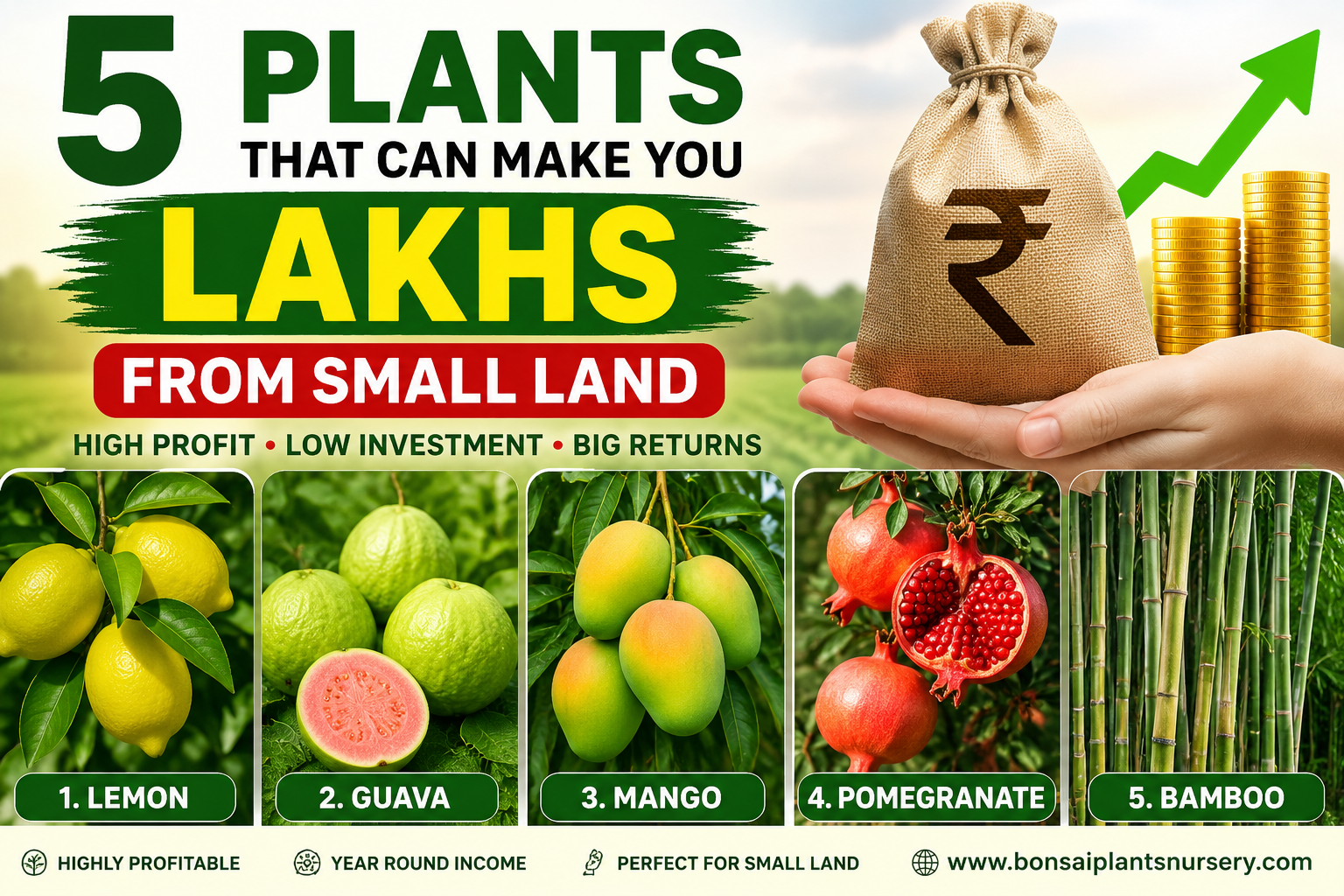
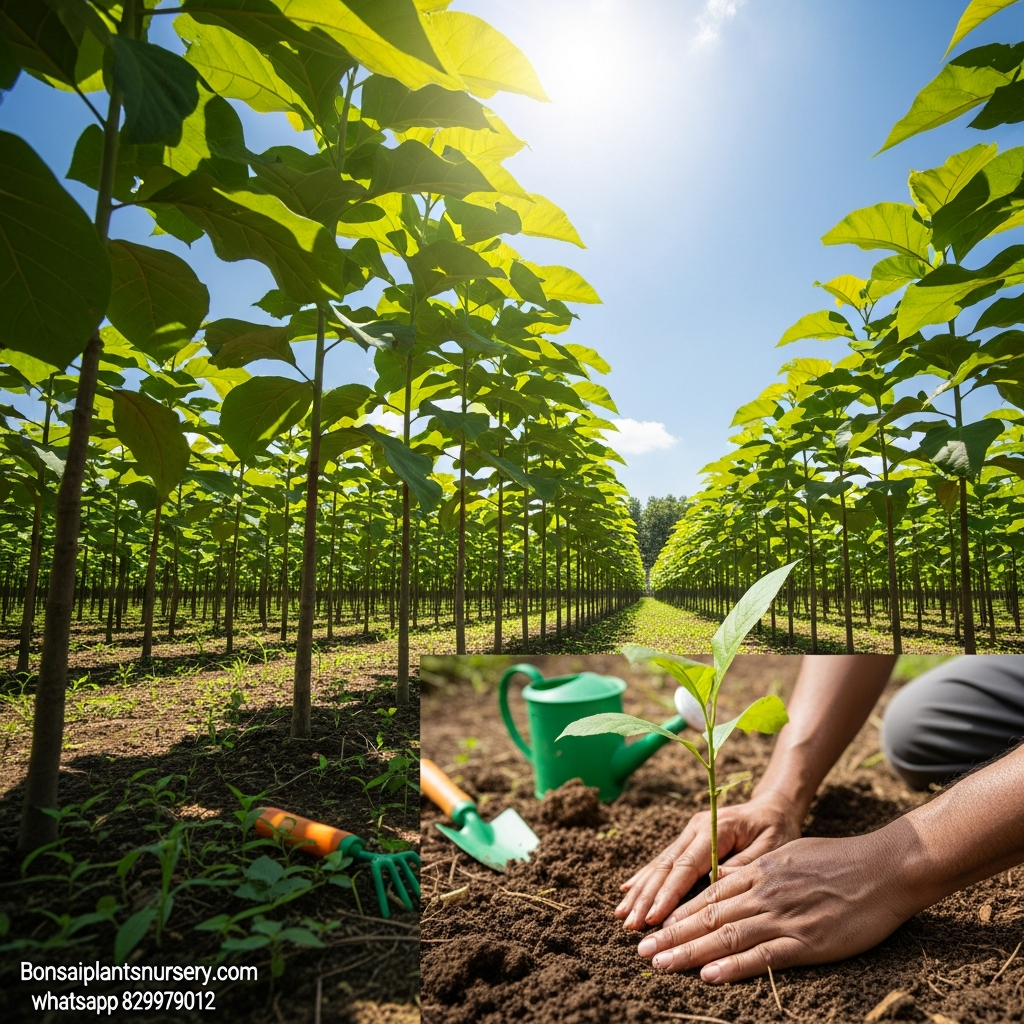
वेबसाइट:www.bonsaiplantsnursery.com व्हाट्सएप: 8299790172 विषय: कम जमीन में ज्यादा कमाई करने वाले 5 हाई प्रॉफिट प्लांट्स
🌱 भूमिका: क्या सच में छोटे खेत से लाखों कमाए जा सकते हैं?
आज के समय में खेती सिर्फ परंपरागत काम नहीं रही, बल्कि एक high income business opportunity बन चुकी है। पहले लोग मानते थे कि खेती में सिर्फ बड़े किसान ही पैसा कमा सकते हैं, लेकिन अब यह सोच पूरी तरह बदल चुकी है।
अगर आपके पास सिर्फ 1 बीघा, 1 एकड़ या उससे भी कम जमीन है, तब भी आप सही पौधों का चुनाव करके हर साल लाखों रुपये की कमाई कर सकते हैं।
5_Plants_That_Can_Make_You_Lakhs
इस ब्लॉग में हम आपको ऐसे 5 खास पौधों के बारे में बताएंगे जो:
कम देखभाल में उगते हैं
जल्दी मुनाफा देते हैं
बाजार में हमेशा डिमांड में रहते हैं
और लंबे समय तक आय देते हैं
🌳 1. नींबू (Kagji Nimbu) – सबसे तेज और लगातार कमाई वाला पौधा
नींबू खेती भारत में सबसे ज्यादा लाभ देने वाली फसलों में से एक है। खासकर कागजी नींबू की डिमांड हर मौसम में बनी रहती है।
🍋 क्यों नींबू सबसे बेस्ट है?
साल भर फल देता है
3 साल में उत्पादन शुरू
कम पानी में भी बढ़िया ग्रोथ
मार्केट में हमेशा डिमांड
💰 कमाई कितनी हो सकती है?
अगर आप 1 एकड़ में 200–250 नींबू के पौधे लगाते हैं:
प्रति पौधा औसतन 30–50 kg फल
बाजार भाव: ₹20–₹60 प्रति kg
कुल सालाना कमाई: ₹2 लाख से ₹6 लाख+
🌿 खास टिप्स:
ड्रिप इरिगेशन लगाएं
ऑर्गेनिक खाद का उपयोग करें
नियमित pruning करें
👉 सही देखभाल से यह पौधा 15–20 साल तक उत्पादन देता है।
🌳 2. अमरूद (Guava) – कम लागत, ज्यादा मुनाफा
अमरूद को “गरीब का सेब” भी कहा जाता है, लेकिन कमाई में यह किसी भी प्रीमियम फल से कम नहीं है।
🍏 क्यों अमरूद फायदेमंद है?
2–3 साल में फल देना शुरू
कम पानी और कम देखभाल
हर मौसम में मांग
कम लागत में ज्यादा उत्पादन
💰 कमाई का अनुमान:
1 एकड़ में 300–400 पौधे:
प्रति पौधा 40–80 kg उत्पादन
बाजार मूल्य ₹15–₹40 प्रति kg
कुल कमाई: ₹3 लाख से ₹8 लाख प्रति वर्ष
🌿 बेस्ट वैरायटी:
इलाहाबादी सफेदा
लखनऊ-49
थाई अमरूद (High demand premium variety)
🌳 3. आम (Mango) – लंबे समय की सबसे सुरक्षित निवेश फसल
आम को “फलों का राजा” कहा जाता है और यह भारत की सबसे स्थिर और भरोसेमंद फसल है।
🥭 क्यों आम खेती शानदार है?
4–5 साल में उत्पादन
30+ साल तक फल
कम मेंटेनेंस
एक्सपोर्ट मार्केट में डिमांड
💰 कमाई:
1 एकड़ में 100–120 पौधे:
प्रति पौधा 80–150 kg फल
₹20–₹80 प्रति kg (क्वालिटी पर निर्भर)
कुल कमाई: ₹4 लाख से ₹10 लाख+ प्रति वर्ष
🌿 लोकप्रिय किस्में:
दशहरी
लंगड़ा
केसर
आम्रपाली (High density farming)
👉 High Density Mango Farming से कम जमीन में ज्यादा उत्पादन संभव है।
🌳 4. अनार (Pomegranate) – सबसे ज्यादा प्रॉफिट वाला क्रॉप
अनार को “Red Gold” भी कहा जाता है क्योंकि इसकी बाजार कीमत बहुत स्थिर और ऊंची रहती है।
🍎 क्यों अनार खेती?
कम पानी में उगता है
सूखे इलाकों में भी सफल
2–3 साल में उत्पादन
export quality demand
💰 कमाई:
1 एकड़ में 400–500 पौधे:
प्रति पौधा 25–40 kg फल
बाजार मूल्य ₹40–₹120 प्रति kg
कुल कमाई: ₹5 लाख से ₹12 लाख प्रति वर्ष
🌿 बेस्ट वैरायटी:
भगवा (सबसे लोकप्रिय export variety)
गणेश
अरक्ता
🌳 5. बांस (Bamboo) – सबसे ज्यादा लंबी अवधि का पैसा देने वाला प्लांट
अगर आप ऐसी खेती चाहते हैं जो एक बार लगाने के बाद सालों तक पैसा दे, तो बांस सबसे अच्छा विकल्प है।
🎋 क्यों बांस खास है?
बहुत तेजी से बढ़ता है
कम देखभाल
इंडस्ट्री में भारी डिमांड
पेपर, फर्नीचर, निर्माण में उपयोग
💰 कमाई:
1 एकड़ में 400–600 पौधे:
3–4 साल बाद कटाई शुरू
प्रति पौधा कई बार कटाई संभव
सालाना कमाई: ₹3 लाख से ₹15 लाख+
👉 लंबे समय के लिए यह “wealth building crop” है।
📊 तुलना तालिका (Best Profit Crops)
पौधा
शुरुआत
कमाई
मेंटेनेंस
नींबू
3 साल
₹2–6 लाख
कम
अमरूद
2–3 साल
₹3–8 लाख
कम
आम
4–5 साल
₹4–10 लाख
मध्यम
अनार
2–3 साल
₹5–12 लाख
मध्यम
बांस
3–4 साल
₹3–15 लाख
बहुत कम
🌿 कम जमीन में ज्यादा कमाई कैसे करें?
अगर आपके पास कम जमीन है तो इन बातों का ध्यान रखें:
Why Taiwan Pink Guava Farming is Becoming the First Choice of Farmers
Commercial fruit farming is growing rapidly in India, and farmers are now shifting from traditional crops toward high-profit horticulture farming. Among the most profitable fruit crops, Taiwan Pink Guava farming has become extremely popular because of its large fruit size, attractive pink pulp, high sweetness, excellent market demand, and huge production potential.
Compared to ordinary guava varieties, Taiwan Pink Guava produces bigger fruits, higher yields, and better profits. Its demand is increasing in local markets, supermarkets, hotels, juice industries, fruit shops, and even online fruit selling businesses.
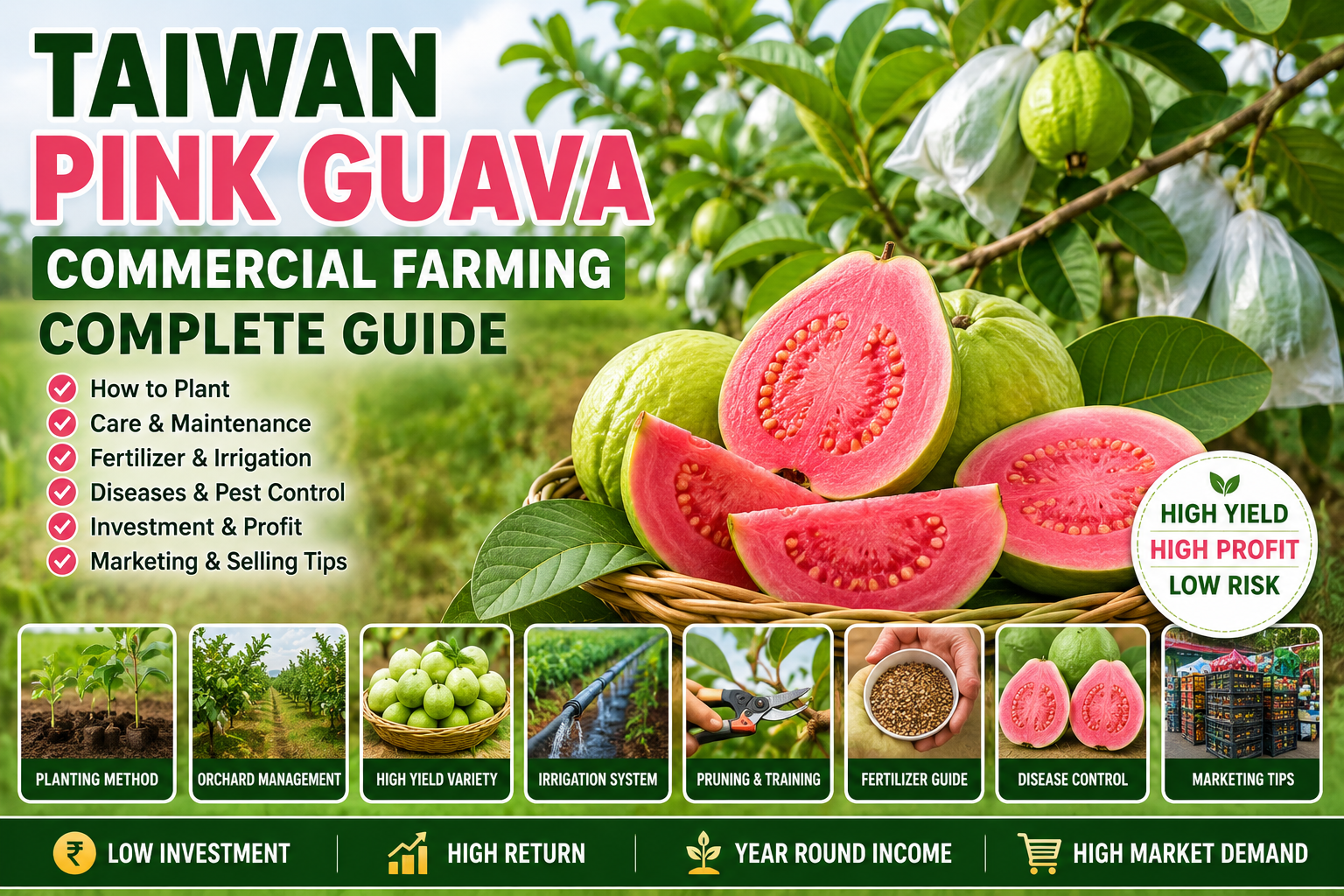
Taiwan_Pink_Guava_Commercial_Farming
Farmers looking for high income from small land holdings can earn excellent profits through Taiwan Pink Guava commercial farming. With proper plantation methods, balanced nutrition, irrigation management, pruning, and marketing strategies, farmers can generate lakhs of rupees annually.
In this complete guide, you will learn:
Features of Taiwan Pink Guava
Climate and soil requirements
Plantation methods
Field preparation
Fertilizer management
Irrigation management
Pest and disease control
Investment and profit calculation
Marketing strategies
Scientific methods for higher production
Intercropping and drip irrigation
Where to buy quality plants
What is Taiwan Pink Guava?
Taiwan Pink Guava is an improved hybrid guava variety famous for its large fruit size, pink flesh, high sweetness, and commercial productivity. It is mainly cultivated for commercial farming because of its premium market demand and excellent shelf life.
The fruits are attractive, glossy, and larger than traditional guava varieties. The inner pulp is pink in color, which makes it highly attractive to consumers.
Main Features of Taiwan Pink Guava
1. Large Fruit Size
The fruits are much bigger than normal guava varieties. A single fruit can weigh between 300 grams to 800 grams, and under proper care some fruits may even reach 1 kilogram.
2. Attractive Pink Pulp
The pink flesh increases market value and consumer demand.
3. Fewer Seeds
The fruits contain fewer seeds and are more enjoyable to eat.
4. Heavy Yield
A mature plant can produce 40 to 100 kilograms of fruits annually.
5. High Market Price
Taiwan Pink Guava generally sells at a higher price than ordinary guava.
6. Longer Shelf Life
The fruits remain fresh for longer durations, making them suitable for transportation and distant markets.
Suitable Climate for Taiwan Pink Guava Farming
Taiwan Pink Guava can be cultivated successfully in most parts of India.
Ideal Temperature
15°C to 35°C is ideal
Frost is harmful
Warm and moderately humid climate is best
Rainfall
800 to 1200 mm annual rainfall is suitable
Waterlogging must be avoided
Sunlight
Good sunlight improves sweetness and fruit quality.
Best Soil for Taiwan Pink Guava Farming
Taiwan Pink Guava grows well in many soil types, but well-drained loamy soil is considered best.
Ideal Soil pH
5.5 to 7.5
Soil Characteristics
Rich in organic matter
Proper drainage
Avoid highly alkaline or waterlogged soil
Land Preparation
Proper land preparation is essential for successful commercial farming.
First Ploughing
Do deep ploughing with a mouldboard plough.
Second and Third Ploughing
Use cultivator or rotavator to make the soil fine and loose.
Weed Removal
Remove all weeds and old crop residues.
Organic Manure
Apply 8 to 10 tons of well-decomposed cow dung manure per acre.
Where to Buy Taiwan Pink Guava Plants?
Always buy grafted and disease-free plants from trusted nurseries.
Drip irrigation is highly beneficial in Taiwan Pink Guava farming.
Advantages
Saves water
Delivers fertilizer directly to roots
Increases yield
Reduces diseases
Improves fruit quality
Irrigation Management
Summer
Irrigation every 5 to 7 days
Winter
Irrigation every 10 to 15 days
Rainy Season
Irrigate only when necessary
Avoid waterlogging at all costs.
Fertilizer and Nutrient Management
Balanced nutrition is essential for high production.
Organic Fertilizers
Per plant:
20 to 30 kg cow dung manure
Vermicompost
Neem cake
Chemical Fertilizer Management
First Year
Apply:
Urea
DAP
Potash
From Second Year
Increase fertilizer dose according to plant age.
Importance of Micronutrients
For better fruit shine and quality, spray:
Zinc
Boron
Calcium
Magnesium
Mulching Benefits
Use plastic mulch or organic mulch.
Benefits
Maintains soil moisture
Reduces weeds
Improves yield
Pruning and Training
Pruning is extremely important in Taiwan Pink Guava farming.
Benefits
Encourages new branches
Increases fruiting
Maintains plant shape
Reduces diseases
Best Time
After harvesting
Remove dry and diseased branches
Flower and Fruit Management
For high-quality fruits:
Remove excess flowers
Thin weak fruits
Provide balanced nutrition
Fruit Bagging Technique
Fruit bagging is becoming very popular in commercial guava farming.
Advantages
Cleaner fruits
Protection from insects
Better market value
Major Diseases in Taiwan Pink Guava
1. Wilt Disease
Symptoms
Drying plants
Yellow leaves
Control
Use Trichoderma
Improve drainage
2. Anthracnose
Symptoms
Black spots on fruits
Control
Spray copper oxychloride
3. Leaf Spot Disease
Control
Use suitable fungicides
Major Pests and Their Control
1. Fruit Fly
Damage
Damages fruits internally.
Control
Use pheromone traps
Maintain cleanliness
2. Mealybug
Control
Neem oil spray
Biological control methods
3. Aphids
Control
Imidacloprid spray
Organic Taiwan Pink Guava Farming
Organic fruit farming demand is increasing rapidly.
Organic Farming Inputs
Cow dung manure
Jeevamrut
Neem based formulations
Vermicompost
Trichoderma
Intercropping for Extra Income
Farmers can grow intercrops during the initial 2 to 3 years.
Suitable Crops
Vegetables
Turmeric
Ginger
Coriander
Groundnut
Fruiting Time
Fruiting starts within 1.5 to 2 years
Commercial production starts in 3 years
Full production after 5 years
Yield Per Plant
Plant Age
Average Yield
2 Years
10–20 kg
3 Years
30–50 kg
5 Years
60–100 kg
Production Per Acre
With proper management:
15 to 30 tons production per acre is possible
Investment in Taiwan Pink Guava Farming
Initial Investment
Work
Estimated Cost
Land preparation
₹10,000–20,000
Plants
₹20,000–80,000
Fertilizers
₹15,000–40,000
Drip irrigation
₹40,000–70,000
Labor
₹15,000–30,000
Miscellaneous
₹10,000–20,000
Total Investment
Around ₹1 lakh to ₹2.5 lakh per acre.
Profit and Income
Average Market Price
₹30 to ₹120 per kilogram
Per Acre Income Example
If production is 20 tons and market price is ₹50 per kilogram:
20,000 kg × ₹50 = ₹10,00,000
Net Profit
Even after expenses, farmers can earn lakhs of rupees annually.
How to Increase Profit?
1. Sell Directly to Consumers
2. Use Social Media Marketing
3. Start Online Selling
4. Supply to Hotels and Juice Shops
5. Attractive Packaging
Best States for Taiwan Pink Guava Farming
North India
Uttar Pradesh
Bihar
Haryana
Punjab
West India
Maharashtra
Gujarat
South India
Karnataka
Tamil Nadu
Telangana
East India
West Bengal
Odisha
Export Opportunities
Taiwan Pink Guava has strong export demand.
Important Export Factors
Grading
Packaging
Quality control
Limited chemical usage
Marketing Strategy
Online Platforms
Facebook
Instagram
WhatsApp Business
YouTube
Offline Markets
Fruit markets
Supermarkets
Hotels
Importance of Branding
Farmers can earn higher profits by developing a strong brand.
Examples
Branded packaging
Social media presence
Business website
Important Tips for Successful Farming
Always buy quality plants
Use drip irrigation
Prune regularly
Increase organic manure usage
Understand market demand
Sell directly to customers
Maintain farming records
Monitor plants regularly
Common Mistakes Farmers Make
1. Buying Low Quality Plants
2. Over Irrigation
3. Ignoring Pruning
4. Poor Nutrient Management
5. Delayed Disease Control
Taiwan Pink Guava vs Normal Guava
Feature
Taiwan Pink Guava
Normal Guava
Fruit Size
Large
Small
Market Price
Higher
Average
Pulp Color
Pink
White
Yield
High
Medium
Demand
High
Normal
Points to Remember While Buying Plants
Buy grafted plants
Choose disease-free plants
Purchase from trusted nurseries
Ensure healthy root systems
Modern Technologies in Guava Farming
1. Drip Irrigation
2. Mulching
3. High Density Plantation
4. Organic Farming
5. Mobile-based Monitoring
Opportunities for Women Farmers
Women farmers can also successfully participate in:
Nursery management
Fruit grading
Packaging
Online selling
Great Opportunity for Young Farmers
Modern educated youth are rapidly entering horticulture farming.
Taiwan Pink Guava farming can become a highly profitable agribusiness if combined with:
Digital marketing
Social media branding
Online sales
Modern irrigation systems
Frequently Asked Questions (FAQ)
Q1. How many years does Taiwan Pink Guava produce fruits?
With proper care, plants can produce well for 15 to 20 years.
Q2. Can Taiwan Pink Guava be grown in pots?
Yes, it can be grown in large containers, but commercial farming is best done in open fields.
Q3. How much production can one plant give?
A mature plant can produce 40 to 100 kilograms of fruits.
Q4. Is organic farming possible?
Yes, and organically grown fruits often get premium prices.
Q5. What is the market price of Taiwan Pink Guava?
Depending on quality and season, prices range from ₹30 to ₹150 per kilogram.
Conclusion
Taiwan Pink Guava commercial farming is becoming one of the most profitable fruit farming businesses in India. Its attractive fruits, high yield potential, premium market demand, and better pricing make it an excellent choice for progressive farmers.
By adopting scientific farming techniques, drip irrigation, balanced nutrition, pruning, and modern marketing strategies, farmers can earn excellent income even from small land holdings.
For farmers looking to move from traditional farming toward modern high-profit horticulture, Taiwan Pink Guava farming can become a golden opportunity.
For premium quality Taiwan Pink Guava plants and professional farming guidance contact:
ताइवान पिंक अमरूद की खेती क्यों बन रही है किसानों की पहली पसंद?
भारत में फलदार पौधों की खेती तेजी से बढ़ रही है और किसानों का रुझान अब पारंपरिक खेती से हटकर हाई प्रॉफिट हॉर्टिकल्चर की ओर जा रहा है। इसी क्रम में ताइवान पिंक अमरूद की खेती आज के समय में सबसे ज्यादा लाभ देने वाली फलों की खेती में शामिल हो चुकी है। बड़े आकार, आकर्षक गुलाबी गूदे, अधिक मिठास, बाजार में ऊँची कीमत और साल में कई बार फल देने की क्षमता के कारण यह किस्म किसानों के बीच तेजी से लोकप्रिय हो रही है।
ताइवान पिंक अमरूद सामान्य देसी अमरूद की तुलना में अधिक वजनदार, अधिक उत्पादन देने वाला और व्यापारिक दृष्टि से ज्यादा लाभदायक माना जाता है। इसकी मांग केवल स्थानीय बाजार तक सीमित नहीं है बल्कि बड़े शहरों, होटल उद्योग, जूस उद्योग, सुपरमार्केट और ऑनलाइन फल विक्रेताओं तक फैली हुई है।
अगर कोई किसान कम जमीन में ज्यादा मुनाफा कमाना चाहता है, तो ताइवान पिंक अमरूद की कमर्शियल खेती एक बेहतरीन विकल्प साबित हो सकती है। सही तकनीक, उचित पौध चयन, समय पर सिंचाई, खाद प्रबंधन और मार्केटिंग के माध्यम से किसान लाखों रुपये तक की आय प्राप्त कर सकते हैं।
Taiwan_Pink_Guava_Commercial_Farming
इस विस्तृत गाइड में हम ताइवान पिंक अमरूद की खेती से जुड़ी हर महत्वपूर्ण जानकारी विस्तार से समझेंगे, जिसमें शामिल हैं:
ताइवान पिंक अमरूद की विशेषताएँ
जलवायु और मिट्टी
पौधे लगाने का सही तरीका
खेत की तैयारी
खाद और उर्वरक प्रबंधन
सिंचाई प्रबंधन
रोग और कीट नियंत्रण
प्रति एकड़ लागत और कमाई
मार्केटिंग रणनीति
अधिक उत्पादन पाने के वैज्ञानिक तरीके
इंटरक्रॉपिंग और ड्रिप सिंचाई
पौध खरीदने की सही जगह
ताइवान पिंक अमरूद क्या है?
ताइवान पिंक अमरूद एक उन्नत हाईब्रिड अमरूद की किस्म है जो मुख्य रूप से अपने बड़े आकार, गुलाबी गूदे और अत्यधिक उत्पादन के लिए जानी जाती है। यह किस्म विशेष रूप से व्यावसायिक खेती के लिए विकसित की गई है और आज भारत के कई राज्यों में इसकी खेती सफलतापूर्वक की जा रही है।
इस अमरूद का फल आकार में बड़ा, चमकदार और देखने में आकर्षक होता है। इसके अंदर का गूदा गुलाबी रंग का होता है, जो इसे बाजार में अन्य किस्मों से अलग पहचान देता है। इसका स्वाद मीठा और कम बीज वाला होता है, जिससे उपभोक्ता इसे काफी पसंद करते हैं।
ताइवान पिंक अमरूद की मुख्य विशेषताएँ
1. बड़े आकार के फल
इस किस्म के फल सामान्य अमरूद की तुलना में काफी बड़े होते हैं। एक फल का वजन 300 ग्राम से लेकर 800 ग्राम तक हो सकता है। सही देखभाल और पोषण मिलने पर कुछ फल 1 किलो तक भी पहुँच सकते हैं।
2. गुलाबी गूदा
इसका गूदा आकर्षक गुलाबी रंग का होता है, जिससे बाजार में इसकी मांग अधिक रहती है।
3. कम बीज
इस किस्म में बीज कम होते हैं, इसलिए खाने में ज्यादा स्वादिष्ट लगती है।
4. अधिक उत्पादन
सही देखभाल के साथ प्रति पौधा 40 से 100 किलो तक उत्पादन प्राप्त किया जा सकता है।
5. बाजार में ऊँची कीमत
ताइवान पिंक अमरूद सामान्य अमरूद की तुलना में अधिक कीमत पर बिकता है। कई शहरों में इसकी कीमत 50 से 150 रुपये प्रति किलो तक मिल जाती है।
6. लंबी शेल्फ लाइफ
इस किस्म के फल अधिक समय तक खराब नहीं होते, जिससे दूर-दराज बाजारों में भी आसानी से भेजे जा सकते हैं।
ताइवान पिंक अमरूद की खेती के लिए उपयुक्त जलवायु
ताइवान पिंक अमरूद की खेती भारत के अधिकांश राज्यों में सफलतापूर्वक की जा सकती है। यह उष्णकटिबंधीय और उपोष्णकटिबंधीय जलवायु में अच्छी वृद्धि करता है।
आदर्श तापमान
15°C से 35°C तक तापमान उपयुक्त
अत्यधिक ठंड और पाला नुकसानदायक
गर्म और हल्की नमी वाली जलवायु बेहतर
वर्षा
800 से 1200 मिमी वार्षिक वर्षा उपयुक्त
जलभराव नहीं होना चाहिए
धूप
अच्छी धूप फल की गुणवत्ता और मिठास बढ़ाने में मदद करती है।
खेती के लिए उपयुक्त मिट्टी
ताइवान पिंक अमरूद लगभग सभी प्रकार की मिट्टी में उगाया जा सकता है, लेकिन अच्छी जल निकासी वाली दोमट मिट्टी सर्वोत्तम मानी जाती है।
मिट्टी का pH मान
5.5 से 7.5 उपयुक्त
मिट्टी की विशेषताएँ
जैविक पदार्थों से भरपूर
जल निकासी अच्छी हो
बहुत अधिक क्षारीय या जलभराव वाली भूमि से बचें
खेत की तैयारी कैसे करें?
अच्छी खेती की शुरुआत सही खेत तैयारी से होती है।
पहली जुताई
खेत की गहरी जुताई मिट्टी पलटने वाले हल से करें।
दूसरी और तीसरी जुताई
कल्टीवेटर या रोटावेटर से करें ताकि मिट्टी भुरभुरी हो जाए।
खरपतवार नियंत्रण
सभी खरपतवार और पुराने पौधों के अवशेष हटाएँ।
गोबर खाद का प्रयोग
प्रति एकड़ 8 से 10 टन अच्छी सड़ी हुई गोबर खाद डालें।
पौधे कहाँ से खरीदें?
कमर्शियल खेती में सबसे महत्वपूर्ण बात होती है पौधों की गुणवत्ता। हमेशा विश्वसनीय नर्सरी से ग्राफ्टेड और रोगमुक्त पौधे खरीदें।
ताइवान पिंक अमरूद में ड्रिप सिंचाई अत्यंत लाभदायक साबित होती है।
फायदे
पानी की बचत
खाद सीधे जड़ों तक
अधिक उत्पादन
रोग कम
फल का आकार बेहतर
सिंचाई प्रबंधन
गर्मियों में
5 से 7 दिन के अंतराल पर
सर्दियों में
10 से 15 दिन पर
वर्षा ऋतु
जरूरत अनुसार
जलभराव से बचना अत्यंत आवश्यक है।
खाद और उर्वरक प्रबंधन
उचित पोषण से ही अधिक उत्पादन प्राप्त किया जा सकता है।
जैविक खाद
प्रति पौधा
20 से 30 किलो गोबर खाद
वर्मी कम्पोस्ट
नीम खली
रासायनिक उर्वरक प्रबंधन
पहले वर्ष
यूरिया
डीएपी
पोटाश
दूसरे वर्ष से
उम्र के अनुसार मात्रा बढ़ाएँ।
सूक्ष्म पोषक तत्वों का महत्व
फल की गुणवत्ता और चमक बढ़ाने के लिए:
जिंक
बोरॉन
कैल्शियम
मैग्नीशियम
का स्प्रे करें।
मल्चिंग का उपयोग
प्लास्टिक मल्च या जैविक मल्च का प्रयोग करने से:
नमी बनी रहती है
खरपतवार कम होते हैं
उत्पादन बढ़ता है
पौधों की कटाई-छंटाई
ताइवान पिंक अमरूद में प्रूनिंग बहुत जरूरी होती है।
क्यों जरूरी?
नई शाखाएँ आती हैं
फल उत्पादन बढ़ता है
पौधे का आकार नियंत्रित रहता है
रोग कम लगते हैं
कब करें?
फसल के बाद
सूखी और रोगग्रस्त शाखाएँ हटाएँ
फूल और फल प्रबंधन
अधिक गुणवत्ता वाले फल पाने के लिए:
अतिरिक्त फूल हटाएँ
कमजोर फल हटाएँ
संतुलित पोषण दें
फल बैगिंग तकनीक
आजकल कमर्शियल खेती में फल बैगिंग तेजी से लोकप्रिय हो रही है।
फायदे
फल चमकदार होते हैं
कीट कम लगते हैं
बाजार मूल्य बढ़ता है
ताइवान पिंक अमरूद में लगने वाले प्रमुख रोग
1. विल्ट रोग
लक्षण
पौधा सूखना
पत्तियाँ पीली पड़ना
नियंत्रण
ट्राइकोडर्मा
जल निकासी सुधारें
2. एन्थ्रेक्नोज
लक्षण
फलों पर काले धब्बे
नियंत्रण
कॉपर ऑक्सीक्लोराइड स्प्रे
3. पत्ती धब्बा रोग
नियंत्रण
उचित फफूंदनाशी का छिड़काव
प्रमुख कीट और नियंत्रण
1. फल मक्खी
नुकसान
फल खराब हो जाते हैं।
नियंत्रण
फेरोमोन ट्रैप
स्वच्छता बनाए रखें
2. मिलीबग
नियंत्रण
नीम तेल स्प्रे
जैविक नियंत्रण
3. एफिड्स
नियंत्रण
इमिडाक्लोप्रिड स्प्रे
जैविक खेती कैसे करें?
आज जैविक अमरूद की मांग तेजी से बढ़ रही है।
जैविक खेती के तरीके
गोबर खाद
जीवामृत
नीमास्त्र
वर्मी कम्पोस्ट
ट्राइकोडर्मा
का प्रयोग करें।
इंटरक्रॉपिंग से अतिरिक्त कमाई
शुरुआती 2 से 3 वर्षों तक खाली जगह में दूसरी फसलें उगाकर अतिरिक्त आय प्राप्त की जा सकती है।
उपयुक्त फसलें
सब्जियाँ
हल्दी
अदरक
धनिया
मूंगफली
ताइवान पिंक अमरूद में फल आने का समय
1.5 से 2 वर्ष में फल आना शुरू
3 वर्ष में व्यावसायिक उत्पादन
5 वर्ष में पूर्ण उत्पादन
प्रति पौधा उत्पादन
पौधे की उम्र
औसत उत्पादन
2 वर्ष
10–20 किलो
3 वर्ष
30–50 किलो
5 वर्ष
60–100 किलो
प्रति एकड़ उत्पादन
सही प्रबंधन के साथ:
15 से 30 टन प्रति एकड़ तक उत्पादन संभव
ताइवान पिंक अमरूद की खेती में लागत
प्रारंभिक लागत
कार्य
अनुमानित लागत
खेत तैयारी
₹10,000–20,000
पौधे
₹20,000–80,000
खाद एवं उर्वरक
₹15,000–40,000
ड्रिप सिंचाई
₹40,000–70,000
मजदूरी
₹15,000–30,000
अन्य खर्च
₹10,000–20,000
कुल लागत
लगभग ₹1 लाख से ₹2.5 लाख प्रति एकड़
कमाई कितनी हो सकती है?
औसत बाजार मूल्य
₹30 से ₹120 प्रति किलो
प्रति एकड़ आय
अगर 20 टन उत्पादन और औसत ₹50 प्रति किलो मूल्य मिले:
20,000 किलो × ₹50 = ₹10,00,000
शुद्ध लाभ
खर्च निकालने के बाद भी किसान लाखों रुपये कमा सकते हैं।
अधिक मुनाफा कैसे कमाएँ?
1. सीधे ग्राहक तक बेचें
2. सोशल मीडिया मार्केटिंग करें
3. ऑनलाइन बिक्री करें
4. होटल और जूस दुकानों से संपर्क करें
5. पैकेजिंग अच्छी रखें
कौन-कौन से राज्य खेती के लिए उपयुक्त हैं?
उत्तर भारत
उत्तर प्रदेश
बिहार
हरियाणा
पंजाब
पश्चिम भारत
महाराष्ट्र
गुजरात
दक्षिण भारत
कर्नाटक
तमिलनाडु
तेलंगाना
पूर्व भारत
पश्चिम बंगाल
ओडिशा
निर्यात की संभावनाएँ
ताइवान पिंक अमरूद की मांग विदेशों में भी बढ़ रही है।
निर्यात के लिए जरूरी बातें
ग्रेडिंग
पैकिंग
क्वालिटी कंट्रोल
रसायनों का सीमित प्रयोग
मार्केटिंग रणनीति
ऑनलाइन प्लेटफॉर्म
Facebook
Instagram
WhatsApp Business
YouTube
स्थानीय मंडियाँ
फल मंडी
सुपरमार्केट
होटल
ब्रांड बनाना क्यों जरूरी है?
अगर किसान अपनी खेती को ब्रांड के रूप में विकसित करें तो उन्हें अधिक लाभ मिल सकता है।
उदाहरण
पैकिंग बॉक्स पर नाम
सोशल मीडिया पेज
वेबसाइट
सफल खेती के लिए महत्वपूर्ण सुझाव
हमेशा अच्छे पौधे खरीदें
ड्रिप सिंचाई अपनाएँ
समय पर प्रूनिंग करें
जैविक खाद का प्रयोग बढ़ाएँ
बाजार की मांग समझें
सीधे ग्राहक तक पहुँच बनाएँ
रिकॉर्ड रखें
नियमित निरीक्षण करें
शुरुआती किसानों की सामान्य गलतियाँ
1. गलत पौधे खरीदना
2. बहुत अधिक सिंचाई
3. प्रूनिंग न करना
4. पोषण प्रबंधन में लापरवाही
5. रोग नियंत्रण में देरी
ताइवान पिंक अमरूद बनाम सामान्य अमरूद
विशेषता
ताइवान पिंक
सामान्य अमरूद
फल आकार
बड़ा
छोटा
बाजार मूल्य
अधिक
सामान्य
गूदा रंग
गुलाबी
सफेद
उत्पादन
अधिक
मध्यम
मांग
अधिक
सामान्य
पौध खरीदते समय किन बातों का ध्यान रखें?
ग्राफ्टेड पौधे लें
रोगमुक्त पौधे लें
विश्वसनीय नर्सरी से खरीदें
पौधे की जड़ें स्वस्थ हों
खेती में आधुनिक तकनीकों का उपयोग
1. ड्रिप सिंचाई
2. मल्चिंग
3. हाई डेंसिटी प्लांटेशन
4. जैविक खेती
5. मोबाइल आधारित मॉनिटरिंग
महिला किसानों के लिए अवसर
ताइवान पिंक अमरूद की खेती में महिलाएँ भी सफलतापूर्वक भाग ले सकती हैं।
नर्सरी प्रबंधन
फल ग्रेडिंग
पैकिंग
ऑनलाइन बिक्री
के माध्यम से अच्छा रोजगार प्राप्त किया जा सकता है।
युवा किसानों के लिए सुनहरा अवसर
आज के समय में पढ़े-लिखे युवा आधुनिक खेती की ओर तेजी से बढ़ रहे हैं। ताइवान पिंक अमरूद की खेती कम समय में अच्छा मुनाफा देने वाली खेती है।
अगर युवा किसान:
डिजिटल मार्केटिंग
सोशल मीडिया
ऑनलाइन बिक्री
आधुनिक सिंचाई
को अपनाएँ, तो कम जमीन में भी बड़ा व्यवसाय खड़ा किया जा सकता है।
ताइवान पिंक अमरूद से जुड़े अक्सर पूछे जाने वाले प्रश्न (FAQ)
प्रश्न 1: ताइवान पिंक अमरूद का पौधा कितने साल तक उत्पादन देता है?
उत्तर: सही देखभाल के साथ 15 से 20 वर्षों तक अच्छा उत्पादन देता है।
प्रश्न 2: क्या इसकी खेती गमले में की जा सकती है?
उत्तर: हाँ, बड़े गमले में की जा सकती है लेकिन कमर्शियल उत्पादन के लिए खेत उपयुक्त है।
प्रश्न 3: एक पौधे से कितना उत्पादन मिलता है?
उत्तर: 40 से 100 किलो तक उत्पादन मिल सकता है।
प्रश्न 4: क्या इसकी खेती जैविक तरीके से संभव है?
उत्तर: हाँ, जैविक खेती में इसकी मांग और कीमत दोनों बढ़ जाती हैं।
प्रश्न 5: बाजार में इसकी कीमत कितनी मिलती है?
उत्तर: गुणवत्ता और मौसम के अनुसार ₹30 से ₹150 प्रति किलो तक।
निष्कर्ष
ताइवान पिंक अमरूद की कमर्शियल खेती आज के समय में किसानों के लिए अत्यधिक लाभदायक विकल्प बन चुकी है। बड़े आकार के आकर्षक फल, अधिक उत्पादन, ऊँची बाजार कीमत और तेजी से बढ़ती मांग इसे भविष्य की हाई प्रॉफिट खेती बनाती है।
अगर किसान सही पौध चयन, वैज्ञानिक खेती तकनीक, ड्रिप सिंचाई, संतुलित पोषण और आधुनिक मार्केटिंग रणनीतियों को अपनाएँ, तो कम जमीन में भी लाखों रुपये की आय प्राप्त की जा सकती है।
विशेष रूप से वे किसान जो पारंपरिक खेती से हटकर आधुनिक फल उत्पादन व्यवसाय शुरू करना चाहते हैं, उनके लिए ताइवान पिंक अमरूद की खेती एक सुनहरा अवसर साबित हो सकती है।
उच्च गुणवत्ता वाले ताइवान पिंक अमरूद के पौधों और खेती संबंधी मार्गदर्शन के लिए सम्पर्क करें:
Modern farming in India is changing rapidly. Farmers are no longer dependent only on traditional crops like wheat, rice, and sugarcane. Today, commercial fruit farming has become one of the most profitable agricultural businesses because of rising demand for fresh fruits, healthy food habits, juice industries, food processing units, hotels, resorts, export markets, and organic produce.
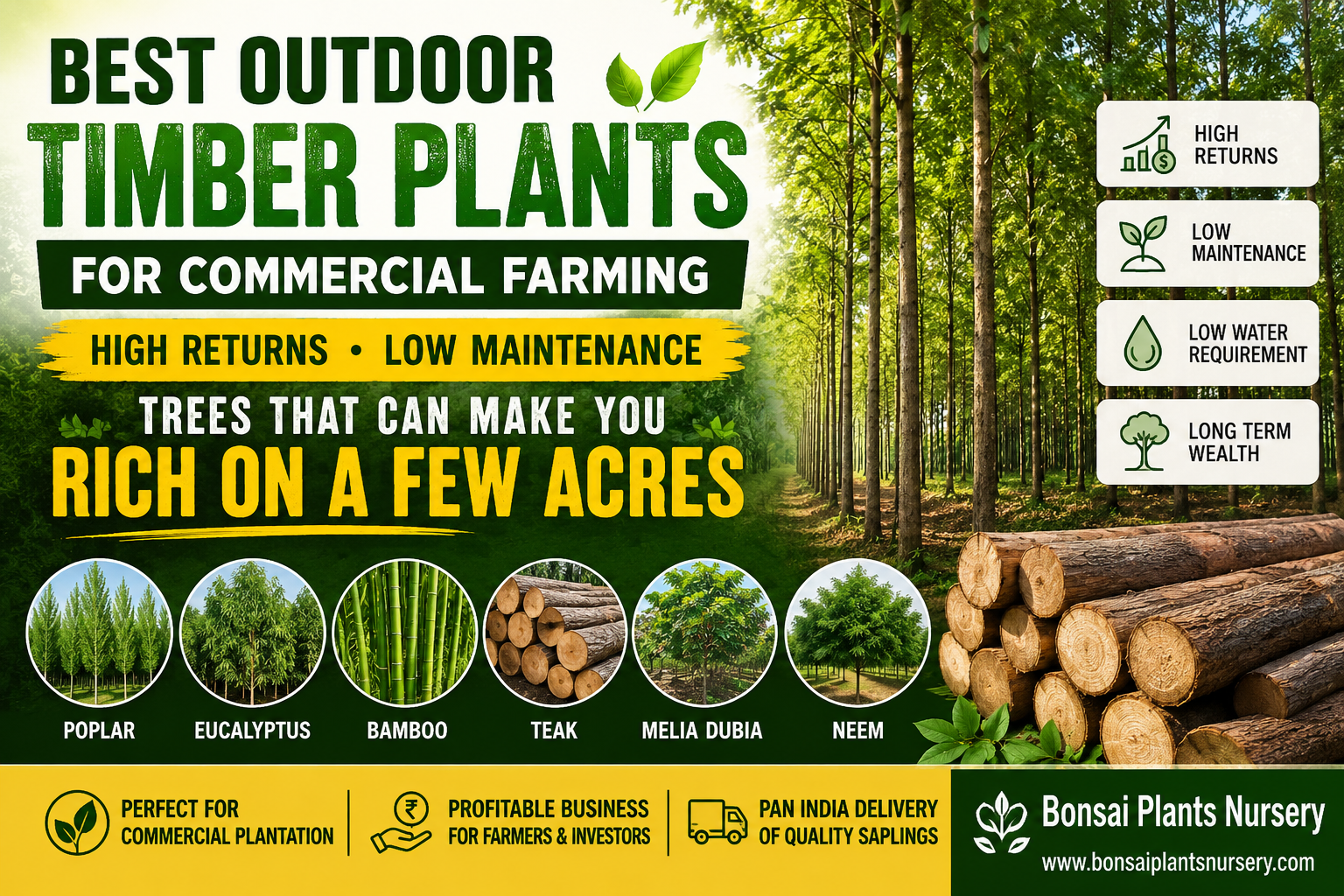
Best_Outdoor_Fruit_Plants_for_Commercial_Farming
Many outdoor fruit plants require very little maintenance while providing excellent long-term profits. These fruit crops:
Grow well with low maintenance
Need less water
Produce fruits for many years
Have strong market demand
Can generate huge profits even on small land areas
Are suitable for commercial farming and wholesale markets
If you own just 1–5 acres of land, choosing the right commercial fruit plants can help you build a highly profitable farming business.
In this complete SEO-friendly guide, we will discuss:
Best outdoor fruit plants for commercial farming
Region-wise profitable fruit crops in India
North India fruit farming
South India fruit farming
East India fruit farming
West India fruit farming
Low-maintenance fruit plantations
High-return fruit farming opportunities
Future fruit market trends
Commercial plantation strategies
This guide can help farmers, nursery owners, investors, and landowners choose the best fruit plants for long-term profits.
Why Commercial Fruit Farming Is Becoming Highly Profitable
The demand for fruits is increasing rapidly in India because:
Health-conscious consumers are growing
Juice and beverage industries are expanding
Organic fruit demand is increasing
Export opportunities are improving
Hotels and restaurants require fresh fruits daily
Food processing industries are growing fast
Because of this, commercial fruit farming is considered one of the best agricultural investments today.
Major Advantages of Commercial Fruit Farming
1. Long-Term Income
Fruit plants continue producing for many years after plantation.
2. Low Maintenance
Many fruit crops require minimal care after establishment.
3. Multiple Income Sources
Besides fresh fruit sales, farmers can earn from:
Fruit processing
Plant nurseries
Organic farming
Agro tourism
Value-added products
4. High Profit from Small Land
High-density plantations allow excellent profits even on limited land.
Important Things to Know Before Starting Fruit Farming
Before starting a commercial fruit plantation:
Select climate-suitable crops
Understand water availability
Research market demand
Conduct soil testing
Choose disease-resistant varieties
Buy healthy grafted plants
Best Fruit Plants for North India
North India includes:
Uttar Pradesh
Punjab
Haryana
Delhi
Rajasthan
Uttarakhand
Himachal Pradesh
These regions experience both hot summers and cold winters, so hardy fruit crops perform best.
1. Kagzi Lemon — Year-Round Income Fruit Plant
Kagzi Lemon is one of the most profitable commercial fruit plants in India.
Why Is It So Profitable?
Year-round market demand
Heavy use in juice industries
Low maintenance
Early fruit production
Income Sources
Fresh fruit market
Juice shops
Pickle industry
Wholesale markets
Best States
Uttar Pradesh
Punjab
Rajasthan
Haryana
2. Guava — High Profits with Low Investment
Guava is becoming extremely popular among commercial fruit farmers.
Advantages
High yield
Low water requirement
Strong market demand
Early production
Popular Varieties
Allahabad Safeda
Lucknow 49
Taiwan Pink
3. Pomegranate — High Value Export Fruit
Pomegranate is one of the best export-oriented fruit crops.
Why It Is Profitable
Excellent export demand
Premium market prices
Drought tolerance
Long shelf life
4. Mango Plantation — India’s Biggest Fruit Business
Mango is considered the king of commercial fruit farming.
Why Mango Farming Is Profitable
Huge domestic demand
Strong export opportunities
Processing industry demand
Popular Varieties
Dasheri
Langra
Amrapali
Mallika
Best Fruit Plants for West India
West India includes:
Maharashtra
Gujarat
Goa
Western Rajasthan
The warm and dry climate makes drought-tolerant fruit crops ideal.
5. Dragon Fruit — Huge Profits with Low Water
Dragon Fruit has become one of India’s fastest-growing fruit farming businesses.
Why Dragon Fruit Is Profitable
Very high market price
Low water requirement
Strong exotic fruit demand
High-density farming possible
Best States
Gujarat
Maharashtra
Rajasthan
6. Custard Apple — Low Maintenance Commercial Fruit
Custard Apple grows successfully even in poor soils.
Advantages
Minimal care required
Good nutrition demand
Processing industry uses
7. Amla — Medicinal Fruit Goldmine
Amla is highly demanded in Ayurvedic industries.
Income Sources
Juice
Candy
Powder
Herbal medicine
Best Fruit Plants for South India
South India includes:
Tamil Nadu
Kerala
Karnataka
Andhra Pradesh
Telangana
The tropical climate is excellent for many fruit crops.
8. Coconut Plantation — Lifetime Income Tree
Coconut is among the most profitable long-term crops in South India.
Why Coconut Is Profitable
Multiple product industries
Coconut oil market
Coconut water demand
Coir industry
9. Banana Farming — Fast Income Fruit Crop
Banana remains one of the most commercially successful fruit crops.
Advantages
Fast harvesting
Huge consumption market
Export opportunities
10. Sapota (Chikoo) — Low Risk Tropical Fruit
Sapota performs very well in tropical climates.
Why It Is Profitable
Sweet fruit demand
Long fruiting duration
Low maintenance
11. Jackfruit — The Future Superfood Crop
Jackfruit is becoming increasingly popular in global vegan food markets.
Best Fruit Plants for East India
East India includes:
Bihar
West Bengal
Jharkhand
Odisha
Assam
These regions have high humidity and rainfall.
12. Litchi — Premium Seasonal Fruit
Litchi is one of the most profitable seasonal fruits in Eastern India.
Why Litchi Is Profitable
Premium market price
Export opportunities
Seasonal demand
13. Papaya — Fastest Return Fruit Crop
Papaya starts producing very quickly.
Advantages
Early harvesting
High yield
Juice industry demand
14. Pineapple — High Demand Processing Fruit
Pineapple has strong demand in juice and canning industries.
Most Demanded Fruit Crops Across India
Some fruit crops remain profitable throughout India.
Fruit Plant
Major Market
Lemon
Juice & daily use
Mango
Domestic & export
Guava
Fresh fruit market
Dragon Fruit
Premium market
Papaya
Processing industry
Best Low-Maintenance Fruit Plants
If you want low-maintenance farming, these are excellent options:
Lemon
Amla
Custard Apple
Dragon Fruit
Coconut
How to Become Wealthy from a Few Acres of Fruit Farming
Strategy 1 — High Density Plantation
Plant more trees per acre using scientific spacing methods.
Strategy 2 — Mixed Fruit Farming
Grow multiple fruit crops to reduce risk and increase income.
Strategy 3 — Direct Marketing
Sell fruits directly to consumers for better profit margins.
Strategy 4 — Value Addition
Start:
Juice production
Pickle making
Dry fruit processing
Fruit packaging
for higher income.
Future of Organic Fruit Farming
Consumers increasingly prefer:
Chemical-free fruits
Organic produce
Healthy food products
Organic fruit farming may become even more profitable in the future.
Why Drip Irrigation Is Important
Benefits include:
Water saving
Better plant growth
Efficient fertilizer use
Higher production
Fruit Crops with Highest Profit Margins
High Profit Fruit Crops
Dragon Fruit
Pomegranate
Litchi
Mango
Coconut
Fastest Returning Fruit Plants
Fruit Plant
First Harvest
Papaya
8–10 months
Banana
12–15 months
Lemon
1.5–2 years
Guava
2 years
Dragon Fruit
1.5–2 years
Best Long-Term Wealth Building Fruit Plants
These fruit crops provide stable income for many years:
Mango
Coconut
Amla
Pomegranate
Side Businesses Along with Fruit Farming
You can also start:
Plant nursery business
Fruit processing units
Agro tourism
Organic compost production
Important Tips for Buying Fruit Plants
Always choose:
Healthy grafted plants
Disease-free saplings
Trusted nursery suppliers
Biggest Mistakes in Fruit Farming
1. Wrong Variety Selection
Not every variety performs well in every climate.
2. Ignoring Market Research
Understanding demand is extremely important.
3. Poor Irrigation Management
Water stress reduces fruit production significantly.
Dragon Fruit, Pomegranate, and Mango are among the most profitable fruit crops.
Which fruit plants require the least maintenance?
Lemon, Amla, and Custard Apple are low-maintenance options.
Can fruit farming be profitable on a few acres?
Yes, scientific fruit farming can generate excellent income even on small land areas.
Which fruit plants start fruiting quickly?
Papaya, Banana, and Lemon start producing relatively early.
Conclusion
Commercial outdoor fruit farming is becoming one of the fastest-growing agricultural businesses in India. By selecting the right fruit plants according to your region, understanding market demand, and using modern plantation techniques, farmers can build long-term wealth from even a few acres of land.
If you are planning to start profitable fruit farming or want healthy commercial fruit plants, contact us today.
आज के समय में पारंपरिक खेती के साथ-साथ commercial fruit farming यानी व्यावसायिक फलदार पौधों की खेती तेजी से लोकप्रिय हो रही है। बढ़ती जनसंख्या, healthy food की demand, juice industry, processing units, होटल, resorts और export market की वजह से भारत में फलदार पौधों का बाजार लगातार बढ़ रहा है। यही कारण है कि हजारों किसान अब ऐसी fruit plantation की ओर बढ़ रहे हैं जो कम maintenance में ज्यादा profit दे सके।
Best_Outdoor_Fruit_Plants_for_Commercial_Farming
सबसे बड़ी बात यह है कि कई outdoor fruit plants ऐसे हैं जिन्हें:
बहुत कम देखरेख की जरूरत होती है
कम पानी में तैयार हो जाते हैं
सालों तक लगातार फल देते हैं
market में हमेशा demand रहती है
छोटे किसानों के लिए भी लाभदायक हैं
यदि आपके पास केवल 1–5 एकड़ जमीन भी है, तो सही commercial fruit plants चुनकर आप आने वाले वर्षों में शानदार income बना सकते हैं।
इस विस्तृत SEO friendly guide में हम भारत के अलग-अलग regions — North India, South India, East India और West India — के अनुसार सबसे profitable outdoor fruit plants के बारे में विस्तार से बताएंगे।
Commercial Fruit Farming इतनी Profitable क्यों है?
भारत में:
Healthy lifestyle trend बढ़ रहा है
Fresh fruits की demand तेजी से बढ़ रही है
Juice और food processing industry बढ़ रही है
Export market मजबूत हो रहा है
Organic fruits की popularity बढ़ रही है
इन सभी कारणों से fruit farming भविष्य की सबसे profitable agricultural businesses में गिनी जा रही है।
Outdoor Fruit Plants Farming के मुख्य फायदे
1. Long-Term Income
एक बार पौधे लग जाने के बाद कई सालों तक फल देते रहते हैं।
2. कम Maintenance
कुछ fruit plants बहुत कम देखरेख में भी अच्छे उत्पादन देते हैं।
3. Multiple Income Sources
फल बेचने के अलावा:
nursery plants
processed products
organic farming
agro tourism
से भी कमाई हो सकती है।
4. कम जमीन में अधिक Profit
High-density plantation से कम area में भी भारी income संभव है।
Commercial Fruit Plantation शुरू करने से पहले ध्यान देने योग्य बातें
Climate अनुसार plants चुनें
Water availability देखें
Market demand समझें
Soil testing करवाएँ
सही variety चुनें
Disease-resistant plants लें
North India के लिए सबसे Profitable Outdoor Fruit Plants
North India में:
उत्तर प्रदेश
पंजाब
हरियाणा
दिल्ली
राजस्थान
उत्तराखंड
हिमाचल प्रदेश
शामिल हैं।
यहाँ गर्मी और सर्दी दोनों होती हैं, इसलिए hardy fruit plants सबसे अच्छे रहते हैं।
1. Kagzi Lemon – सालभर Income देने वाला पौधा
Kagzi Lemon भारत के सबसे profitable commercial fruit plants में गिना जाता है।
क्यों इतना profitable?
सालभर demand
Juice industry में भारी उपयोग
कम maintenance
जल्दी फल देना
Income Sources
Fresh market
Juice shops
Pickle industry
Wholesale mandi
Best States
उत्तर प्रदेश
पंजाब
राजस्थान
हरियाणा
2. Guava (Amrood) – कम लागत में शानदार कमाई
Guava भारत में तेजी से लोकप्रिय commercial fruit crop बन चुका है।
फायदे
High yield
कम पानी
Strong market demand
जल्दी production
सबसे लोकप्रिय varieties
Allahabad Safeda
Lucknow 49
Taiwan Pink
3. Pomegranate – High Value Export Fruit
Pomegranate commercial farming के लिए बेहद profitable माना जाता है।
क्यों profitable?
Export demand
High market price
Drought tolerant
Long shelf life
4. Mango Plantation – भारत का सबसे बड़ा Fruit Business
Mango commercial fruit farming का king माना जाता है।
क्यों profitable?
Huge domestic demand
Export opportunities
Processing industry
Popular varieties
Dasheri
Langra
Amrapali
Mallika
West India के लिए सबसे ज्यादा Return देने वाले Fruit Plants
West India में:
महाराष्ट्र
गुजरात
गोवा
पश्चिमी राजस्थान
शामिल हैं।
यहाँ dry और warm climate रहता है इसलिए drought-tolerant fruit crops बेहतर रहती हैं।
5. Dragon Fruit – कम पानी में लाखों की कमाई
Dragon Fruit आज भारत की सबसे trending fruit farming बन चुकी है।
क्यों profitable?
Very high market price
कम पानी
Exotic fruit demand
High density farming possible
Best States
गुजरात
महाराष्ट्र
राजस्थान
6. Custard Apple (Sitaphal) – Low Maintenance Fruit Plant
Custard Apple poor soil में भी grow कर सकता है।
फायदे
कम देखरेख
High nutrition demand
Processing use
7. Amla – Medicinal Goldmine
Amla Ayurvedic industry में भारी demand रखता है।
Income Sources
Candy
Juice
Powder
Ayurveda
South India के लिए सबसे Profitable Outdoor Fruit Plants
South India में:
तमिलनाडु
केरल
कर्नाटक
आंध्र प्रदेश
तेलंगाना
शामिल हैं।
यहाँ tropical climate exotic fruits के लिए ideal माना जाता है।
8. Coconut Plantation – Lifetime Income Tree
Coconut South India की सबसे profitable long-term crops में से एक है।
क्यों profitable?
Multiple product use
Oil industry
Water market
Coir industry
9. Banana Farming – Fast Income Fruit Crop
Banana सालभर demand वाला crop है।
फायदे
Fast harvesting
Huge consumption
Export potential
10. Sapota (Chikoo) – Low Risk Commercial Fruit
Sapota tropical regions में शानदार perform करता है।
क्यों profitable?
Sweet fruit demand
Long fruiting
Low maintenance
11. Jackfruit – Future Superfood Crop
Jackfruit international vegan food market में तेजी से popular हो रहा है।
East India के लिए सबसे ज्यादा कमाई देने वाले Fruit Plants
East India में:
बिहार
पश्चिम बंगाल
झारखंड
ओडिशा
असम
जैसे राज्य शामिल हैं।
यहाँ humidity और rainfall अधिक होती है।
12. Litchi – Premium Seasonal Fruit
Litchi बिहार और पूर्वी भारत की profitable crop है।
क्यों profitable?
Premium market price
Export potential
Seasonal demand
13. Papaya – Fastest Return Fruit Crop
Papaya कम समय में production शुरू कर देता है।
फायदे
जल्दी harvesting
High yield
Juice industry demand
14. Pineapple – High Demand Processing Fruit
Pineapple juice और canning industry में heavy demand रखता है।
पूरे भारत में सबसे ज्यादा Demand वाले Outdoor Fruit Plants
कुछ fruit crops पूरे भारत में profitable हैं:
Fruit Plant
Main Market
Lemon
Juice & daily use
Mango
Domestic & export
Guava
Fresh market
Dragon Fruit
Premium market
Papaya
Processing
सबसे कम Maintenance वाले Fruit Plants
यदि आप कम मेहनत में खेती करना चाहते हैं:
Lemon
Amla
Custard Apple
Dragon Fruit
Coconut
बेहद अच्छे विकल्प हैं।
कुछ एकड़ जमीन में करोड़ों कैसे कमाएँ?
Strategy 1 – High Density Plantation
कम area में ज्यादा पौधे लगाएँ।
Strategy 2 – Mixed Fruit Farming
एक से अधिक fruit crops लगाएँ।
Strategy 3 – Direct Selling
Farm to customer model अपनाएँ।
Strategy 4 – Processing Unit जोड़ें
Juice, pickle, candy बनाकर value addition करें।
Organic Fruit Farming का Future
आज consumers:
chemical-free fruits
organic produce
healthy food
को prefer कर रहे हैं।
इसलिए organic fruit farming future में और profitable बन सकती है।
Fruit Plantation में Drip Irrigation क्यों जरूरी है?
Benefits:
Water saving
Better growth
Fertilizer efficiency
Higher production
Fruit Farming में सबसे ज्यादा Profit Margin किन Crops में है?
High Profit Crops
Dragon Fruit
Pomegranate
Litchi
Mango
Coconut
जल्दी Return देने वाले Fruit Plants
Plant
First Harvest
Papaya
8–10 months
Banana
12–15 months
Lemon
1.5–2 years
Guava
2 years
Dragon Fruit
1.5–2 years
Long-Term Wealth बनाने वाले Fruit Plants
Mango
Coconut
Amla
Pomegranate
इनसे कई वर्षों तक stable income मिलती रहती है।
Fruit Farming के साथ कौन से Side Businesses करें?
Nursery business
Fruit processing
Agro tourism
Organic manure production
Fruit Plants खरीदते समय किन बातों का ध्यान रखें?
हमेशा:
Grafted plants लें
Disease-free saplings चुनें
Trusted nursery से खरीदें
Fruit Farming में सबसे बड़ी गलतियाँ
1. गलत variety selection
हर variety हर climate में successful नहीं होती।
2. Market research न करना
Demand समझना जरूरी है।
3. Poor irrigation management
Water stress production कम कर देता है।
Government Support और Subsidies
भारत में:
Horticulture mission
Fruit farming subsidy
Drip irrigation subsidy
जैसी योजनाएँ उपलब्ध हैं।
Fruit Farming में Buyers कौन होते हैं?
Wholesale mandi
Juice companies
Hotels
Retail chains
Exporters
Online fruit sellers
Fruit Farming + Nursery Business = Double Income
यदि आप:
commercial fruit farming करें
साथ में fruit plants बेचें
तो income कई गुना बढ़ सकती है।
Future में सबसे ज्यादा Demand किन Fruits की रहेगी?
2026 और आगे:
Dragon Fruit
Lemon
Avocado
Pomegranate
Exotic fruits
की demand तेजी से बढ़ सकती है।
Commercial Fruit Plantation शुरू करने का सबसे अच्छा समय
Dragon Fruit, Pomegranate और Mango बहुत profitable माने जाते हैं।
कौन से fruit plants कम maintenance वाले हैं?
Lemon, Amla और Custard Apple।
क्या कुछ एकड़ जमीन में fruit farming profitable है?
हाँ, सही planning से बहुत अच्छी income संभव है।
कौन से fruit plants जल्दी फल देते हैं?
Papaya, Banana और Lemon जल्दी production देते हैं।
निष्कर्ष
Commercial outdoor fruit farming भारत में भविष्य का सबसे तेजी से बढ़ता agricultural business बनता जा रहा है। सही region के अनुसार सही fruit plants चुनकर, smart plantation techniques अपनाकर और market demand को समझकर किसान कुछ एकड़ जमीन में भी शानदार wealth create कर सकते हैं।
यदि आप commercial fruit plants खरीदना चाहते हैं या profitable fruit farming शुरू करना चाहते हैं, तो आज ही संपर्क करें।
India’s farming sector is changing rapidly. Earlier, most farmers depended only on traditional crops like wheat, rice, and sugarcane. But today, smart farmers are shifting toward long-term profitable plantation businesses that require less maintenance and provide excellent financial returns. One of the fastest-growing sectors in modern agriculture is Commercial Timber Farming.
Best_Outdoor_Timber_Plants
Due to the massive growth of the furniture industry, plywood factories, real estate construction, packaging industries, paper mills, and luxury interior markets, the demand for timber wood is increasing every year in India. This has created a huge opportunity for farmers, landowners, nursery businesses, and investors to earn substantial profits through commercial timber plantations.
The best part is that many timber trees:
Require very little maintenance
Grow well with low water supply
Survive in difficult climates
Need minimal labor after establishment
Have strong long-term market demand
Continue increasing in value year after year
If you own even 1 acre, 2 acres, or 5 acres of land, the right timber plantation can become a lifetime wealth-building asset.
In this complete SEO-friendly guide, we will discuss:
The best timber trees for different regions of India
North India timber plants
South India timber plants
East India timber plants
West India timber plants
Fast-growing timber trees
Low-maintenance commercial plantation ideas
High-return agroforestry opportunities
Future timber market trends
Timber farming profits and strategies
If you are planning to start a profitable plantation business, this article can become your roadmap.
What Is Timber Farming?
Timber farming means growing trees commercially for wood production. The harvested wood is used for:
Furniture
Plywood
Construction
Doors and windows
Paper industry
Packaging
Decorative interiors
Export industries
Timber plantations are considered one of the most stable long-term agricultural investments in India.
Why Timber Farming Is Becoming Extremely Profitable
India’s timber demand is rising rapidly because:
The furniture market is expanding
Construction projects are increasing
Luxury housing is growing
Imported wood is becoming expensive
Natural forests are protected by regulations
Plywood and paper industries need continuous raw material
This creates a strong future for private timber plantations.
Major Advantages of Commercial Timber Farming
1. Low Maintenance Farming
Once the trees are established, they require very little care compared to regular crops.
2. Long-Term Wealth Creation
Timber trees become more valuable with age, making them excellent long-term assets.
3. Low Water Requirement
Many commercial timber species can survive with limited irrigation.
4. Multiple Income Opportunities
Besides wood, many timber trees generate income from:
Seeds
Leaves
Branches
Biomass
Nursery saplings
5. Increasing Market Demand
Wood demand is expected to increase significantly in coming years.
Important Things to Know Before Starting Timber Farming
Before starting a timber plantation:
Choose region-specific trees
Understand market demand
Study harvesting duration
Learn local regulations
Maintain proper spacing
Buy healthy saplings
Best Timber Trees for North India
North India includes:
Uttar Pradesh
Punjab
Haryana
Delhi
Uttarakhand
Himachal Pradesh
Parts of Rajasthan
The climate here includes both hot summers and cold winters, so hardy species perform best.
1. Poplar Tree — The Timber King of North India
Poplar Tree is one of the most profitable timber trees in North India.
Why Is It So Popular?
Very fast growth
Huge plywood industry demand
Ready in 6–8 years
Contract farming opportunities available
Best States
Uttar Pradesh
Punjab
Haryana
Profit Potential
Even a few acres can generate substantial profits.
2. Eucalyptus — High Returns with Low Maintenance
Eucalyptus is widely used in paper mills and plywood industries.
Advantages
Fast-growing
Drought-tolerant
Low maintenance
Performs well in poor soils
Commercial Uses
Paper manufacturing
Biomass
Furniture
Plywood
3. Teak (Sagwan) — Premium Long-Term Investment Tree
Teak is considered one of the most valuable timber species in the world.
Why Teak Is Valuable
Premium furniture wood
Water resistant
Termite resistant
Long lifespan
High export demand
Important
Teak is a long-term investment but provides exceptional returns.
4. Shisham — Strong Hardwood for Furniture Industry
Shisham is highly valued in the furniture market.
Benefits
Strong durable wood
Excellent furniture quality
High market value
Best Timber Trees for West India
West India includes:
Maharashtra
Gujarat
Goa
Western Rajasthan
The climate is generally hot and dry, making drought-tolerant trees ideal.
5. Bamboo — The Green Gold of India
Bamboo Plant is becoming one of the most profitable plantation businesses.
Why Bamboo Is Profitable
Fastest growing plant
Huge furniture demand
Construction uses
Paper industry demand
Decorative market value
Biggest Advantage
Harvesting can begin much earlier than traditional timber trees.
6. Melia Dubia — Fast Growing Millionaire Tree
Melia Dubia is becoming extremely popular in commercial plantations.
Growth Period
Ready for harvest in around 6–8 years.
Commercial Uses
Plywood
Packing industry
Biomass fuel
7. Neem Tree — Low Maintenance Income Tree
Neem performs well in dry climates.
Income Sources
Timber
Neem oil
Seeds
Organic pesticide industry
Best Timber Trees for South India
South India includes:
Tamil Nadu
Karnataka
Kerala
Telangana
Andhra Pradesh
The tropical climate is highly favorable for timber farming.
8. Sandalwood — One of the Most Expensive Trees in the World
Sandalwood is among the world’s most valuable commercial trees.
Why It Is Valuable
Perfume industry demand
Ayurvedic uses
Export market
Luxury fragrance industry
Important
Always understand local legal regulations before sandalwood farming.
9. Mahogany — Luxury Hardwood Tree
Mahogany is highly demanded in luxury furniture markets.
Benefits
Strong export potential
Premium wood quality
Long-term value growth
10. Silver Oak — Fast Growing Commercial Plantation Tree
Silver Oak is commonly planted in South India.
It is also widely used in coffee plantation shade systems.
Best Timber Trees for East India
East India includes:
Bihar
West Bengal
Odisha
Jharkhand
Assam
These regions have high humidity and rainfall.
11. Gamhar Tree — Fast Growing Hardwood Tree
Gamhar is gaining popularity in furniture industries.
Benefits
Fast growth
Quality timber
Good market demand
12. Acacia — Low Maintenance Commercial Timber Tree
Acacia is widely used in:
Paper industry
Fuelwood
Industrial wood
13. Kadam Tree — Fast Growing Multipurpose Tree
Kadam is becoming increasingly profitable in East India.
Timber Trees with Highest Demand Across India
Some timber species remain profitable across all Indian regions.
Timber Tree
Major Industry
Teak
Luxury furniture
Poplar
Plywood
Eucalyptus
Paper mills
Bamboo
Multiple industries
Melia Dubia
Commercial plywood
Best Low-Maintenance Timber Trees
If you want low-effort commercial plantations, these are ideal:
Eucalyptus
Bamboo
Neem
Acacia
Melia Dubia
Highest Profit Margin Timber Trees
Premium Long-Term Trees
Sandalwood
Teak
Mahogany
Fast Return Trees
Bamboo
Poplar
Eucalyptus
Melia Dubia
How a Few Acres Can Make You Wealthy
Strategy 1 — Mixed Plantation
Combine fast-growing trees with premium hardwood trees.
Strategy 2 — Agroforestry Model
Grow seasonal crops between timber rows during early years.
Teak, Sandalwood, and Mahogany are among the highest-value timber trees.
Which timber trees grow fastest?
Bamboo, Eucalyptus, Poplar, and Melia Dubia grow rapidly.
Can timber farming be profitable on small land?
Yes, even a few acres can generate substantial long-term income.
Which timber trees need the least maintenance?
Neem, Bamboo, Eucalyptus, and Acacia are low-maintenance options.
Conclusion
Commercial timber farming is becoming one of the most profitable long-term agricultural businesses in India. By selecting the right timber species according to your region, maintaining proper plantation management, and using smart marketing strategies, farmers can create sustainable wealth from even a few acres of land.
If you are looking for healthy commercial timber saplings and professional plantation guidance, contact us today.
भारत में खेती का तरीका तेजी से बदल रहा है। पहले जहाँ किसान केवल पारंपरिक फसलों जैसे गेहूँ, धान और गन्ने पर निर्भर रहते थे, वहीं आज लाखों किसान long-term profitable farming की ओर बढ़ रहे हैं। इन्हीं में सबसे तेजी से लोकप्रिय हो रही है — Commercial Timber Farming यानी लकड़ी देने वाले पेड़ों की व्यावसायिक खेती।
Best_Outdoor_Timber_Plants
आज भारत में furniture industry, plywood factories, construction sector, paper mills, packaging industry और luxury interior market के बढ़ने के कारण timber plants की मांग लगातार बढ़ रही है। यही कारण है कि बहुत से किसान अब कम मेहनत और कम maintenance में अधिक profit देने वाले timber plants लगा रहे हैं।
सबसे खास बात यह है कि कई timber trees ऐसे हैं जिन्हें:
बहुत कम देखभाल की जरूरत होती है
एक बार लगाने के बाद सालों तक maintenance कम रहता है
सूखे और गर्म मौसम में भी survive कर जाते हैं
कम पानी में तैयार हो जाते हैं
market में उनकी लकड़ी की हमेशा demand रहती है
यदि आपके पास 1 एकड़, 2 एकड़ या 5 एकड़ जमीन भी है, तो सही timber plantation करके आने वाले वर्षों में लाखों से करोड़ों रुपये तक की income बनाई जा सकती है।
इस detailed guide में हम आपको भारत के अलग-अलग regions — North India, South India, East India और West India — के अनुसार सबसे profitable timber plants के बारे में बताएंगे।
Timber Farming क्या है?
Timber farming का मतलब है commercial purpose के लिए लकड़ी वाले पेड़ों की खेती करना। इन पेड़ों की लकड़ी का उपयोग:
Furniture
Doors & windows
Plywood
Construction
Interior decoration
Paper industry
Packaging
जैसे कार्यों में किया जाता है।
Timber Plantation इतना Profitable क्यों है?
आज भारत में:
लकड़ी की demand लगातार बढ़ रही है
जंगलों से कटाई पर restrictions हैं
Imported wood महंगी हो रही है
Furniture industry तेजी से बढ़ रही है
इसलिए commercial timber farming future का बेहद profitable business माना जा रहा है।
Timber Farming के सबसे बड़े फायदे
1. कम Maintenance
एक बार पौधे स्थापित हो जाएँ तो बहुत कम देखभाल की जरूरत पड़ती है।
2. Long-Term Wealth Creation
पेड़ समय के साथ asset बनते जाते हैं।
3. कम पानी में खेती
कई timber trees drought resistant होते हैं।
4. Multiple Income Sources
लकड़ी के अलावा:
पत्तियाँ
शाखाएँ
biomass
nursery plants
से भी income हो सकती है।
5. कम Competition
अब भी बहुत कम किसान professional timber farming कर रहे हैं।
Timber Farming शुरू करने से पहले ध्यान देने योग्य बातें
अपने region के अनुसार plant चुनें
market demand समझें
growth duration जानें
legal permissions की जानकारी रखें
spacing सही रखें
North India के लिए सबसे Profitable Timber Plants
North India में:
उत्तर प्रदेश
पंजाब
हरियाणा
दिल्ली
उत्तराखंड
हिमाचल
राजस्थान का कुछ भाग
शामिल हैं।
यहाँ गर्मी और ठंड दोनों होती है इसलिए hardy timber plants अच्छे perform करते हैं।
1. Poplar Tree – North India का Timber King
Poplar Tree उत्तर भारत में सबसे ज्यादा commercial timber plantation के लिए लगाया जाता है।
क्यों इतना profitable है?
बहुत तेजी से growth
Plywood industry में भारी demand
6–8 साल में तैयार
Contract farming possible
कहाँ सबसे ज्यादा सफल?
उत्तर प्रदेश
पंजाब
हरियाणा
Profit Potential
1 एकड़ में लाखों रुपये की income संभव।
2. Eucalyptus – कम Maintenance में शानदार Return
Eucalyptus paper mills और plywood industry में बहुत demand में रहता है।
फायदे
Fast growth
कम पानी
कम देखभाल
poor soil में भी grow
Commercial Use
Paper industry
Biomass
Furniture
3. Teak (Sagwan) – Long-Term Rich Farmer Tree
Teak दुनिया की सबसे premium लकड़ियों में गिना जाता है।
क्यों इतना valuable?
High quality furniture wood
पानी और दीमक resistant
लकड़ी की कीमत बहुत अधिक
ध्यान रखें
Teak long-term investment है लेकिन return भी extraordinary होता है।
4. Shisham Tree – मजबूत लकड़ी का बादशाह
Shisham furniture industry में बेहद popular है।
फायदे
Strong hardwood
Long life
Premium furniture demand
West India के लिए सबसे ज्यादा Return देने वाले Timber Trees
West India में:
महाराष्ट्र
गुजरात
गोवा
राजस्थान का पश्चिमी भाग
शामिल हैं।
यहाँ dry और hot climate रहता है इसलिए drought-tolerant trees सबसे बेहतर रहते हैं।
5. Bamboo – Green Gold of India
Bamboo Plant आज timber farming में सबसे तेजी से बढ़ता business बन चुका है।
क्यों profitable?
Fastest growing
Furniture demand
Construction use
Paper industry
Decorative market
सबसे बड़ी खासियत
हर साल harvesting संभव।
6. Melia Dubia – Fast Growing Millionaire Tree
Melia Dubia South और West India में बहुत तेजी से popular हो रहा है।
Growth Time
6–8 साल में harvesting possible।
Commercial Use
Plywood
Packing industry
Biomass
7. Neem Tree – Low Maintenance Profitable Tree
Neem कम पानी और poor soil में भी survive करता है।
Income Sources
Timber
Neem oil
Seeds
Organic pesticides
South India के लिए सबसे ज्यादा Profitable Timber Plants
South India में:
तमिलनाडु
कर्नाटक
तेलंगाना
आंध्र प्रदेश
केरल
शामिल हैं।
यहाँ tropical climate timber farming के लिए बेहद उपयुक्त माना जाता है।
8. Sandalwood – सबसे महंगा Timber Tree
Sandalwood दुनिया की सबसे महंगी लकड़ियों में से एक है।
क्यों इतना valuable?
Perfume industry
Ayurveda
Export market
Important
चंदन plantation के लिए local regulations जरूर समझें।
9. Mahogany – Luxury Furniture Wood
Mahogany luxury furniture market में बहुत demand में रहता है।
फायदे
Premium export quality
Strong wood
High resale value
10. Silver Oak – Fast Growing Commercial Tree
Silver Oak South India में coffee plantations के साथ भी लगाया जाता है।
East India के लिए सबसे अच्छे Timber Plants
East India में:
बिहार
पश्चिम बंगाल
झारखंड
ओडिशा
असम
शामिल हैं।
यहाँ humidity और rainfall अधिक होती है।
11. Gamhar Tree – Fast Growing Hardwood Tree
Gamhar furniture industry में काफी popular है।
फायदे
Fast growth
Good timber quality
High demand
12. Acacia – कम Maintenance Timber Plant
Acacia paper और fuel industry में भारी demand रखता है।
13. Kadam Tree – Fast Growing Profitable Tree
Kadam East India में तेजी से popular हो रहा है।
पूरे भारत में सबसे ज्यादा Demand वाले Timber Trees
कुछ timber plants ऐसे हैं जिनकी demand पूरे भारत में बनी रहती है।
Plant
Demand
Teak
Luxury furniture
Poplar
Plywood
Eucalyptus
Paper industry
Bamboo
Multiple industries
Melia Dubia
Commercial plywood
सबसे कम Maintenance वाले Timber Trees
यदि आप कम मेहनत में अधिक income चाहते हैं तो ये plants ideal हैं:
Eucalyptus
Neem
Bamboo
Acacia
Melia Dubia
Timber Farming में सबसे ज्यादा Profit Margin किन Trees में है?
High-value timber:
Sandalwood
Teak
Mahogany
Fast-return timber:
Poplar
Eucalyptus
Bamboo
Melia Dubia
कुछ एकड़ जमीन में करोड़ों कैसे कमाएँ?
Strategy 1 – Mixed Plantation
Fast-growing + premium timber trees साथ लगाएँ।
Strategy 2 – Contract Farming
Plywood companies से contract करें।
Strategy 3 – Nursery Business
Timber saplings भी बेचें।
Strategy 4 – Agroforestry Model
बीच में seasonal crops उगाएँ।
Agroforestry क्यों Future है?
आज भारत में agroforestry तेजी से popular हो रही है क्योंकि:
extra income
soil improvement
long-term security
climate benefits
मिलते हैं।
Timber Plantation में दूरी कितनी रखें?
यह tree species पर depend करता है लेकिन सामान्यतः:
8×8 feet
10×10 feet
12×12 feet
spacing रखी जाती है।
कौन से Timber Trees जल्दी तैयार हो जाते हैं?
Tree
Harvest Time
Bamboo
3–4 years
Eucalyptus
5–7 years
Poplar
6–8 years
Melia Dubia
6–8 years
कौन से Trees Long-Term Wealth बनाते हैं?
Teak
Sandalwood
Mahogany
इनकी लकड़ी समय के साथ और महंगी होती जाती है।
Timber Farming के लिए जमीन कैसी होनी चाहिए?
Best soil:
अच्छी drainage
मध्यम fertility
water logging न हो
Timber Farming में सिंचाई कितनी जरूरी है?
पहले 1–2 साल irrigation महत्वपूर्ण होती है। बाद में कई trees rain-fed survive कर जाते हैं।
Timber Farming से जुड़ी सबसे बड़ी गलतियाँ
1. गलत species selection
हर tree हर region में successful नहीं होता।
2. Market research न करना
Demand समझना जरूरी है।
3. Poor spacing
गलत spacing growth रोक देती है।
Government Support और Subsidy
भारत में कई राज्यों में:
agroforestry promotion
plantation subsidy
free saplings
जैसी schemes उपलब्ध हैं।
Timber Farming में Risk कैसे कम करें?
Multiple species plantation करें
Insurance देखें
Local buyers से connection बनाएं
Timber Trees बेचने के Buyers कौन होते हैं?
Plywood factories
Furniture makers
Construction companies
Paper mills
Exporters
Timber Farming + Nursery Business = Double Income
यदि आप:
Timber plantation करें
साथ में saplings भी बेचें
तो आपकी income कई गुना बढ़ सकती है।
Timber Plantation के साथ कौन सी Intercrops उगा सकते हैं?
पहले वर्षों में:
हल्दी
अदरक
दालें
सब्जियाँ
उगाई जा सकती हैं।
Timber Farming से Monthly Income कैसे बनाएं?
Nursery sales
Bamboo harvesting
Intercropping
Organic compost sales
Future में सबसे ज्यादा Demand किन Timber Trees की रहेगी?
2026 और आगे:
Teak
Bamboo
Melia Dubia
Sandalwood
Mahogany
की demand तेजी से बढ़ने की संभावना है।
Timber Plantation शुरू करने के लिए Best Time
बारिश का मौसम
जुलाई–अगस्त
सबसे उपयुक्त माना जाता है।
Timber Saplings खरीदते समय किन बातों का ध्यान रखें?
Teak, Sandalwood और Mahogany सबसे high-value trees माने जाते हैं।
कौन से trees जल्दी तैयार हो जाते हैं?
Bamboo, Eucalyptus और Poplar जल्दी harvesting देते हैं।
क्या कम जमीन में timber farming profitable है?
हाँ, सही planning से कुछ एकड़ जमीन में भी लाखों की income संभव है।
सबसे कम maintenance वाला timber tree कौन सा है?
Neem, Bamboo और Eucalyptus।
निष्कर्ष
Commercial timber farming भारत में future का सबसे profitable agricultural business बनता जा रहा है। सही region के अनुसार सही timber trees चुनकर, कम maintenance और smart planning के साथ किसान long-term wealth create कर सकते हैं।
यदि आप commercial timber plants या saplings खरीदना चाहते हैं, तो आज ही संपर्क करें।
How to Earn High Profit from Small Agricultural Land
Modern farming is no longer limited to traditional crops like wheat and rice. Today, fruit farming has become one of the most profitable agricultural businesses due to increasing demand for fresh fruits, healthy lifestyles, and organic produce.
If you own only 1 bigha of land, you can still generate excellent income by selecting the right fruit plants and using smart farming techniques.
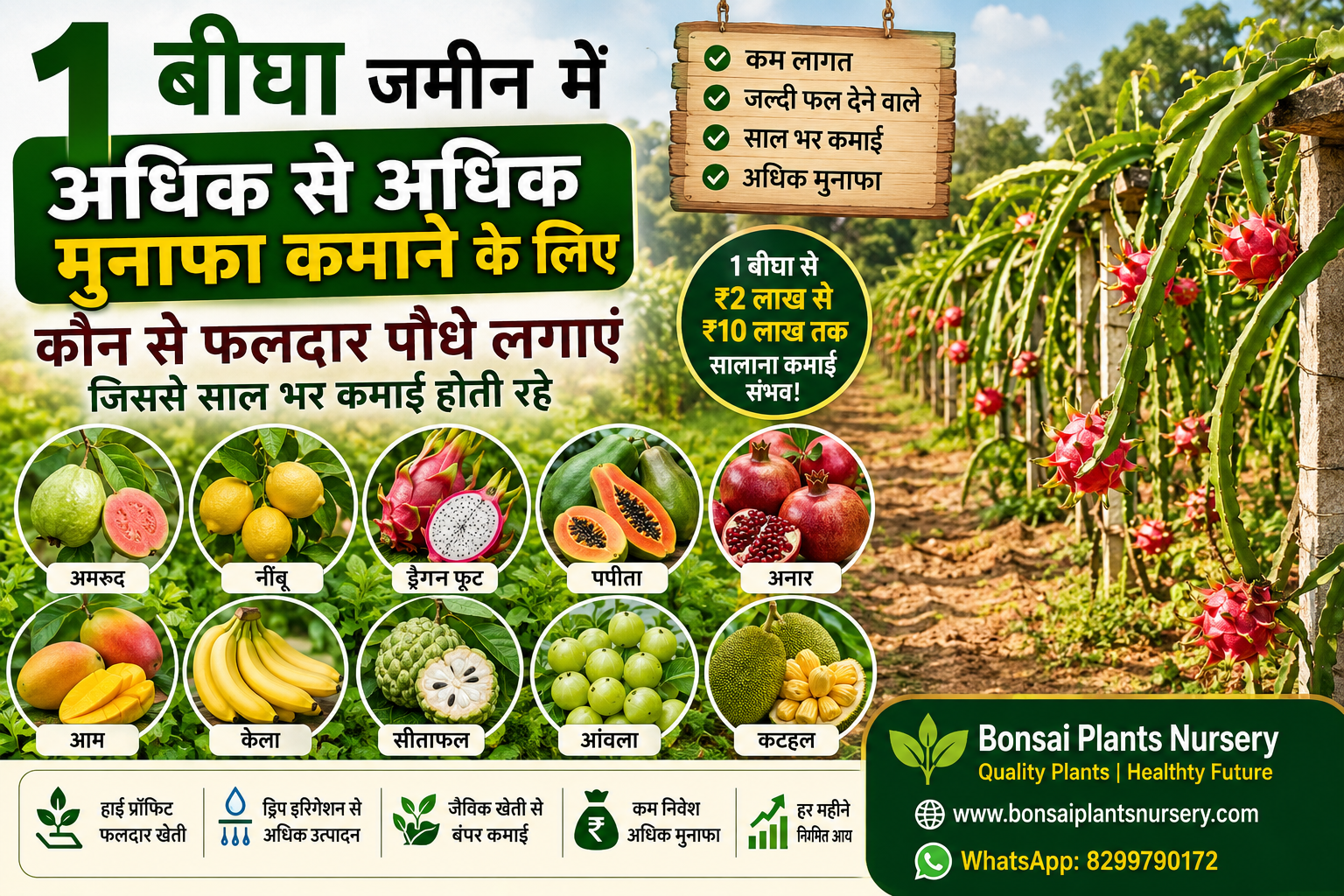
1_Bigha_Land_to_Earn_Maximum_Profit
Many farmers and beginners ask:
Which fruit plants are most profitable for 1 bigha land?
Which plants provide income throughout the year?
Which fruit farming business gives quick returns?
Which crops require less maintenance but offer high profit?
How can small landowners maximize income?
In this detailed guide, you will learn:
Best fruit plants for maximum profit
High-density farming techniques
Year-round income farming models
Organic farming methods
Professional tips for higher production
Intercropping ideas for extra earnings
Modern irrigation and plant care methods
For quality fruit plants and professional gardening guidance: 🌿 www.bonsaiplantsnursery.com 📱 WhatsApp: 8299790172
Why Fruit Farming is More Profitable Than Traditional Farming
Fruit farming has several advantages:
Higher market value
Long-term income source
Lower labor cost after establishment
Increasing demand in cities
Export opportunities
Organic fruit market growth
With proper planning, even 1 bigha land can generate lakhs of rupees annually.
Important Things to Consider Before Planting Fruit Trees
1. Soil Testing
Before starting fruit farming, test your soil for:
pH level
Water holding capacity
Organic matter
Drainage quality
Most fruit plants grow best in soil with pH between 6.0 and 7.5.
2. Water Availability
Installing a drip irrigation system is highly recommended because:
It saves water
Improves plant growth
Increases yield
Reduces fertilizer wastage
3. Market Demand
Always grow fruits that have strong local market demand and stable pricing.
4. Mixed Farming Approach
Instead of growing only one crop, combine multiple fruit plants for:
Year-round income
Reduced financial risk
Better land utilization
Most Profitable Fruit Plants for 1 Bigha Land
Now let’s explore the best fruit plants for maximum profit.
1. Guava Farming – Highly Profitable and Easy to Manage
Guava is one of the best fruit crops for small landowners.
Why Grow Guava?
Fast fruit production
High market demand
Easy maintenance
Suitable for fresh sale and processing
Best Guava Varieties
Allahabad Safeda
Taiwan Pink Guava
Lucknow-49
Red Flesh Guava
Number of Plants in 1 Bigha
Approximately 80–120 plants can be grown.
Expected Income
With proper management:
₹2 lakh to ₹5 lakh annually
Professional Tips for Higher Yield
Drip Irrigation
Improves fruit quality and reduces water wastage.
Pruning
Regular pruning increases branching and fruit production.
Organic Fertilizers
Use vermicompost and cow dung manure.
2. Lemon Farming – Continuous Year-Round Demand
Lemon farming is highly profitable because lemons are used throughout the year.
Benefits of Lemon Farming
Constant market demand
Long productive life
Low maintenance
Good shelf life
Best Lemon Varieties
Kagzi Lemon
Thai Lemon
Seedless Lemon
Production Capacity
One mature plant can produce over 1000 lemons annually.
Income from 1 Bigha
Potential earnings:
₹1.5 lakh to ₹4 lakh per year
Professional Tips
Use Potash Fertilizer
Improves fruit size and production.
Neem Oil Spray
Protects plants from pests naturally.
Consistent Watering
Especially during flowering season.
3. Dragon Fruit Farming – High Income Modern Farming
Dragon fruit farming is one of the fastest-growing high-profit farming businesses today.
Why Dragon Fruit Farming is Profitable
Premium market price
Low water requirement
Fewer diseases
Long productive lifespan
Plant Density
Approximately 400–500 plants can be grown in 1 bigha.
Modern mango farming techniques allow more plants in smaller areas.
Advantages
More plants per acre
Faster fruiting
Higher productivity
Best Varieties
Amrapali
Mallika
Dasheri
Potential Income
₹2 lakh to ₹6 lakh annually.
7. Banana Farming – Fast and Reliable Income
Banana farming is always in demand.
Advantages
Fast growth
Continuous demand
High production
Best Variety
G9 Banana
Expected Income
₹1.5 lakh to ₹3 lakh annually.
8. Custard Apple Farming – Low Water Requirement Crop
Custard apple is ideal for dry regions.
Benefits
Drought tolerant
Low maintenance
Good market price
Income Potential
₹1 lakh to ₹3 lakh annually.
9. Amla Farming – Medicinal and Commercial Crop
Amla has huge demand in Ayurvedic industries.
Benefits
Medicinal value
Long productive life
Low maintenance
Additional Income Opportunities
You can also sell:
Amla juice
Candy
Powder
Pickles
10. Jackfruit Farming – Emerging High Demand Crop
Jackfruit demand is growing rapidly due to healthy food trends.
Benefits
Low cultivation cost
Processing industry demand
Strong market growth
Best Mixed Farming Model for Year-Round Income
For continuous monthly income, mixed fruit farming is the best strategy.
Example Mixed Farming Model
Main Fruit Plants
Guava
Lemon
Dragon Fruit
Between Rows
Papaya
Banana
Boundary Plants
Curry Leaf
Aloe Vera
Drumstick (Moringa)
This model creates multiple income sources throughout the year.
Intercropping for Extra Income
Empty spaces between fruit plants can generate additional profit.
Best Intercrops
Coriander
Spinach
Chilli
Turmeric
Ginger
Intercropping improves land efficiency and monthly cash flow.
Why Drip Irrigation is Essential
Benefits
Saves up to 50% water
Increases yield
Reduces weed growth
Improves fertilizer efficiency
Organic Farming for Higher Profit
Organic fruits are increasingly popular in urban markets.
Best Organic Fertilizers
Cow dung manure
Vermicompost
Neem cake
Bone meal
Best Time to Apply Fertilizer
Important stages:
New growth stage
Before flowering
During fruit development
Professional Techniques for Higher Fruit Production
1. Mulching
Helps retain soil moisture and controls weeds.
2. Pruning
Encourages fresh growth and better fruiting.
3. Micronutrient Spray
Zinc, calcium, and boron improve fruit quality.
4. Bee Farming
Beekeeping improves pollination and increases yield.
Natural Pest Control Methods
Avoid harmful chemical pesticides whenever possible.
Best Organic Solutions
Neem Oil Spray
Natural insect control.
Trichoderma
Controls fungal diseases.
Buttermilk Spray
Helps prevent fungal infections naturally.
How to Sell Fruits for Better Profit
Selling Options
Local markets
Fruit wholesalers
Hotels and restaurants
Online sales
WhatsApp marketing
Direct farm sales
Value Addition Increases Profit
Instead of selling raw fruits only, you can also produce:
Juice
Jam
Pickles
Fruit pulp
Dried fruit products
Processing can significantly increase income.
Most Profitable Farming Models for 1 Bigha Land
Model 1 – High-Profit Modern Farming
Dragon Fruit + Papaya + Vegetables
Model 2 – Low-Risk Stable Farming
Guava + Lemon + Banana
Model 3 – Organic Farming Model
Amla + Moringa + Aloe Vera
Budget Planning Before Starting
Major Expenses
Plant purchase
Irrigation setup
Fertilizers
Labor
Support structures
Planning your budget carefully is very important.
Government Subsidies and Schemes
Many states offer subsidies for:
Drip irrigation systems
Fruit plant cultivation
Polyhouse farming
Organic farming
Check your local agriculture department for details.
Common Mistakes New Farmers Make
Choosing poor quality plants
Overwatering
Ignoring soil testing
Lack of market research
Poor pest management
Avoiding these mistakes can dramatically improve profits.
Why High-Quality Plants Matter
Buying plants from a trusted nursery ensures:
Faster growth
Early fruiting
Better disease resistance
Higher production
Future of Fruit Farming in India
Fruit farming is becoming one of the strongest agricultural businesses due to:
Rising health awareness
Growing urban demand
Export opportunities
Organic farming trends
Farmers adopting modern methods today are likely to earn significantly higher profits in the future.
Final Thoughts
With proper planning and smart crop selection, even 1 bigha land can become a highly profitable farming business.
The keys to success are:
Choose high-demand fruit plants
Use drip irrigation
Practice mixed farming
Focus on organic methods
Buy quality plants from trusted nurseries
If you are looking for high-quality fruit plants, dragon fruit plants, guava plants, lemon plants, mango plants, papaya plants, exotic plants, or professional gardening advice, contact:
Bonsai Plants Nursery
🌿 Fast Growing Quality Plants 🌿 Fruit Plants | Terrace Garden Plants | Exotic Plants 🌿 Wholesale & Retail Available
आज के समय में खेती केवल पारंपरिक अनाज उगाने तक सीमित नहीं रह गई है। बढ़ती जनसंख्या, बदलती जीवनशैली और फल-फूलों की बढ़ती मांग ने फलदार पौधों की खेती को बेहद लाभदायक बना दिया है। यदि आपके पास केवल 1 बीघा जमीन है, तब भी आप सही योजना और सही फलदार पौधों के चयन से लाखों रुपये तक की कमाई कर सकते हैं।
बहुत से किसान और नए निवेशक यह जानना चाहते हैं कि:
1 बीघा जमीन में कौन से फलदार पौधे सबसे ज्यादा लाभ देंगे?
कौन से पौधे कम देखरेख में ज्यादा उत्पादन देते हैं?
साल भर लगातार कमाई कैसे हो?
कौन से पौधे जल्दी फल देना शुरू करते हैं?
कौन सी खेती भविष्य में सबसे ज्यादा मुनाफा दे सकती है?
इस विस्तृत लेख में हम इन्हीं सभी सवालों के जवाब विस्तार से जानेंगे।
1_Bigha_Land_to_Earn_Maximum_Profit
गुणवत्ता वाले फलदार पौधों और प्रोफेशनल गार्डनिंग सलाह के लिए संपर्क करें: 🌿 www.bonsaiplantsnursery.com 📱 WhatsApp: 8299790172
1 बीघा जमीन में खेती करते समय किन बातों का ध्यान रखें?
फलदार पौधे लगाने से पहले सही योजना बनाना बहुत जरूरी है।
1. मिट्टी की जांच
सबसे पहले मिट्टी की जांच कराएं:
मिट्टी का pH
पानी रोकने की क्षमता
जैविक पदार्थों की मात्रा
अधिकांश फलदार पौधे 6.0–7.5 pH वाली मिट्टी में अच्छे बढ़ते हैं।
2. पानी की उपलब्धता
ड्रिप इरिगेशन सिस्टम लगाना सबसे बेहतर रहता है क्योंकि:
पानी की बचत होती है
पौधों को सही मात्रा में पानी मिलता है
उत्पादन बढ़ता है
3. बाजार की मांग समझें
ऐसे फलदार पौधे चुनें जिनकी स्थानीय बाजार में लगातार मांग हो।
4. मिश्रित खेती अपनाएं
सिर्फ एक प्रकार के पौधे लगाने की बजाय मिश्रित खेती करें ताकि:
साल भर आय बनी रहे
जोखिम कम हो
जमीन का बेहतर उपयोग हो
1 बीघा जमीन में सबसे ज्यादा मुनाफा देने वाले फलदार पौधे
अब जानते हैं उन पौधों के बारे में जो कम जमीन में अधिक मुनाफा दे सकते हैं।
1. अमरूद की खेती (Guava Farming)
अमरूद सबसे ज्यादा मुनाफा देने वाले फलदार पौधों में से एक है।
अमरूद क्यों लगाएं?
जल्दी फल देता है
पूरे साल मांग रहती है
कम देखरेख में अच्छा उत्पादन
प्रोसेसिंग इंडस्ट्री में भी उपयोग
कौन सी किस्म सबसे अच्छी है?
इलाहाबादी सफेदा
लाल गूदा अमरूद
लखनऊ-49
Taiwan Pink Guava
1 बीघा में कितने पौधे लग सकते हैं?
लगभग 80–120 पौधे।
कमाई कितनी हो सकती है?
अच्छी देखरेख से:
₹2 लाख से ₹5 लाख सालाना तक
प्रोफेशनल टिप्स
ड्रिप सिंचाई करें
समय-समय पर प्रूनिंग करें
जैविक खाद उपयोग करें
2. नींबू की खेती (Lemon Farming)
नींबू की मांग पूरे साल रहती है।
फायदे
बारह महीने बाजार
लंबे समय तक उत्पादन
कम लागत में खेती
बेस्ट वैरायटी
कागजी नींबू
Thai Lemon
Seedless Lemon
उत्पादन
एक पौधा साल में 1000+ नींबू दे सकता है।
1 बीघा से कमाई
₹1.5 लाख से ₹4 लाख तक संभव।
ज्यादा उत्पादन के टिप्स
पोटाश का उपयोग करें
फूल आने पर नियमित सिंचाई करें
नीम ऑयल स्प्रे करें
3. ड्रैगन फ्रूट की खेती (Dragon Fruit Farming)
ड्रैगन फ्रूट खेती आज के समय की सबसे तेजी से बढ़ती हुई हाई-प्रॉफिट खेती है।
ड्रैगन फ्रूट क्यों फायदेमंद है?
बाजार में ऊंची कीमत
कम पानी में खेती
रोग कम लगते हैं
लंबे समय तक उत्पादन
1 बीघा में पौधों की संख्या
400–500 पौधे तक।
बाजार भाव
₹80–₹300 प्रति किलो तक।
संभावित कमाई
₹4 लाख से ₹10 लाख सालाना तक।
प्रोफेशनल टिप्स
सीमेंट पोल सिस्टम लगाएं
ड्रिप इरिगेशन करें
जैविक खाद उपयोग करें
4. पपीता की खेती (Papaya Farming)
पपीता जल्दी कमाई देने वाली खेती है।
विशेषताएं
8–10 महीने में फल
कम लागत
हाई डिमांड
बेस्ट वैरायटी
Red Lady 786
Taiwan Papaya
1 बीघा से कमाई
₹2 लाख तक संभव।
अधिक उत्पादन के उपाय
संतुलित खाद दें
जलभराव न होने दें
नर पौधों को हटाएं
5. अनार की खेती (Pomegranate Farming)
अनार की खेती लंबे समय तक स्थिर आय देती है।
फायदे
हाई मार्केट वैल्यू
एक्सपोर्ट डिमांड
कम पानी की जरूरत
लोकप्रिय किस्में
भगवा
गणेश
संभावित आय
₹3 लाख से ₹7 लाख तक।
महत्वपूर्ण टिप्स
नियमित प्रूनिंग करें
फंगल रोग से बचाव करें
अच्छी धूप जरूरी
6. आम की हाई डेंसिटी खेती (High Density Mango Farming)
नई तकनीक से आम की खेती अब कम जगह में भी संभव है।
फायदे
कम जगह में ज्यादा पौधे
जल्दी फल
उच्च उत्पादन
बेस्ट वैरायटी
अमरपाली
मल्लिका
दशहरी
1 बीघा से आय
₹2 लाख से ₹6 लाख तक।
7. केला की खेती (Banana Farming)
केला हमेशा मांग में रहने वाली फसल है।
फायदे
तेजी से बढ़ती है
कम समय में उत्पादन
हर मौसम में मांग
बेस्ट किस्म
G9 Banana
कमाई
₹1.5 लाख से ₹3 लाख तक।
8. सीताफल की खेती (Custard Apple Farming)
कम पानी वाले क्षेत्रों के लिए बेहतरीन विकल्प।
फायदे
कम रखरखाव
अच्छी बाजार कीमत
सूखा सहनशील
आय
₹1 लाख से ₹3 लाख तक।
9. आंवला की खेती (Amla Farming)
आंवला औषधीय गुणों के कारण बहुत लोकप्रिय है।
फायदे
आयुर्वेदिक उपयोग
लंबे समय तक उत्पादन
कम देखभाल
प्रोसेसिंग से अतिरिक्त कमाई
कैंडी
जूस
पाउडर
10. कटहल की खेती (Jackfruit Farming)
कटहल का बाजार तेजी से बढ़ रहा है।
फायदे
कम लागत
हाई डिमांड
प्रोसेसिंग इंडस्ट्री में उपयोग
साल भर कमाई के लिए मिश्रित खेती मॉडल
यदि आप चाहते हैं कि हर महीने आय आती रहे, तो मिश्रित खेती सबसे बेहतर है।
उदाहरण मॉडल
मुख्य फलदार पौधे
अमरूद
नींबू
ड्रैगन फ्रूट
बीच में लगाएं
पपीता
केला
किनारों पर
करी पत्ता
सहजन
एलोवेरा
इंटरक्रॉपिंग से अतिरिक्त कमाई
फलदार पौधों के बीच खाली जगह में:
धनिया
पालक
मिर्च
हल्दी
अदरक
उगाकर अतिरिक्त आय प्राप्त कर सकते हैं।
ड्रिप इरिगेशन क्यों जरूरी है?
फायदे
50% तक पानी की बचत
ज्यादा उत्पादन
कम खरपतवार
खाद की बचत
जैविक खेती से अधिक लाभ
आजकल ऑर्गेनिक फलों की मांग तेजी से बढ़ रही है।
जैविक खाद
गोबर खाद
वर्मी कम्पोस्ट
नीम खली
बोनमील
फलदार पौधों में खाद कब दें?
महत्वपूर्ण समय
नई ग्रोथ के समय
फूल आने से पहले
फल बनने के समय
अधिक फल पाने की प्रोफेशनल तकनीक
1. मल्चिंग
मिट्टी में नमी बनाए रखती है।
2. प्रूनिंग
नई शाखाएं और ज्यादा फल लाने में मदद।
3. माइक्रो न्यूट्रिएंट स्प्रे
जिंक, बोरॉन, कैल्शियम जरूरी।
4. मधुमक्खी पालन
परागण बढ़ाकर उत्पादन बढ़ाता है।
फलदार पौधों को रोगों से कैसे बचाएं?
प्राकृतिक उपाय
नीम ऑयल स्प्रे
ट्राइकोडर्मा
छाछ स्प्रे
मार्केटिंग कैसे करें?
बेचने के तरीके
मंडी
लोकल मार्केट
होटल
ऑनलाइन बिक्री
WhatsApp ऑर्डर
Nursery & Plant Selling
प्रोसेसिंग से ज्यादा कमाई
फल बेचने के अलावा:
जूस
जैम
अचार
ड्राई फ्रूट
पल्प
से भी अच्छी कमाई हो सकती है।
1 बीघा जमीन के लिए सबसे लाभदायक मॉडल
मॉडल 1 – हाई प्रॉफिट
ड्रैगन फ्रूट + पपीता + सब्जियां
मॉडल 2 – कम रिस्क
अमरूद + नींबू + केला
मॉडल 3 – ऑर्गेनिक मॉडल
आंवला + सहजन + एलोवेरा
खेती शुरू करने से पहले बजट योजना
संभावित खर्च
पौधे
सिंचाई
खाद
मजदूरी
बांस/सपोर्ट
सरकार की योजनाएं और सब्सिडी
कई राज्यों में:
ड्रिप इरिगेशन सब्सिडी
फलदार पौधों पर सहायता
पॉलीहाउस सब्सिडी
उपलब्ध होती है।
नए किसान कौन सी गलतियां करते हैं?
गलत पौधे चुनना
ज्यादा पानी देना
मिट्टी जांच न कराना
बाजार रिसर्च न करना
खराब गुणवत्ता वाले पौधे खरीदना
गुणवत्ता वाले पौधे क्यों जरूरी हैं?
अच्छी नर्सरी से पौधे लेने के फायदे:
रोग मुक्त पौधे
तेजी से वृद्धि
जल्दी फल
ज्यादा उत्पादन
निष्कर्ष
यदि सही योजना और सही पौधों का चयन किया जाए तो केवल 1 बीघा जमीन से भी शानदार कमाई की जा सकती है। आज के समय में फलदार पौधों की खेती पारंपरिक खेती की तुलना में कई गुना अधिक लाभदायक साबित हो रही है।
सबसे महत्वपूर्ण बातें:
बाजार की मांग समझें
मिश्रित खेती अपनाएं
ड्रिप इरिगेशन उपयोग करें
जैविक खेती पर ध्यान दें
गुणवत्ता वाले पौधे लगाएं
यदि आप उच्च गुणवत्ता वाले फलदार पौधे, ड्रैगन फ्रूट पौधे, अमरूद, नींबू, आम, पपीता, सजावटी पौधे या गार्डनिंग सलाह चाहते हैं तो संपर्क करें:
Bonsai Plants Nursery
🌿 Fast Growing Quality Plants 🌿 Fruit Plants | Terrace Garden Plants | Exotic Plants 🌿 Wholesale & Retail Available
Mahogany has rapidly emerged as one of the most profitable and reliable timber trees in India. Due to its high-value wood, low maintenance, and long-term returns, mahogany is popularly known as the “Poor Man’s Sandalwood.” This detailed guide is written to help farmers, landowners, investors, and garden lovers understand why planting mahogany today can secure a strong financial future tomorrow.
Mahogany_plants_for_sale
What Is Mahogany?
Mahogany (Swietenia species) is a premium hardwood tree known for its straight trunk, fast growth, and durable reddish-brown timber. It is widely used in luxury furniture, interior décor, musical instruments, and plywood industries.
Why Is Mahogany Called the Poor Man’s Sandalwood?
High market value like sandalwood
No fragrance-related legal restrictions in most states
Easy to grow and maintain
Suitable for farmers with limited resources
Long-term green investment
Mahogany offers wealth creation without legal complications, making it ideal for middle-class farmers and investors.
Benefits of Planting Mahogany Trees
1. High Timber Value
Mahogany wood is extremely durable and fetches premium prices in the timber market.
2. Low Maintenance
Requires minimal watering after establishment and grows well in Indian climates.
3. Fast Growth Rate
Under proper care, mahogany grows 4–6 feet per year.
4. Suitable for Agroforestry
Can be grown alongside crops, vegetables, or fruit plants.
5. Long-Term Asset
Acts as a natural fixed deposit for landowners.
Mahogany Growth Timeline
Year
Approx Height
Status
1
4–6 ft
Establishment
5
18–25 ft
Strong trunk
10
35–45 ft
Timber value rises
15–20
60+ ft
Commercial harvest
Is Mahogany Legal in India?
Yes ✅ Mahogany cultivation is legal in most Indian states. However, before harvesting, farmers should consult local forest authorities for transport rules.
Best Climate & Soil for Mahogany
Climate: Tropical & subtropical
Soil: Well-drained loamy soil
pH: 6.5–7.5
Rainfall: Moderate
How to Plant Mahogany Saplings
Best Season: July–September
Pit Size: 2×2×2 feet
Spacing: 10–12 feet
Fertilizer: Organic manure preferred
Mahogany Plant Care Guide
Regular watering for first year
Protect from grazing animals
Organic compost every 6 months
Minimal pruning required
Where Can Mahogany Be Grown?
Agricultural fields
Farmhouses
Roadside plantations
Industrial land
Agroforestry projects
Mahogany Plant Price in India
Mahogany plant prices depend on age, height, and quality.
📌 Healthy, premium-quality mahogany plants available
आज के समय में जब लोग कम ज़मीन में ज़्यादा मुनाफ़ा, लॉन्ग‑टर्म सुरक्षित निवेश और भविष्य की आर्थिक सुरक्षा की तलाश में हैं, तब एक नाम सबसे तेज़ी से लोकप्रिय हो रहा है—महोगनी (Mahogany) का पौधा। यही कारण है कि महोगनी को अब भारत में “गरीबों का चंदन” कहा जाने लगा है।
महोगनी एक ऐसा बहुमूल्य लकड़ी वाला पेड़ है जो कम देखभाल, तेज़ ग्रोथ और आने वाले वर्षों में लाखों रुपये तक की लकड़ी देने की क्षमता रखता है। किसान, ज़मीन मालिक, फार्महाउस ओनर, प्लॉट निवेशक और यहाँ तक कि नौकरीपेशा लोग भी अब महोगनी को Green Investment के रूप में देख रहे हैं।
Mahogany_plants_for_sale
🌳 महोगनी क्या है? (What is Mahogany?)
महोगनी एक हार्डवुड ट्री है जिसकी लकड़ी अंतरराष्ट्रीय स्तर पर फर्नीचर, इंटीरियर, दरवाज़े, लक्ज़री आइटम्स और सजावटी कार्यों में इस्तेमाल होती है। इसकी लकड़ी:
मजबूत होती है
दीमक प्रतिरोधी होती है
लंबे समय तक टिकती है
और दिखने में बेहद प्रीमियम होती है
इसी कारण महोगनी की लकड़ी की मांग हमेशा बनी रहती है।
🪵 महोगनी को “गरीबों का चंदन” क्यों कहा जाता है?
चंदन बहुत कीमती है लेकिन:
उगाने में कठिन
सरकारी नियम कड़े
और सामान्य व्यक्ति के लिए जोखिम भरा
वहीं महोगनी:
✔️ उगाने में आसान
✔️ कानूनी
✔️ कम लागत
✔️ और भविष्य में बहुत ज़्यादा मूल्य
इसीलिए कहा जाता है:
“अगर चंदन अमीरों का सपना है, तो महोगनी गरीबों की हकीकत है।”
✅ महोगनी का पौधा लगाने के प्रमुख फायदे
1️⃣ लंबी अवधि का सुरक्षित निवेश
महोगनी शेयर बाज़ार या क्रिप्टो की तरह अस्थिर नहीं है। यह ज़मीन में खड़ा फिजिकल एसेट है।
2️⃣ तेज़ ग्रोथ
पहले ही साल में 4–6 फीट तक बढ़ सकता है।
3️⃣ कम देखभाल
ना ज़्यादा पानी, ना ज़्यादा खाद।
4️⃣ हर मौसम में उगने योग्य
उत्तर भारत से दक्षिण भारत तक सफल।
5️⃣ भविष्य में लाखों की लकड़ी
15–20 साल में एक पेड़ लाखों रुपये का हो सकता है।
📈 महोगनी की ग्रोथ और कमाई – सच्चाई (Reality Based Analysis)
वर्ष
अनुमानित ऊँचाई
स्थिति
1 वर्ष
4–6 फीट
पौधा स्थापित
3 वर्ष
12–15 फीट
तेज़ विकास
5 वर्ष
20–25 फीट
तना मोटा
10 वर्ष
35–45 फीट
लकड़ी का मूल्य बढ़ता
15–20 वर्ष
60+ फीट
व्यावसायिक कटाई
⚠️ महत्वपूर्ण नोट: कोई भी नर्सरी 5 साल में करोड़ों का झूठा वादा करे—उससे बचें।
💰 महोगनी की लकड़ी की कीमत
महोगनी की लकड़ी की कीमत समय, साइज और बाज़ार पर निर्भर करती है।
आज भी फर्नीचर इंडस्ट्री में महोगनी महंगी बिकती है
आने वाले 15–20 सालों में लकड़ी की कमी के कारण कीमत और बढ़ेगी
👉 इसीलिए आज लगाया गया पौधा भविष्य का सोना है।
⚖️ क्या महोगनी का पौधा कानूनी है?
✅ हाँ, महोगनी भारत के अधिकांश राज्यों में कानूनी है।
Today, farmers and investors are looking for crops that:
Give long-term stable income
Require low maintenance
Have constant market demand
Mahogany Commercial Plantation
👉 Mahogany Commercial Plantation fulfills all these needs.
In this article, we present the 50 most important questions and correct answers about Mahogany plantation, helping you take the right decision without confusion.
🌱 Mahogany Commercial Plantation – 50 Important Questions & Answers
1. What is Mahogany?
Mahogany is a valuable timber tree known for its premium quality wood used in furniture and exports.
2. Can Mahogany be grown in India?
Yes, India’s climate is highly suitable for Mahogany cultivation.
3. What is the scientific name of Mahogany?
Swietenia Mahagoni
4. Why is Mahogany wood expensive?
Because it is durable, strong, termite-resistant and beautiful.
5. In how many years does Mahogany mature?
Usually 12 to 15 years.
6. What is the best time to plant Mahogany?
July–September and February–March.
7. In which states is Mahogany successfully grown?
UP, Bihar, MP, Chhattisgarh, Maharashtra, Karnataka, Tamil Nadu, etc.
8. How many plants per acre?
Approximately 400–500 plants.
9. What type of soil is best for Mahogany?
Well-drained loamy soil.
10. Does Mahogany require a lot of water?
No, after 2 years it requires very little irrigation.
11. What is the cost of Mahogany farming?
₹40,000–₹60,000 per acre.
12. How much profit can Mahogany generate?
₹40 lakh to ₹1 crore per acre is possible.
13. What is the price of Mahogany wood?
₹8,000–₹15,000 per cubic foot.
14. Is government permission required for cutting Mahogany?
Yes, in many states it is required.
15. How tall does a Mahogany tree grow?
Up to 60–80 feet.
16. Is Mahogany fast-growing?
Moderately fast-growing.
17. Can Mahogany be grown at home?
Yes, but only in open spaces.
18. Can Mahogany be grown as Bonsai?
No, it is mainly a large timber tree.
19. Does Mahogany need fertilizer?
Yes, twice a year organic fertilizer is recommended.
20. Which fertilizer is best for Mahogany?
Cow dung manure and vermicompost.
21. What are common diseases in Mahogany?
Leaf spot, termites, fungal infections.
22. How to prevent diseases?
Neem oil spray and organic pesticides.
23. Where is Mahogany wood used?
Furniture, doors, decoration, shipbuilding.
24. Why is Mahogany demand increasing?
Due to shortage of quality wood and high export demand.
25. Is Mahogany better than Teak?
Yes, lower cost with high returns.
26. Can intercrops be grown with Mahogany?
Yes, during first 3–4 years.
27. Which intercrops are suitable?
Pulses, vegetables, turmeric, ginger.
28. How are Mahogany seeds prepared?
Extracted from mature fruits.
29. Are nursery plants better than seeds?
Yes, nursery plants are more reliable.
30. Where to buy Mahogany plants?
From a trusted nursery like BonsaiPlantsNursery.com
31. When should Mahogany be harvested?
After 12–15 years.
32. Is permission required after harvesting?
Yes, from the local forest department.
33. Where to sell Mahogany wood?
Timber markets, furniture factories, exporters.
34. What is the risk level in Mahogany farming?
Very low.
35. Is crop insurance available?
In some states, yes.
36. Is subsidy available for Mahogany?
Available in selected states.
37. How much sunlight does Mahogany need?
Full sunlight.
38. Can Mahogany grow in shade?
No, it requires open sunlight.
39. What is the lifespan of Mahogany?
More than 100 years.
40. Is Mahogany eco-friendly?
Yes, it helps in carbon absorption.
41. Does Mahogany damage soil fertility?
No, it strengthens soil.
42. Does Mahogany lower groundwater level?
No, it uses water like normal trees.
43. Is Mahogany banned by the government?
No, only cutting regulations apply.
44. Can small farmers grow Mahogany?
Yes, it is very profitable for small farmers.
45. Is Mahogany exported?
Yes, on a large scale.
46. How to identify genuine Mahogany wood?
By reddish-brown color and strong grains.
47. Is fake Mahogany common?
Yes, so buy plants only from trusted nurseries.
48. What is the price of a Mahogany plant?
₹100–₹150 per plant.
49. Does Bonsai Plants Nursery supply in bulk?
Yes, all over India.
50. What is the first step to start Mahogany plantation?
⭐ Introduction – Why African Mahogany is Emerging as the Next Big Timber Revolution
Across India and many countries, one tree is rapidly rising in popularity—African Mahogany. Known scientifically as Khaya senegalensis or Khaya ivorensis, this tree is becoming a game-changer for farmers, wood industries, agroforestry investors, and commercial plantation developers.
African Mahogany is being hailed as “The Green Gold of the Future” due to:
its high-quality hardwood,
exceptionally fast growth,
strong demand in domestic & global markets,
suitability to Indian climate,
and extremely high returns on investment.
In this long-form, deeply researched guide, we will explore the top 10 strongest reasons why African Mahogany is considered the most profitable timber tree of the coming decades.
Plant African Mahogany – Earn Lakhs in 10 Years
Let’s dive in.
⭐ Reason 1 – One of the Fastest-Growing Premium Hardwood Trees
Growth speed is the backbone of profitable forestry. African Mahogany offers exceptional speed, especially in its early years.
📌 Growth Statistics
2–3 meters height increase every year during the first 3–4 years
30–40 cm girth within 7–10 years
1 meter or more trunk girth by 15–18 years
Final height reaches 60–90 feet
📌 Comparison with Teak
Teak usually takes 20–25 years to mature. African Mahogany matures in 12–15 years, cutting almost half the waiting period.
👉 Faster maturity = Faster profits = Faster return on investment. This is one of the biggest reasons it is called Green Gold.
It is counted among the finest luxury woods worldwide.
📌 Major Applications
Premium furniture
Doors & windows
Wardrobe & interior panels
Wooden flooring
Hotel & resort interiors
Sculptures & decorative products
Kitchen cabinets
Musical instruments
Boat building
Veneer manufacturing
The market never stops demanding high-quality hardwood. This makes African Mahogany a stable, long-term investment tree.
⭐ Reason 3 – Rapidly Growing Demand in the Indian Market
In the last 5–7 years, furniture manufacturers, interior designers, and wood traders across India have started shifting toward African Mahogany due to its:
⭐ परिचय – African Mahogany क्या है और यह इतना खास क्यों है?
आज भारत में यदि कोई पेड़ सबसे तेज़ी से लोकप्रिय हो रहा है, तो वह है — अफ़्रीकन महोगनी (अफ्रीकन महोगनी)। इसे वन-विज्ञान में खाया सिनेगालेन्सिस और खाया आइवोरेन्सिस जैसी प्रजातियों के नाम से भी जाना जाता है।
पिछले कुछ वर्षों में भारत, अफ्रीका, थाईलैंड, इंडोनेशिया और ऑस्ट्रेलिया सहित कई देशों में इस पेड़ की व्यावसायिक खेती में तेज़ी आई है।
इसकी तेज़ वृद्धि, उच्च गुणवत्ता की लकड़ी, बढ़ती बाज़ार माँग और कम समय में बेहतर कमाई के कारण इसे आज दुनिया भर में भविष्य का “ग्रीन गोल्ड” (हरा सोना) कहा जाता है।
इस विस्तृत लेख में हम जानेंगे कि आखिर यह पेड़ इतना खास क्यों है और भारत में इसे उगाना किसानों के लिए कितना फायदेमंद है।
Plant African Mahogany – Earn Lakhs in 10 Years
🌟 कारण 1 – अफ्रीकन महोगनी की वृद्धि गति बेहद तेज़ है
भारत में किसान ऐसे पेड़ चाहते हैं जो:
जल्दी बड़े हों,
जल्दी लकड़ी दें,
और खेती में कम समय लगाएँ।
अफ्रीकन महोगनी इस मामले में बिल्कुल सही पेड़ है।
✔ औसत वृद्धि
पहले 3–4 साल में 2 से 3 मीटर तक ऊँचाई
7–10 साल में 30–40 सेंटीमीटर तना मोटाई
15–18 साल में 1 मीटर से अधिक तना मोटाई
कुल ऊँचाई 60–90 फीट तक
✔ यह सागौन (टीक) से तेज़ क्यों बढ़ता है?
सागौन को 20–25 वर्ष लगते हैं, जबकि अफ्रीकन महोगनी 12–15 वर्ष में ही तैयार हो जाता है।
यानी निवेश जल्दी वापस, कम समय में लकड़ी तैयार।
👉 यही इसे भविष्य का “ग्रीन गोल्ड’’ बनाता है।
🌟 कारण 2 – अफ्रीकन महोगनी की लकड़ी अत्यधिक मूल्यवान और टिकाऊ होती है
महोगनी लकड़ी दुनिया भर में लकड़ी की सर्वोच्च श्रेणी में गिनी जाती है।
इसकी विशेषताएँ:
मजबूत, घनी और टिकाऊ
दीमक और फंगस से स्वाभाविक रूप से सुरक्षित
लाल-भूरे रंग का आकर्षक रूप
सीधी और सुंदर लकड़ी की लहरदार बनावट
अनेक वर्षों तक खराब न होने वाली गुणवत्ता
✔ उपयोग
महँगे फर्नीचर
दरवाज़े और खिड़कियाँ
शोपीस और सजावटी वस्तुएँ
रसोई के कैबिनेट
होटल और रिसॉर्ट का इंटीरियर
संगीत वाद्ययंत्र
जहाज़ों के डेक
महोगनी लकड़ी की कीमतें भारत में लगातार बढ़ रही हैं।
👉 जहाँ भी प्रीमियम लकड़ी की मांग होगी, महोगनी वहाँ हमेशा चमकेगी।
🌟 कारण 3 – भारत में इसकी बाज़ार माँग तेज़ी से बढ़ रही है
भारत में पिछले 5–7 वर्षों में अफ्रीकन महोगनी की मांग तेजी से बढ़ी है।
इसका मुख्य कारण है:
बढ़ता हुआ निर्माण कार्य
लक्ज़री फर्नीचर उद्योग
इंटीरियर डिज़ाइन और लकड़ी आधारित उद्योगों का विस्तार
विदेशों में बढ़ती मांग
✔ लकड़ी का बाज़ार भाव
कच्चा लट्ठा: ₹1,500 – ₹2,800 प्रति घन फीट
तैयार तख्ते: ₹3,500 – ₹6,000 प्रति घन फीट
सजावटी परत (वीनीयर): ₹60 – ₹120 प्रति वर्ग फीट
कई कंपनियाँ टीक (सागौन) के बजाय महोगनी को बेहतर विकल्प मान रही हैं।
👉 यानी मांग बढ़ने से किसानों को बिक्री में कोई समस्या नहीं होती।
🌟 कारण 4 – 12–15 वर्षों में करोड़ों तक की कमाई का सामर्थ्य
अफ्रीकन महोगनी की खेती को सबसे अधिक लाभदायक इसलिए कहा जाता है क्योंकि यह कम समय में असाधारण कमाई देता है।
✔ प्रति एकड़ पौधे
250 से 300 पौधे (12×12 फीट दूरी पर)
✔ लागत
लगभग ₹35,000 – ₹50,000 केवल एक बार में
✔ प्रति पेड़ लकड़ी
8 से 15 घन फीट
प्रति पेड़ कमाई: ₹35,000 – ₹70,000 या उससे अधिक
✔ औसत एकड़ कमाई
यदि 250 पौधे सफल मानें:
250 × ₹40,000 = ₹1,00,00,000 (1 करोड़ रुपये तक)
और यह सब 12–15 वर्षों में।
👉 किसी भी किसान के लिए यह निवेश पर सबसे अधिक लाभ (ROI) देने वाला पेड़ साबित हो सकता है।
🌟 कारण 5 – अंतरफसली खेती में सर्वश्रेष्ठ विकल्प (Agroforestry)
अफ्रीकन महोगनी की छाया शुरुआत के वर्षों में कम होती है, इसलिए किसान इसके नीचे कई फसलें उगा सकते हैं।
✔ उपयुक्त अंतरफसलें
हल्दी
अदरक
लेमनग्रास
सब्जियाँ
सहजन (मोरिंगा)
पशुपालन और चारे की फसलें
मेंहदी
तुलसी
अरहर
इससे किसान को हर साल अतिरिक्त आय मिलती रहती है।
👉 एक ही खेत से दोहरी आमदनी — यही इसकी सबसे बड़ी ताकत है।
🌟 कारण 6 – भारत की जलवायु में खुद को आसानी से ढाल लेता है
यह पेड़ गर्म और नम दोनों प्रकार के मौसम में बहुत अच्छा बढ़ता है।
✔ जहाँ-जहाँ इसकी खेती सफल है
उत्तर प्रदेश
बिहार
मध्य प्रदेश
झारखंड
महाराष्ट्र
कर्नाटक
तेलंगाना
आंध्र प्रदेश
तमिलनाडु
ओडिशा
पश्चिम बंगाल
✔ मिट्टी
काली, लाल, दोमट या बलुई – सभी उपयुक्त
पीएच 6.5 से 7.5 आदर्श
✔ पानी
800–2000 मि.मी. वर्षा क्षेत्र वाले इलाक़े आदर्श
अफ्रीकन महोगनी सूखा भी सह सकता है और ज्यादा बारिश में भी अच्छा पनपता है।
👉 यानी इसे भारत के किसी भी कोने में उगाया जा सकता है।
🌟 कारण 7 – रोग और कीटों का कम खतरा
कई पेड़ों जैसे नीलगिरी, सफेदा, पॉपलर आदि में कीट हमलों की समस्या रहती है।
परंतु अफ्रीकन महोगनी में:
दीमक का हमला बहुत कम
फफूंद समस्याएँ कम
पत्तियों में सड़न की समस्या न के बराबर
तने में छेद करने वाले कीड़े नहीं पनपते
इससे रखरखाव बहुत कम होता है।
👉 किसान को अतिरिक्त खर्च और परेशानी दोनों से राहत मिलती है।
🌟 कारण 8 – विदेशों में अत्यधिक मांग (निर्यात मूल्य बहुत अधिक)
अफ्रीका और एशिया के कई देशों में महोगनी लकड़ी का निर्यात करोड़ों में चलता है। यूरोप, अमेरिका और खाड़ी देशों में इसकी मांग लगातार बढ़ रही है।
✔ मुख्य निर्यात उपयोग
महँगे फर्नीचर
सजावटी उत्पाद
जहाज़
लक्ज़री इंटीरियर
संगीत वाद्ययंत्र
कई भारतीय व्यापारियों ने अब महोगनी की लकड़ी के निर्यात पर ध्यान देना शुरू कर दिया है।
👉 किसान को घरेलू ही नहीं, विदेशी बाज़ार से भी कमाई हो सकती है।
🌟 कारण 9 – पर्यावरण के लिए अत्यंत लाभकारी (कार्बन क्रेडिट आय)
कार्बन क्रेडिट आज एक बड़ी आय का स्रोत बन चुके हैं। तेज़ी से बढ़ने वाले पेड़ अधिक कार्बन पकड़ते हैं और इसके बदले किसान को भुगतान मिलता है।
अफ्रीकन महोगनी:
बहुत कार्बन अवशोषित करता है
पर्यावरण को साफ़ करता है
मिट्टी की गुणवत्ता सुधारता है
✔ कार्बन क्रेडिट कमाई
प्रति पेड़ प्रति वर्ष 0.3–0.5 क्रेडिट
एक क्रेडिट का अंतरराष्ट्रीय मूल्य ₹600–₹1200 तक
👉 बड़े खेत में हजारों पेड़ लगाकर किसान अलग से आय कमा सकते हैं।
🌟 कारण 10 – भविष्य में सागौन (टीक) का सबसे मजबूत विकल्प
सागौन की प्रमुख समस्या यह है कि:
यह धीरे बढ़ता है
देखभाल अधिक चाहिए
दाम बहुत अधिक
उपलब्धता कम
इसके विपरीत, अफ्रीकन महोगनी—
जल्दी बढ़ता है
कम देखभाल चाहता है
मजबूत लकड़ी देता है
सागौन जैसा ही प्रीमियम लुक
सस्ती और बेहतर विकल्प
फर्नीचर उद्योग अब तेजी से महोगनी की तरफ बढ़ रहा है।
👉 इसलिए इसे भविष्य का “ग्रीन गोल्ड’’ कहा जा रहा है।
मेलिया डबिया (Melia Dubia / Malabar Neem) की व्यावसायिक खेती से लाखों रुपए कमाएँ
पूरी जानकारी: पौधा चयन, रोपण विधि, रख-रखाव, लागत, उपज और बिक्री
भारत में आजकल कृषि क्षेत्र में सबसे तेज़ी से बढ़ने वाले पेड़ों में से मेलिया डबिया (Malabar Neem / मेहगनी जैसा लेकिन तेज़ी से बढ़ने वाला) का नाम सबसे ऊपर आता है। यह पौधा केवल 4 से 6 साल में कटाई योग्य हो जाता है और इसका उपयोग फ़र्नीचर, प्लाईवुड, पेपर, पैकिंग बॉक्स, सरकारी व निजी निर्माण कार्यों, लकड़ी मिलों और फ़र्नीचर फैक्ट्रियों में बड़े पैमाने पर किया जाता है।
इसकी तेज़ ग्रोथ, कम पानी की जरूरत, कम रख-रखाव और तैयार लकड़ी की लगातार बढ़ती मार्केट डिमांड इसे एक सबसे अधिक लाभदायक व्यावसायिक पेड़ बनाती है।
Melia Dubia (Malabar Neem) Commercial Farming – Earn Lakhs in Just 4 Years
मेलिया डबिया क्या है?
विवरण
जानकारी
वैज्ञानिक नाम
Melia Dubia
सामान्य नाम
Malabar Neem / मेलिया डबिया
प्रकृति
तेज़ी से बढ़ने वाली व्यावसायिक लकड़ी
कटाई योग्य समय
4–6 वर्ष
उपयोग
फर्नीचर, प्लाईवुड, बॉक्स, पेपर इंडस्ट्री
खासियत
6-10 गुना तेजी से बढ़ता है
मेलिया डबिया की खेती क्यों करें? (मुख्य फायदे)
✔ 4 से 6 साल में तैयार ✔ 100% मार्केट डिमांड ✔ कम पानी और कम खाद आवश्यकता ✔ रोग और कीट से लगभग सुरक्षित ✔ बिना रख-रखाव भी बढ़ता है ✔ खाली खेत या बंजर ज़मीन पर भी सफल ✔ प्लाईवुड इंडस्ट्री में बड़ी मांग ✔ सरकार द्वारा बढ़ावा और अनुदान की संभावना
जलवायु और मिट्टी की आवश्यकता
आवश्यकता
विवरण
तापमान
18°C से 42°C
वर्षा
800 से 1800 mm
मिट्टी
दोमट, लाल, रेतीली-दोमट
pH
6.0 से 7.5
नमी
जल निकासी अच्छी होनी चाहिए
ध्यान रखें: पानी खड़ा नहीं होना चाहिए, जड़ें सड़ सकती हैं।
खेती के लिए उपयुक्त पौधों का चयन
पौधों का प्रकार
विशेषता
सलाह
Tissue Culture Melia Dubia
तेजी से बढ़ते, एक समान ऊंचाई
सर्वश्रेष्ठ
Grafted / Clone Plants
मजबूत जड़ें, रोग प्रतिरोधी
अच्छा विकल्प
स्थानीय बीज वाले पौधे
असमान ग्रोथ, कम उपज
इस्तेमाल ना करें
बोंसाई प्लांट नर्सरी (Bonsaiplantsnursery.com) पर उच्च गुणवत्ता वाले Melia Dubia Tissue Culture Plants उपलब्ध Call/WhatsApp: 8299790172
एक एकड़ में पौधों की संख्या और दूरी
दूरी
प्रति एकड़ पौधे
परिणाम
10 ft × 10 ft
450–500 पौधे
सबसे लोकप्रिय
12 ft × 12 ft
300–350 पौधे
लकड़ी का आकार बड़ा
8 ft × 8 ft
600–700 पौधे
High Density Farming
भूमि की तैयारी
खेत की गहरी जुताई करें
कंकर, घास और झाड़ियों को हटाएँ
जल निकासी की उचित व्यवस्था करें
फिर हल्की जुताई करके मिट्टी भुरभुरी बनाई जाए
गड्ढों की खुदाई और भराई
गड्ढे का आकार:
1 ft x 1 ft x 1 ft
गड्ढे की भराई में मिलाएँ:
सामग्री
मात्रा
गोबर खाद / वर्मी कम्पोस्ट
5 kg
नीमखली
100–150 gm
ट्राइकोडर्मा
50 gm
रेत (यदि मिट्टी भारी है)
10–15%
रोपाई का सही समय
सीजन
उपयुक्तता
वर्षा ऋतु (जुलाई–अगस्त)
सबसे अच्छा
बसंत ऋतु
अच्छा
गर्मी और सर्दी
टालें
सिंचाई प्रबंधन
समय
पानी
रोपाई के 1 महीने तक
हर 4–5 दिन में
बाद में
केवल गर्मियों में
बारिश वाले क्षेत्र
सिंचाई की आवश्यकता नहीं
ड्रिप सिंचाई होने पर पौधा 30–50% तेजी से बढ़ता है।
खाद एवं पोषण प्रबंधन
समय
खाद की मात्रा
रोपाई के समय
5-10 kg जैविक खाद प्रति पौधा
हर 6 महीने
2–3 kg कम्पोस्ट
प्रति वर्ष
NPK 100–200 gm + सूक्ष्म पोषक
कुल 4 साल में पेड़ कितना बढ़ता है?
वर्ष
ऊँचाई
मोटाई (Circumference)
1 वर्ष
7–12 ft
4–6 inch
2 वर्ष
15–20 ft
8–12 inch
3 वर्ष
25–35 ft
14–18 inch
4 वर्ष
35–50 ft
18–24+ inch
4 साल में एक पेड़ 30–60 cubic feet लकड़ी दे सकता है (मार्केट पर निर्भर)।
रोग व कीट प्रबंधन
मेलिया डबिया में रोग और कीट बहुत कम लगते हैं, फिर भी:
समस्या
समाधान
दीमक
क्लोरोपायरीफॉस या नीम तेल का छिड़काव
फफूंद
ट्राइकोडर्मा + गोबर खाद
पत्तियाँ पीली होना
सूक्ष्म पोषक तत्व + पानी नियंत्रण
कटाई और उपज
कटाई का समय:
4 से 5 वर्ष (व्यावसायिक उद्देश्य)
एक पेड़ की कीमत (4 साल में):
₹800 से ₹2,500+ प्रति पेड़ (गुणवत्ता, मोटाई और खरीदार पर निर्भर)
Q1. Melia Dubia (Malabar Neem) की कटाई कितने साल में होती है?
उत्तर: Melia Dubia पौधे की कटाई सामान्यतः 4 से 6 वर्ष में की जा सकती है। यदि पौधा अच्छी भूमि, सिंचाई और खाद के साथ लगाया गया हो तो यह 4 साल में ही कटाई योग्य हो जाता है।
Q2. एक पेड़ से कितनी लकड़ी मिलती है?
उत्तर: 4 साल में एक पेड़ से लगभग 30–60 cubic feet लकड़ी प्राप्त हो सकती है। यह मिट्टी, देखरेख और पौधे की गुणवत्ता पर निर्भर करता है।
Q3. Melia Dubia की लकड़ी की मार्केट प्राइस क्या है?
उत्तर: इसकी कीमत क्षेत्र अनुसार बदलती है, परंतु आम तौर पर:
₹800 से ₹2,500+ प्रति पेड़ (4 साल में)
बड़े आकार पर रेट और भी अधिक मिलता है।
Q4. Melia Dubia के पौधे कहाँ से खरीदें?
उत्तर: प्रमाणित Tissue Culture और Clone पौधे ही खरीदें। Bonsaiplantsnursery.com पर उच्च गुणवत्ता वाले पौधे उपलब्ध हैं। 📞 Call/WhatsApp: 8299790172
Q5. क्या Melia Dubia को बहुत पानी चाहिए?
उत्तर: नहीं। शुरुआत में 1–2 महीनों के लिए हल्की सिंचाई चाहिए। इसके बाद यह बारिश के पानी पर भी बढ़ सकता है।
Q6. क्या यह पौधा रोगों और दीमक से प्रभावित होता है?
उत्तर: Melia Dubia की लकड़ी और जड़ें प्राकृतिक रूप से दीमक प्रतिरोधी होती हैं। रोग बहुत कम लगते हैं, इसलिए यह कम रखरखाव वाला पेड़ है।
Q7. एक एकड़ में कितने पौधे लगाए जा सकते हैं?
उत्तर: Spacing 10 ft × 10 ft रखने पर 450–500 पौधे लगाए जाते हैं।
Q8. क्या Melia Dubia खेती में सरकारी अनुमति चाहिए?
उत्तर: नहीं। यह पौधा Forest Act के अंतर्गत प्रतिबंधित वृक्षों में नहीं आता, इसलिए आप इसकी कटाई और बिक्री आसानी से कर सकते हैं।
Q9. क्या बंजर या कम उपजाऊ जमीन पर Melia Dubia लग सकता है?
उत्तर: हाँ। यह पेड़ कम उपजाऊ मिट्टी में भी तेजी से बढ़ जाता है, बस जल निकासी अच्छी होनी चाहिए।
Q10. क्या Melia Dubia को दूसरे फसलों के साथ भी लगाया जा सकता है?
उत्तर: हाँ। पहले 18–24 महीनों तक आप हल्की फसलें जैसे मूंग, उड़द, बाजरा, चारा आदि साथ में उगा सकते हैं।
✅ सारांश (Conclusion)
यदि आपके पास खाली भूमि है और आप कम निवेश में जल्दी और निश्चित आय चाहते हैं, तो Melia Dubia की व्यावसायिक खेती आपके लिए एक बेहद लाभदायक कृषि व्यापार साबित हो सकती है। सिर्फ 4 साल में 6 से 12 लाख+ तक का लाभ सिर्फ एक एकड़ में संभव है।
उच्च गुणवत्ता वाले Melia Dubia Tissue Culture पौधे उपलब्ध हैं
Bonsaiplantsnursery.com 📞 Call / WhatsApp:8299790172 🚚 All India Delivery 🌱 100% High Survival Rate 🧑🌾 Free Plantation Guidance
Melia Dubia (Malabar Neem) Commercial Farming – Earn Lakhs in Just 4 Years
Complete Guide: Plantation Method, Care, Irrigation, Pruning, Harvesting and Selling
Introduction
If you have vacant land and you are looking for a high-profit, low-maintenance agricultural business, then Melia Dubia (also known as Malabar Neem) is one of the fastest-growing and most income-generating trees you can cultivate.
This tree matures quickly, requires minimal care, grows well in different soil types, and has huge demand in the plywood, furniture, construction, packaging, and paper industries. The best part is that it is not restricted under forest laws, so its harvesting and selling are legally free and hassle-free.
Many farmers across India are earning 6 to 12+ lakhs per acre in just 4 years through Melia Dubia farming.
This article will explain everything step-by-step:
Benefits of Melia Dubia
Climate and soil requirements
Land preparation and spacing
Fertilizer and irrigation schedule
Pest and disease management
Expected yield and profit calculation
Wood market prices and buyers list
Complete business model to start farming successfully
What is Melia Dubia (Malabar Neem)?
Melia Dubia is a fast-growing deciduous timber tree belonging to the mahogany family. It grows rapidly and forms straight cylindrical boles, making it ideal for timber production.
Melia Dubia (Malabar Neem) Commercial Farming – Earn Lakhs in Just 4 Years
Common Names:
Name
Region
Melia Dubia
Scientific/Common name
Malabar Neem
South India
Sevanthi / Hebbevu
Karnataka
Maha Neem / Kala Neem
North India
Mahanim
Eastern regions
Characteristics of Melia Dubia:
Can grow 25–40 feet in 3–4 years
Ready for harvesting in 4–6 years
Naturally resistant to termites
Grows well with minimal water
Strong demand in wood markets
Why Melia Dubia is a Profitable Crop?
Feature
Advantage
Very fast growth
Ready for cutting in just 4 years
High survival rate
Adapts to almost all climates
Strong market demand
Used in plywood, packing & furniture
No government restrictions
Free harvesting and selling
Low maintenance
Minimal fertilizers and irrigation required
This makes it suitable for:
Farmers
Plantation business investors
Real estate land developers
Agri entrepreneurs
Climate & Soil Requirements
Climate
Grows best in tropical and sub-tropical regions
Temperature range: 18°C to 42°C
Requires moderate sunlight throughout the year
Soil
Performs well in:
Red soil
Black soil
Loamy soil
Sandy-loam soil
pH range: 6.5 to 8
Soil must be well-drained (no water logging)
Land Preparation
Plough the field 2–3 times to make soil fine and loose.
Always purchase High-Quality Tissue Culture or Grafted Plants.
Why Tissue Culture Plants?
Feature
Benefit
Uniform growth
Even height and shape development
Disease resistance
Lower mortality rate
Higher wood quality
Better market price
To Buy Certified Melia Dubia Plants: 🌱 Bonsaiplantsnursery.com 📞 Call / WhatsApp: 8299790172 🚚 Home Delivery Available Across India
Plantation Spacing
For Commercial Timber Farming:
Spacing
Plants Per Acre
10 ft × 10 ft
450–500 plants
12 ft × 12 ft
350–380 plants
8 ft × 8 ft
600+ plants (recommended for small land areas)
Irrigation Requirements
First month: Light watering every 3 days
2–6 months: Irrigate weekly
After 6 months: Irrigation only during dry months
In rainfall areas, no irrigation needed after 1 year
Melia Dubia survives well in rain-fed areas.
Fertilizer Schedule
Time
Fertilizer
Qty per plant
At plantation
Cow dung or organic manure
2–3 kg
After 6 months
NPK (19:19:19) in water
50 gm
Every year
Cow dung manure
3–5 kg
Use Organic neem cake and Jeevamrut to improve soil life.
Weeding and Maintenance
Remove weeds every 60 days for the first year.
Prune side branches after 8–12 months to ensure a straight, tall trunk, which increases market value.
Pest & Disease Control
Melia Dubia is naturally disease and termite-resistant, but sometimes mild pest attacks occur.
Problem
Solution
Leaf-eating insects
Neem oil spray (5 ml per liter)
Fungus in rainy season
Copper oxychloride spray
No chemical pesticides are generally required.
Growth Timeline
Year
Growth Stage
1st year
6–10 feet
2nd year
12–18 feet
3rd year
20–30 feet
4th year
25–40+ feet, ready to harvest
Harvesting & Yield
Tree ready for cutting at 4–6 years
Average wood from one tree: 30–60 cubic feet
Example: 450 plants per acre
→ Yield approx. 15,000 to 30,000 cubic feet wood
Market Price & Profit Calculation
Item
Value
Selling price per cubic ft
₹50 to ₹120 (region-wise)
Revenue per tree
₹800 to ₹2,500+
Revenue per acre (450 trees)
₹4,00,000 to ₹12,00,000+
Total cost per acre
₹50,000 to ₹1,20,000 only
Net Profit per acre in 4 years
₹6 to ₹12 lakhs+
Where to Sell Melia Dubia Wood?
Plywood factories
Furniture manufacturers
Packaging box industries
Paper and pulp mills
Timber & wood traders
Conclusion
Melia Dubia farming is a sustainable, profitable, and low-maintenance agribusiness model with a guaranteed market. If you have even 1 acre of land, you can earn 6–12+ lakhs in just 4 years.
This is not just farming; it is a long-term wealth-building plantation model.
Frequently Asked Questions (FAQs) About Melia Dubia (Malabar Neem) Farming
Q1. How many years does it take for Melia Dubia to be ready for harvesting?
Answer: Melia Dubia reaches harvesting stage in 4 to 6 years, depending on soil quality, climate, irrigation, and plant variety. With proper management, many farmers harvest profitable timber as early as 4 years.
Q2. How many plants can be grown in one acre?
Answer: With recommended spacing of 10 ft x 10 ft, you can plant 450 to 500 plants per acre. In smaller spacing like 8 ft x 8 ft, more than 600+ plants can be cultivated.
Q3. How much income can be earned from Melia Dubia farming per acre?
Answer: In 4 years, one acre plantation can generate approx:
₹4,00,000 to ₹12,00,000+ revenue
Net profit: ₹6 to ₹12 lakhs per acre, depending on market price and wood quality.
Q4. What is the market price of Melia Dubia wood?
Answer: The price varies by region and wood diameter:
₹50 to ₹120 per cubic feet Large-diameter wood always receives a higher price in timber yards.
Q5. Is Melia Dubia affected by termites or pests?
Answer: No. Melia Dubia wood is naturally termite and pest resistant. This makes it very low maintenance compared to other timber crops.
Q6. Can Melia Dubia be grown on low-fertility or dry land?
Answer: Yes. This tree grows well in low-fertility and semi-dry land conditions. However, ensure good drainage and avoid waterlogging.
Q7. Does Melia Dubia require high irrigation?
Answer: No. Only light irrigation is needed for the first 2–3 months. After that, it can survive mainly on rainwater.
Q8. Can we plant crops along with Melia Dubia?
Answer: Yes. Intercropping is beneficial during the first 18–24 months. Best crops to grow alongside:
Millets (Bajra, Jowar)
Pulses (Moong, Urad)
Fodder crops Avoid tall crops that block sunlight.
Teak Wood Farming on Vacant Land: Earn Lakhs in 5–12 Years
A Complete Guide to Planting, Maintenance, Harvesting and Profit
Teak Wood Farming is becoming one of the most profitable long-term agricultural investments for farmers, landowners, and agro-entrepreneurs. If you have vacant land, unused farmland, or barren soil, you can convert it into a high-income asset by planting Teak (Sagwan) trees.
Teak is called “The Golden Timber” due to its high durability, strength, beautiful texture, and extremely high global market demand. The wood of teak is widely used in luxury furniture, government projects, naval shipbuilding, interior designing, hotels, resorts, railway coaches, and export markets.
In India, the price of teak wood continues to grow every year. This means the longer the tree grows, the more valuable it becomes, creating lifelong wealth.
सागौन-की-खेती-Teak-Wood-Farming
What is Teak (Sagwan)?
Property
Description
Scientific Name
Tectona Grandis
Growth Type
Hardwood Timber Tree
Lifespan
50–100+ years
Region
Grows well in tropical climates
Nickname
Golden Timber
Its natural oil content, straight grain texture, and weather resistance make it one of the most expensive woods in the world.
Why Teak Wood is Highly Valuable?
Feature
Benefit
Natural Oil Content
Protects wood from water and rotting
Termite & Insect Resistant
No need for chemical preservation
Hard and Heavy Wood
Ideal for heavy furniture and big structures
Attractive Golden Brown Color
Enhances beauty and finish
High Export Demand
Global furniture industry depends on teak
Teak Wood Market Price
Teak wood price ranges from:
₹7,000 to ₹15,000+ per cubic feet (based on age and quality)
Older trees fetch much higher prices.
Why Choose Teak Farming? (Key Advantages)
सागौन-की-खेती-Teak-Wood-Farming
✔ Once planted, trees continue to grow for years ✔ Very low maintenance compared to crops ✔ Requires only seasonal irrigation ✔ Can be grown even in semi-fertile or low fertility soil ✔ Suitable for agroforestry and mixed farming ✔ Wood buyers, mills, and exporters are always ready to purchase
This makes Teak farming a safe and profitable long-term investment.
Suitable Climate and Soil Conditions for Teak Farming
Condition
Requirement
Ideal Temperature
18°C to 42°C
Annual Rainfall
1000–2500 mm
Soil Type
Loamy, Red Loamy, Sandy-Loam
Soil pH
6.5 to 7.5
Elevation
Works in both plain and mild hilly areas
Water should not stagnate around the roots; proper drainage is essential.
Step-by-Step Teak Plantation Process
1. Land Preparation
Plough the land 2–3 times to loosen the soil.
Remove weeds, stones, and wild shrubs.
Create proper drainage channels to prevent waterlogging.
आज के समय में किसान और भूमि मालिक अपनी खाली जमीन या परती खेतों को किसी लंबे समय तक मुनाफा देने वाले कृषि विकल्प में लगाना चाहते हैं। ऐसे में सागौन (Teak Wood / Sagwan) की खेती सबसे बेहतर और सुरक्षित विकल्प मानी जाती है। सागौन की लकड़ी की दुनिया भर में बहुत अधिक मांग है क्योंकि यह लकड़ी बहुत मजबूत, टिकाऊ, सुंदर रंग वाली और कीटों से सुरक्षित होती है।
भारत और विदेशों में फर्नीचर उद्योग, निर्माण क्षेत्र, सरकारी प्रोजेक्ट, इंटीरियर डिज़ाइन, होटेल-रिसॉर्ट लकड़ी इंटीरियर आदि में सागौन की मांग लगातार बढ़ रही है। इसके कारण सागौन की लकड़ी की कीमत साल दर साल बढ़ती जाती है, जो किसान को बहुत बड़ा लाभ देती है।
सागौन-की-खेती-Teak-Wood-Farming
सागौन (Teak) क्या है?
सागौन का वैज्ञानिक नाम Tectona grandis है। इसे दुनिया में Golden Timber या लकड़ियों का सोना भी कहा जाता है।
मुख्य विशेषताएं:
भारी और मजबूत लकड़ी
पानी, कीट, फैलाव और मौसम से सुरक्षित
50-100 वर्षों तक टिकाऊ
रंग सुंदर सुनहरा भूरा
पॉलिश होने पर बेहद आकर्षक
सागौन की लकड़ी इतनी महंगी क्यों है?
कारण
विवरण
टिकाऊपन
पानी, धूप, दीमक और कीड़ों से सुरक्षित
फर्नीचर की पसंदीदा
लकड़ी का दाना पॉलिश पर बेहद सुंदर दिखता है
एक्सपोर्ट मांग
विदेशों में प्रीमियम दामों पर खरीदी जाती है
निर्माण उद्योग में उपयोग
बड़े प्रोजेक्ट्स में भारी मात्रा में इस्तेमाल
बाज़ार दर: सागौन की लकड़ी की कीमत ₹7,000 से ₹15,000 प्रति क्यूबिक फीट तक रहती है। पुराना सागौन इससे भी महंगे दामों में बिकता है।
क्यों करें सागौन की खेती?
✔ एक बार लगाओ → सालों तक फायदा ✔ देखभाल बहुत कम ✔ सिंचाई कम होती है ✔ सूखी या कमजोर मिट्टी में भी उग सकता है ✔ पेड़ 10-15 साल में ही अच्छा लाभ दे देता है ✔ बड़े व्यापारी, फैक्ट्री और निर्यात कंपनियाँ इसे खरीदती हैं
सागौन की खेती के लिए आवश्यक जलवायु और मिट्टी
तत्व
आवश्यक मान
तापमान
18°C से 42°C
वर्षा
1000–2500 मिमी वार्षिक
मिट्टी
लाल दोमट / बलुई दोमट
pH स्तर
6.5 से 7.5
धूप
6–8 घंटे प्रतिदिन
ध्यान रहे कि पानी रुकने वाली मिट्टी सागौन के लिए हानिकारक होती है।
सागौन की खेती कैसे करें? (Step-by-Step Practical Guide)
सागौन-की-खेती-Teak-Wood-Farming
1. जमीन की जुताई
सबसे पहले 2–3 बार गहरी जुताई करें।
खरपतवार पूरी तरह साफ करें।
मिट्टी को भुरभुरा बनाएँ ताकि जड़ें तेजी से फैलें।
2. गड्ढे खोदना
1×1×1 फीट के गड्ढे बनाएं
गड्ढों में यह खाद मिश्रण डालें:
5 किलो गोबर खाद / केंचुआ खाद
100 ग्राम Neem cake
200 ग्राम NPK (20:20:20)
3. पौधे का चयन
टिशू कल्चर / क्लोनल सागौन पौधे चुनें।
यह पौधे तेजी से बढ़ते हैं और लकड़ी मजबूत बनती है।
ध्यान रहे: देसी बीज वाले पौधे धीमे बढ़ते हैं और कम लकड़ी देते हैं।
रोपण दूरी (Spacing) और पौधों की संख्या
दूरी (फुट)
प्रति एकड़ पौधों की संख्या
उपयोग
8×8 फीट
680 पौधे
सामान्य खेती
10×10 फीट
450–500 पौधे
व्यावसायिक खेती
6×6 फीट
1200+ पौधे
हाई डेंसिटी प्लांटेशन
सिंचाई (Irrigation)
रोपण के 30-45 दिनों तक सप्ताह में 2 बार पानी दें।
उसके बाद केवल गर्मियों में सिंचाई पर्याप्त है।
वर्षा वाले क्षेत्रों में अतिरिक्त सिंचाई की आवश्यकता नहीं होती।
खाद एवं उर्वरक (Fertilization)
समय
खाद
रोपण के समय
5 किलो गोबर / केंचुआ खाद
हर 6 महीने
1–2 किलो जैविक खाद प्रति पौधा
साल में 1 बार
NPK + सूक्ष्म पोषक तत्व
देखभाल और रखरखाव (Maintenance)
✔ खरपतवार हटाते रहें ✔ पौधों के आसपास मिट्टी चढ़ाएं ✔ 6 महीनों के अंतर पर ट्रेंच बनाकर नमी रोकें
कीट एवं रोग नियंत्रण
सागौन में रोग कम लगते हैं। फिर भी:
कीट/रोग
समाधान
दीमक
नीम तेल + पानी स्प्रे
फफूंद
ट्राइकोडर्मा मिश्रित खाद
पत्ती झुलसा
Bordo mix का हल्का छिड़काव
सागौन पेड़ की कटाई (Harvesting)
आयु
उत्पादन
अनुमानित मूल्य
5 वर्ष
पतली लकड़ी
₹1,000–₹3,000 प्रति पेड़
10 वर्ष
1.5–2.5 cft लकड़ी
₹10,000–₹35,000 प्रति पेड़
15 वर्ष
4–7 cft लकड़ी
₹40,000–₹1,00,000+ प्रति पेड़
1 एकड़ खेती में लागत और आय (Profit Calculation)
कुल लागत (1 एकड़ पर 500 पौधे):
खर्च
राशि (₹)
पौधे
25,000–50,000
मजदूरी/जुताई
15,000–30,000
खाद/उर्वरक
8,000–18,000
5 साल तक देखभाल
12,000–30,000
कुल निवेश
₹60,000 से ₹1,30,000
10 वर्षों बाद आय
500 × ₹15,000 = ₹75,00,000 (75 लाख रुपए तक)
15 वर्षों बाद आय
500 × ₹50,000 = ₹2,50,00,000 (2.5 करोड़ रुपए तक)
बिक्री कहाँ करें?
लकड़ी व्यापारी
सॉ-मिल संचालक
फर्नीचर निर्माता
प्लाईवुड फैक्ट्री
निर्यात कंपनियां
सरकारी अनुमति
कुछ राज्यों में पेड़ कटाई के लिए वन विभाग की अनुमति आवश्यक होती है। कई राज्यों में अब सागौन निजी वृक्ष श्रेणी में आता है, जिससे नियम आसान हो गए हैं।
FAQ (सामान्य प्रश्न)
प्रश्न: क्या सागौन बंजर / सूखी भूमि में उगता है? उत्तर: हाँ, यदि पानी नहीं रुकता हो।
प्रश्न: क्या इसमें ज्यादा मेहनत लगती है? उत्तर: नहीं, सिर्फ खरपतवार नियंत्रण और हल्की सिंचाई।
प्रश्न: पौधे कहाँ से खरीदें? उत्तर: नीचे जानकारी दी गई है।
उच्च गुणवत्ता वाले टिशू कल्चर सागौन पौधे उपलब्ध
✅ Bonsaiplantsnursery.com 📞 Call/WhatsApp:8299790172 🚚 पूरे भारत में सप्लाई
निष्कर्ष
यदि आपके पास कोई खाली जमीन या परती खेत है, तो सागौन की खेती आपको आने वाले वर्षों में लाखों से करोड़ों तक कमाई करा सकती है। यह खेती कम खर्च और कम मेहनत में अधिक लाभ देती है। बस एक बार पौधे लगाइए और प्रकृति को अपना काम करने दें।