
India’s farming sector is changing rapidly. Earlier, most farmers depended only on traditional crops like wheat, rice, and sugarcane. But today, smart farmers are shifting toward long-term profitable plantation businesses that require less maintenance and provide excellent financial returns. One of the fastest-growing sectors in modern agriculture is Commercial Timber Farming.
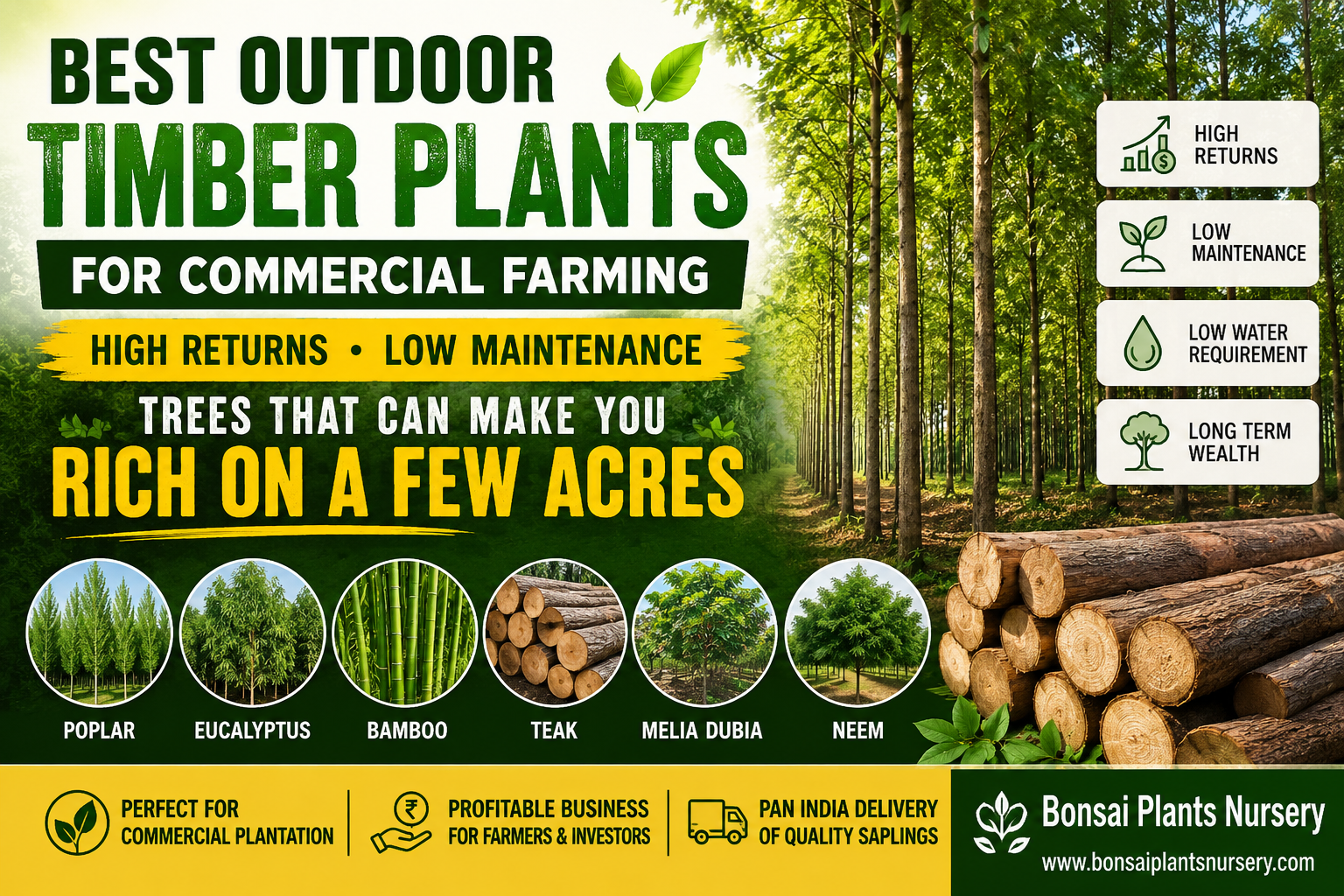
Due to the massive growth of the furniture industry, plywood factories, real estate construction, packaging industries, paper mills, and luxury interior markets, the demand for timber wood is increasing every year in India. This has created a huge opportunity for farmers, landowners, nursery businesses, and investors to earn substantial profits through commercial timber plantations.
The best part is that many timber trees:
- Require very little maintenance
- Grow well with low water supply
- Survive in difficult climates
- Need minimal labor after establishment
- Have strong long-term market demand
- Continue increasing in value year after year
If you own even 1 acre, 2 acres, or 5 acres of land, the right timber plantation can become a lifetime wealth-building asset.
In this complete SEO-friendly guide, we will discuss:
- The best timber trees for different regions of India
- North India timber plants
- South India timber plants
- East India timber plants
- West India timber plants
- Fast-growing timber trees
- Low-maintenance commercial plantation ideas
- High-return agroforestry opportunities
- Future timber market trends
- Timber farming profits and strategies
If you are planning to start a profitable plantation business, this article can become your roadmap.
What Is Timber Farming?
Timber farming means growing trees commercially for wood production. The harvested wood is used for:
- Furniture
- Plywood
- Construction
- Doors and windows
- Paper industry
- Packaging
- Decorative interiors
- Export industries
Timber plantations are considered one of the most stable long-term agricultural investments in India.
Why Timber Farming Is Becoming Extremely Profitable
India’s timber demand is rising rapidly because:
- The furniture market is expanding
- Construction projects are increasing
- Luxury housing is growing
- Imported wood is becoming expensive
- Natural forests are protected by regulations
- Plywood and paper industries need continuous raw material
This creates a strong future for private timber plantations.
Major Advantages of Commercial Timber Farming
1. Low Maintenance Farming
Once the trees are established, they require very little care compared to regular crops.
2. Long-Term Wealth Creation
Timber trees become more valuable with age, making them excellent long-term assets.
3. Low Water Requirement
Many commercial timber species can survive with limited irrigation.
4. Multiple Income Opportunities
Besides wood, many timber trees generate income from:
- Seeds
- Leaves
- Branches
- Biomass
- Nursery saplings
5. Increasing Market Demand
Wood demand is expected to increase significantly in coming years.
Important Things to Know Before Starting Timber Farming
Before starting a timber plantation:
- Choose region-specific trees
- Understand market demand
- Study harvesting duration
- Learn local regulations
- Maintain proper spacing
- Buy healthy saplings
Best Timber Trees for North India
North India includes:
- Uttar Pradesh
- Punjab
- Haryana
- Delhi
- Uttarakhand
- Himachal Pradesh
- Parts of Rajasthan
The climate here includes both hot summers and cold winters, so hardy species perform best.
1. Poplar Tree — The Timber King of North India
Poplar Tree is one of the most profitable timber trees in North India.
Why Is It So Popular?
- Very fast growth
- Huge plywood industry demand
- Ready in 6–8 years
- Contract farming opportunities available
Best States
- Uttar Pradesh
- Punjab
- Haryana
Profit Potential
Even a few acres can generate substantial profits.
2. Eucalyptus — High Returns with Low Maintenance
Eucalyptus is widely used in paper mills and plywood industries.
Advantages
- Fast-growing
- Drought-tolerant
- Low maintenance
- Performs well in poor soils
Commercial Uses
- Paper manufacturing
- Biomass
- Furniture
- Plywood
3. Teak (Sagwan) — Premium Long-Term Investment Tree
Teak is considered one of the most valuable timber species in the world.
Why Teak Is Valuable
- Premium furniture wood
- Water resistant
- Termite resistant
- Long lifespan
- High export demand
Important
Teak is a long-term investment but provides exceptional returns.
4. Shisham — Strong Hardwood for Furniture Industry
Shisham is highly valued in the furniture market.
Benefits
- Strong durable wood
- Excellent furniture quality
- High market value
Best Timber Trees for West India
West India includes:
- Maharashtra
- Gujarat
- Goa
- Western Rajasthan
The climate is generally hot and dry, making drought-tolerant trees ideal.
5. Bamboo — The Green Gold of India
Bamboo Plant is becoming one of the most profitable plantation businesses.
Why Bamboo Is Profitable
- Fastest growing plant
- Huge furniture demand
- Construction uses
- Paper industry demand
- Decorative market value
Biggest Advantage
Harvesting can begin much earlier than traditional timber trees.
6. Melia Dubia — Fast Growing Millionaire Tree
Melia Dubia is becoming extremely popular in commercial plantations.
Growth Period
Ready for harvest in around 6–8 years.
Commercial Uses
- Plywood
- Packing industry
- Biomass fuel
7. Neem Tree — Low Maintenance Income Tree
Neem performs well in dry climates.
Income Sources
- Timber
- Neem oil
- Seeds
- Organic pesticide industry
Best Timber Trees for South India
South India includes:
- Tamil Nadu
- Karnataka
- Kerala
- Telangana
- Andhra Pradesh
The tropical climate is highly favorable for timber farming.
8. Sandalwood — One of the Most Expensive Trees in the World
Sandalwood is among the world’s most valuable commercial trees.
Why It Is Valuable
- Perfume industry demand
- Ayurvedic uses
- Export market
- Luxury fragrance industry
Important
Always understand local legal regulations before sandalwood farming.
9. Mahogany — Luxury Hardwood Tree
Mahogany is highly demanded in luxury furniture markets.
Benefits
- Strong export potential
- Premium wood quality
- Long-term value growth
10. Silver Oak — Fast Growing Commercial Plantation Tree
Silver Oak is commonly planted in South India.
It is also widely used in coffee plantation shade systems.
Best Timber Trees for East India
East India includes:
- Bihar
- West Bengal
- Odisha
- Jharkhand
- Assam
These regions have high humidity and rainfall.
11. Gamhar Tree — Fast Growing Hardwood Tree
Gamhar is gaining popularity in furniture industries.
Benefits
- Fast growth
- Quality timber
- Good market demand
12. Acacia — Low Maintenance Commercial Timber Tree
Acacia is widely used in:
- Paper industry
- Fuelwood
- Industrial wood
13. Kadam Tree — Fast Growing Multipurpose Tree
Kadam is becoming increasingly profitable in East India.
Timber Trees with Highest Demand Across India
Some timber species remain profitable across all Indian regions.
| Timber Tree | Major Industry |
|---|---|
| Teak | Luxury furniture |
| Poplar | Plywood |
| Eucalyptus | Paper mills |
| Bamboo | Multiple industries |
| Melia Dubia | Commercial plywood |
Best Low-Maintenance Timber Trees
If you want low-effort commercial plantations, these are ideal:
- Eucalyptus
- Bamboo
- Neem
- Acacia
- Melia Dubia
Highest Profit Margin Timber Trees
Premium Long-Term Trees
- Sandalwood
- Teak
- Mahogany
Fast Return Trees
- Bamboo
- Poplar
- Eucalyptus
- Melia Dubia
How a Few Acres Can Make You Wealthy
Strategy 1 — Mixed Plantation
Combine fast-growing trees with premium hardwood trees.
Strategy 2 — Agroforestry Model
Grow seasonal crops between timber rows during early years.
Strategy 3 — Timber Nursery Business
Sell commercial saplings alongside plantation farming.
Strategy 4 — Contract Farming
Partner with plywood companies and industrial buyers.
Why Agroforestry Is the Future
Agroforestry provides:
- Additional income
- Soil improvement
- Climate resilience
- Long-term wealth
- Sustainable farming
This model is rapidly gaining popularity in India.
Recommended Spacing for Timber Trees
Spacing depends on species, but common plantation spacing includes:
- 8×8 feet
- 10×10 feet
- 12×12 feet
Proper spacing improves growth and timber quality.
Fastest Growing Timber Trees
| Tree | Harvest Period |
|---|---|
| Bamboo | 3–4 years |
| Eucalyptus | 5–7 years |
| Poplar | 6–8 years |
| Melia Dubia | 6–8 years |
Best Long-Term Wealth Trees
These species continue increasing in value over time:
- Teak
- Sandalwood
- Mahogany
Ideal Soil for Timber Farming
Best soils:
- Well-drained soils
- Moderate fertility
- No waterlogging
Irrigation Requirements
The first 1–2 years are important for irrigation. After establishment, many timber trees survive with rainfall alone.
Biggest Mistakes in Timber Farming
1. Choosing the Wrong Species
Not every tree performs well in every climate.
2. Ignoring Market Demand
Always research commercial demand before planting.
3. Improper Spacing
Overcrowding reduces timber quality and growth.
Government Support and Subsidies
Several Indian states support:
- Agroforestry promotion
- Plantation subsidies
- Free saplings
- Farmer training programs
How to Reduce Risk in Timber Farming
- Diversify tree species
- Build connections with buyers
- Use mixed plantation systems
- Understand local regulations
Major Buyers of Timber Trees
Potential buyers include:
- Furniture manufacturers
- Plywood factories
- Paper mills
- Construction companies
- Exporters
Timber Farming + Nursery Business = Double Income
Many successful farmers:
- Grow timber trees
- Sell saplings commercially
This creates additional cash flow before timber harvest.
Best Intercrops for Timber Plantations
During the early years you can grow:
- Turmeric
- Ginger
- Pulses
- Vegetables
between tree rows.
Future Timber Market Trends
The highest future demand is expected for:
- Teak
- Bamboo
- Sandalwood
- Melia Dubia
- Mahogany
Best Season for Timber Plantation
The rainy season is considered best:
- July
- August
because survival rates are highest.
Tips for Buying Timber Saplings
Always choose:
- Healthy roots
- Disease-free plants
- Trusted nursery suppliers
- Correct commercial varieties
Why Buy Timber Plants from Our Nursery?
Bonsai Plants Nursery offers:
- Healthy timber saplings
- Commercial plantation guidance
- Wholesale pricing
- Pan India delivery
- Premium plantation plants
Frequently Asked Questions (FAQ)
Which timber tree gives the highest profit?
Teak, Sandalwood, and Mahogany are among the highest-value timber trees.
Which timber trees grow fastest?
Bamboo, Eucalyptus, Poplar, and Melia Dubia grow rapidly.
Can timber farming be profitable on small land?
Yes, even a few acres can generate substantial long-term income.
Which timber trees need the least maintenance?
Neem, Bamboo, Eucalyptus, and Acacia are low-maintenance options.
Conclusion
Commercial timber farming is becoming one of the most profitable long-term agricultural businesses in India. By selecting the right timber species according to your region, maintaining proper plantation management, and using smart marketing strategies, farmers can create sustainable wealth from even a few acres of land.
If you are looking for healthy commercial timber saplings and professional plantation guidance, contact us today.
🌱 Website: www.bonsaiplantsnursery.com
📞 WhatsApp Orders: 8299790172
Healthy Timber Plants • Wholesale Available • Pan India Delivery • Premium Commercial Plantation Guidance