
Website: www.bonsaiplantsnursery.com
WhatsApp: 8299790172
📌 Introduction
Lemon (Citrus limon) is an essential fruit in every Indian household—used in drinks, salads, pickles, and daily cooking. The good news is that you don’t need a large garden anymore. With the right techniques, you can grow lemon plants in pots (container gardening) and enjoy fruits throughout the year (baramasi/everbearing).
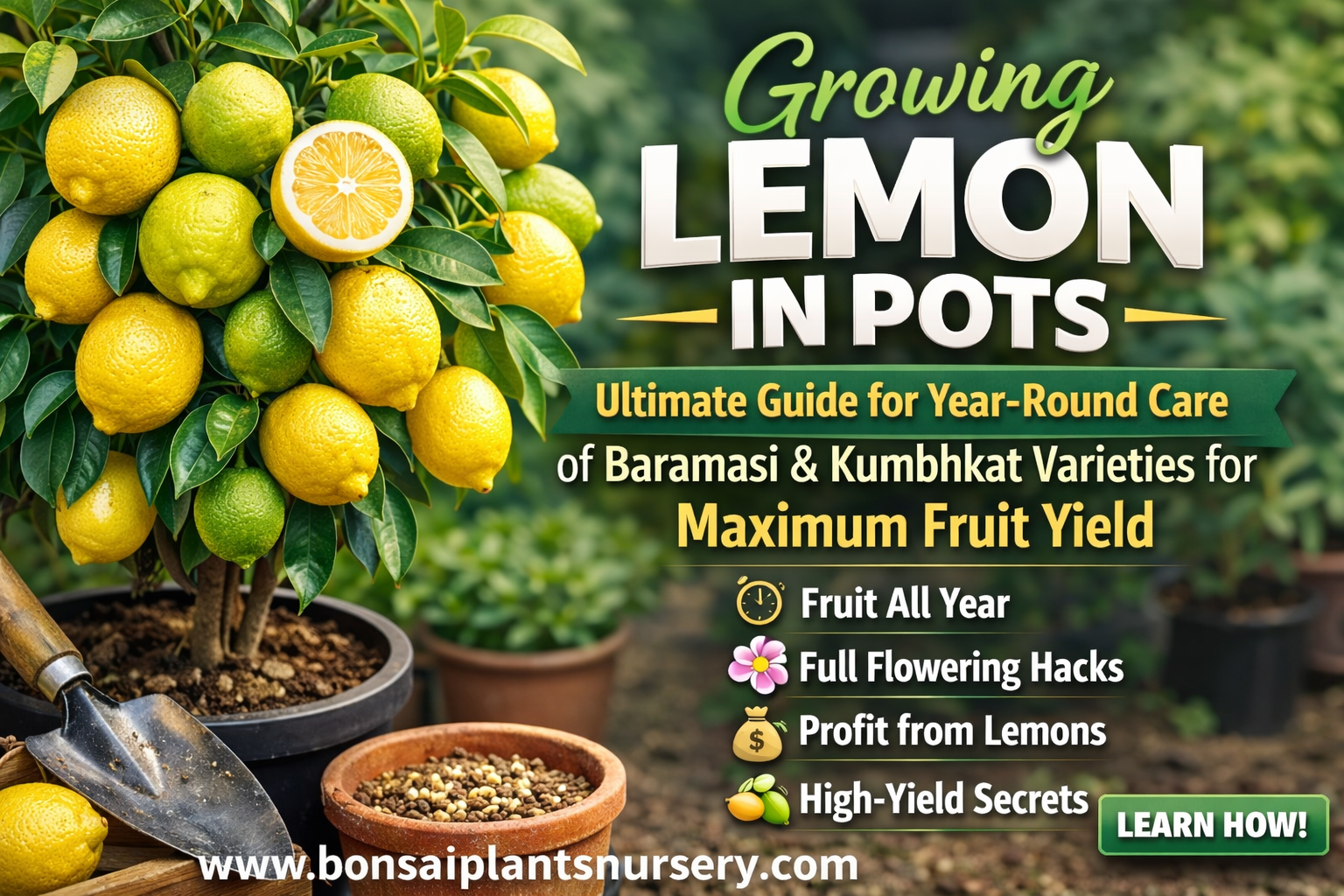
This ultimate expert-level guide (5200+ words) covers everything you need—from selecting the right variety to advanced methods for year-round fruiting and high yield in containers.
🌱 Choosing the Right Variety
✔️ 1. Kagzi Lemon (Kagzi Nimbu)
- Thin peel, very juicy
- Best for pots and high yield
✔️ 2. Baramasi (Everbearing) Lemon
- Multiple flushes per year
- With proper care, fruits almost year-round
Fully Grown All Season Lemon Plant for pot and garden – Loaded with many Lemons
✔️ 3. Kumbhkat Lemon
- Larger fruits, vigorous growth
- Performs well in containers with proper pruning
👉 Pro Tip: Always buy grafted or air-layered plants for early fruiting (1–2 years).
🪴 Scientific Pot Selection
✔️ Size Plan:
- Start: 12–14 inches
- After 1 year: 16–18 inches
- Mature: 20–24 inches (40–60 liters)
✔️ Material:
- Terracotta (best aeration)
- HDPE grow bags (budget-friendly)
✔️ Drainage:
- 3–5 holes (1–1.5 cm)
- Bottom layer: stones + mesh
👉 Poor drainage = root rot = plant decline.
🌿 Advanced Soil Mix (Soil Engineering)
✔️ Ideal Mix:
- 40% garden soil (sterilized/clean)
- 25% well-rotted cow dung manure
- 15% vermicompost
- 10% river sand
- 5% neem cake
- 5% cocopeat
✔️ Bio Add-ons:
- Trichoderma (fungal protection)
- Mycorrhiza (root expansion)
👉 Ideal pH: 5.5–7 (slightly acidic to neutral)
🌱 Planting Method (Step-by-Step)
- Add drainage layer (stones)
- Fill 70% soil mix
- Place plant (do not disturb root ball)
- Backfill and press lightly
- Water thoroughly
👉 Keep in partial shade for 5–7 days (acclimatization).
☀️ Sunlight & Temperature
- 6–8 hours of direct sunlight daily
- Ideal temperature: 15°C–35°C
👉 Extreme cold slows growth; protect from frost.
💧 Irrigation Strategy (Watering)
| Season | Frequency |
|---|---|
| Summer | Daily / alternate day |
| Winter | Every 3–4 days |
| Monsoon | As needed (avoid waterlogging) |
👉 Rule: Keep soil moist, not soggy.
🌾 Fertilizer & Nutrition Plan (High Yield)
✔️ Monthly Base Feeding:
- Cow dung manure: 1–2 kg
- Vermicompost: 300–500 g
- Neem cake: 100 g
✔️ Liquid Feeding (Every 15 days):
- Mustard cake solution (well fermented)
✔️ Micronutrients (Monthly spray):
- Epsom salt (Magnesium): 1 tsp/L
- Zinc (as per label)
- Boron (for fruit set): 0.5–1 g/L
✔️ Flower Booster (limited use):
- NPK 19-19-19 or 0-52-34 (foliar, low dose)
👉 Overfeeding nitrogen = more leaves, fewer fruits.
🌸 Flowering & Fruit Set (Science)
Flowering Triggers:
- Slight water stress (controlled)
- Reduced nitrogen before bloom
- Good sunlight
Improve Fruit Set:
- Boron spray during pre-bloom
- Consistent moisture
- Pollinator activity (bees)
Reduce Fruit Drop:
- Avoid sudden watering changes
- Balanced nutrition (Ca, Mg, B)
🍋 Year-Round Fruiting (Baramasi Technique)
- Manage multiple flushes via pruning cycles
- Light pruning every 6–8 weeks after harvest
- Balanced feeding before each flush
- Maintain consistent moisture
👉 This scheduling enables near continuous flowering and fruiting.
✂️ Pruning & Canopy Management
- Remove dead, crossing, inward-growing branches
- Maintain open center for airflow and light
- Height control for containers
👉 Better light penetration = more flowers = higher yield.
🐛 Pest & Disease Management (IPM)
Common Pests:
- Aphids
- Leaf miner
- Mealybugs
Organic Control:
- Neem oil: 3–5 ml/L (weekly/biweekly)
- Soap solution: mild spray
- Garlic-chili extract (repellent)
Diseases:
- Leaf curl, canker, root rot
👉 Prevention is key: good airflow, clean soil, proper drainage.
📅 Month-wise Care Calendar (India)
- Jan–Feb: Pre-flowering care, micronutrient sprays
- Mar–Jun: Fruit development, regular watering, feeding
- Jul–Sep: Vegetative growth, pest vigilance (monsoon)
- Oct–Dec: Second flush preparation, light pruning
⚠️ Common Mistakes to Avoid
- Overwatering / waterlogging
- Using small pots long-term
- Excess nitrogen fertilizers
- No pruning or canopy control
- Ignoring micronutrients
❓ FAQ (15 Detailed Questions)
Q1: Can lemon be grown in pots?
Yes, very successfully with proper care.
Q2: When will it start fruiting?
1–2 years for grafted plants.
Q3: Which variety is best for pots?
Kagzi lemon.
Q4: Why are leaves turning yellow?
Nutrient deficiency or overwatering.
Q5: Why no flowering?
Excess nitrogen or lack of sunlight/cool trigger.
Q6: Best fertilizer?
Organic compost + balanced micronutrients.
Q7: How often to water?
Depends on season; keep soil moist.
Q8: Is pruning necessary?
Yes, for structure and yield.
Q9: Why fruits drop early?
Water/nutrient imbalance, heat stress.
Q10: Sunlight requirement?
6–8 hours daily.
Q11: Ideal pot size?
20–24 inches for mature plants.
Q12: Can it grow on terrace?
Yes, ideal with full sun.
Q13: Daily watering?
In summer yes; reduce in winter.
Q14: Can I grow from seeds?
Yes, but fruiting is delayed (4–7+ years).
Q15: Where to buy quality plants?
www.bonsaiplantsnursery.com or WhatsApp 8299790172
Fully Grown All Season Lemon Plant for pot and garden – Loaded with many Lemons
🌟 Conclusion
Growing lemons in pots is practical, productive, and profitable. With the right variety, soil, nutrition, and pruning strategy, you can achieve year-round harvests and even build a small business around container-grown citrus.
📲 For more information or to buy plants:
Website: www.bonsaiplantsnursery.com
WhatsApp: 8299790172