
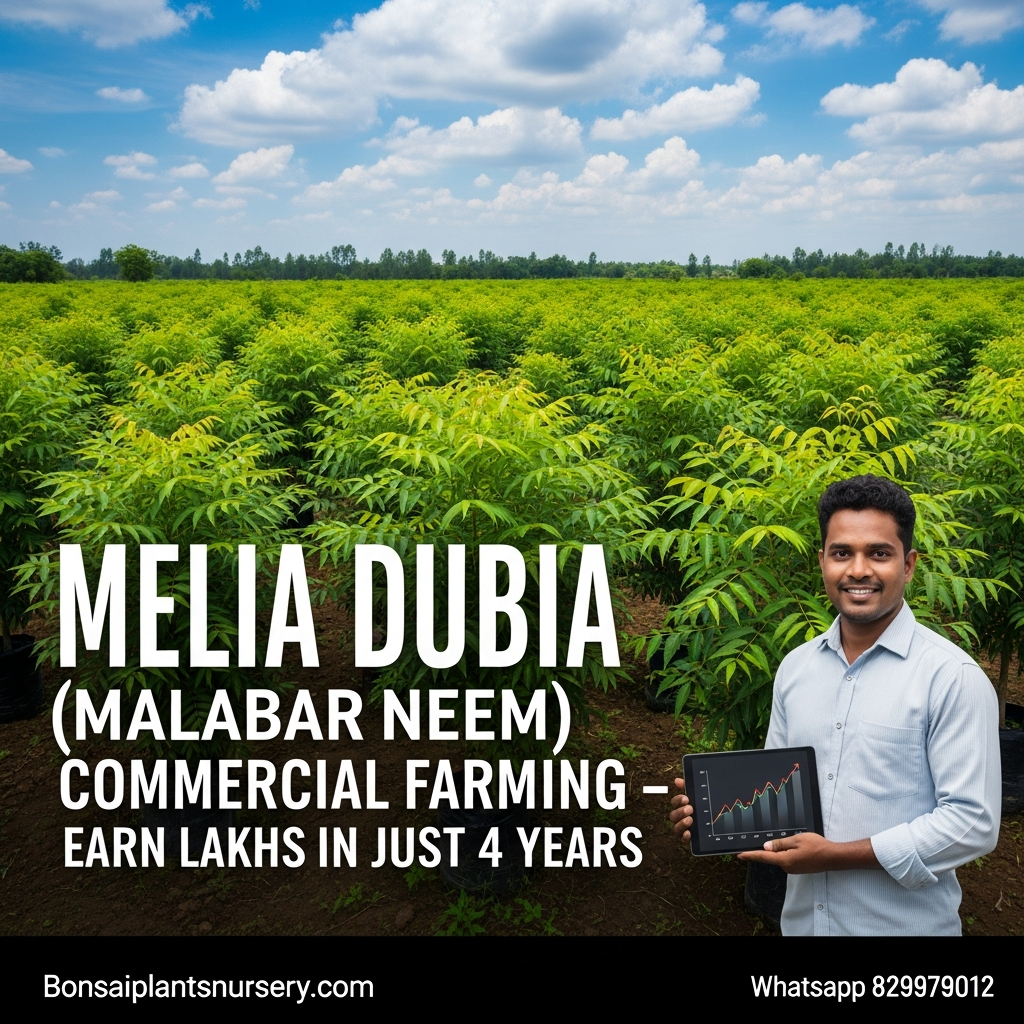
Melia Dubia (Malabar Neem) Commercial Farming – Earn Lakhs in Just 4 Years
Complete Guide: Plantation Method, Care, Irrigation, Pruning, Harvesting and Selling
Introduction
If you have vacant land and you are looking for a high-profit, low-maintenance agricultural business, then Melia Dubia (also known as Malabar Neem) is one of the fastest-growing and most income-generating trees you can cultivate.
This tree matures quickly, requires minimal care, grows well in different soil types, and has huge demand in the plywood, furniture, construction, packaging, and paper industries. The best part is that it is not restricted under forest laws, so its harvesting and selling are legally free and hassle-free.
Many farmers across India are earning 6 to 12+ lakhs per acre in just 4 years through Melia Dubia farming.
This article will explain everything step-by-step:
-
Benefits of Melia Dubia
-
Climate and soil requirements
-
Land preparation and spacing
-
Fertilizer and irrigation schedule
-
Pest and disease management
-
Expected yield and profit calculation
-
Wood market prices and buyers list
-
Complete business model to start farming successfully
What is Melia Dubia (Malabar Neem)?
Melia Dubia is a fast-growing deciduous timber tree belonging to the mahogany family.
It grows rapidly and forms straight cylindrical boles, making it ideal for timber production.
Common Names:
| Name | Region |
|---|---|
| Melia Dubia | Scientific/Common name |
| Malabar Neem | South India |
| Sevanthi / Hebbevu | Karnataka |
| Maha Neem / Kala Neem | North India |
| Mahanim | Eastern regions |
Characteristics of Melia Dubia:
-
Can grow 25–40 feet in 3–4 years
-
Ready for harvesting in 4–6 years
-
Naturally resistant to termites
-
Grows well with minimal water
-
Strong demand in wood markets
Why Melia Dubia is a Profitable Crop?
| Feature | Advantage |
|---|---|
| Very fast growth | Ready for cutting in just 4 years |
| High survival rate | Adapts to almost all climates |
| Strong market demand | Used in plywood, packing & furniture |
| No government restrictions | Free harvesting and selling |
| Low maintenance | Minimal fertilizers and irrigation required |
This makes it suitable for:
-
Farmers
-
Plantation business investors
-
Real estate land developers
-
Agri entrepreneurs
Climate & Soil Requirements
Climate
-
Grows best in tropical and sub-tropical regions
-
Temperature range: 18°C to 42°C
-
Requires moderate sunlight throughout the year
Soil
-
Performs well in:
-
Red soil
-
Black soil
-
Loamy soil
-
Sandy-loam soil
-
-
pH range: 6.5 to 8
-
Soil must be well-drained (no water logging)
Land Preparation
-
Plough the field 2–3 times to make soil fine and loose.
-
Remove weeds and stones.
-
Prepare pits of size 2ft x 2ft x 2ft.
-
Fill pits with:
50% soil

+ 25% well-decomposed cow dung/compost

+ 25% river sand (optional)
Planting Material
Always purchase High-Quality Tissue Culture or Grafted Plants.
Why Tissue Culture Plants?
| Feature | Benefit |
|---|---|
| Uniform growth | Even height and shape development |
| Disease resistance | Lower mortality rate |
| Higher wood quality | Better market price |
To Buy Certified Melia Dubia Plants:
🌱 Bonsaiplantsnursery.com
📞 Call / WhatsApp: 8299790172
🚚 Home Delivery Available Across India
Plantation Spacing
For Commercial Timber Farming:
| Spacing | Plants Per Acre |
|---|---|
| 10 ft × 10 ft | 450–500 plants |
| 12 ft × 12 ft | 350–380 plants |
| 8 ft × 8 ft | 600+ plants (recommended for small land areas) |
Irrigation Requirements
-
First month: Light watering every 3 days
-
2–6 months: Irrigate weekly
-
After 6 months: Irrigation only during dry months
-
In rainfall areas, no irrigation needed after 1 year
Melia Dubia survives well in rain-fed areas.
Fertilizer Schedule
| Time | Fertilizer | Qty per plant |
|---|---|---|
| At plantation | Cow dung or organic manure | 2–3 kg |
| After 6 months | NPK (19:19:19) in water | 50 gm |
| Every year | Cow dung manure | 3–5 kg |
Use Organic neem cake and Jeevamrut to improve soil life.
Weeding and Maintenance
-
Remove weeds every 60 days for the first year.
-
Prune side branches after 8–12 months to ensure a straight, tall trunk, which increases market value.
Pest & Disease Control
Melia Dubia is naturally disease and termite-resistant, but sometimes mild pest attacks occur.
| Problem | Solution |
|---|---|
| Leaf-eating insects | Neem oil spray (5 ml per liter) |
| Fungus in rainy season | Copper oxychloride spray |
No chemical pesticides are generally required.
Growth Timeline
| Year | Growth Stage |
|---|---|
| 1st year | 6–10 feet |
| 2nd year | 12–18 feet |
| 3rd year | 20–30 feet |
| 4th year | 25–40+ feet, ready to harvest |
Harvesting & Yield
-
Tree ready for cutting at 4–6 years
-
Average wood from one tree:
30–60 cubic feet -
Example: 450 plants per acre
→ Yield approx. 15,000 to 30,000 cubic feet wood
Market Price & Profit Calculation
| Item | Value |
|---|---|
| Selling price per cubic ft | ₹50 to ₹120 (region-wise) |
| Revenue per tree | ₹800 to ₹2,500+ |
| Revenue per acre (450 trees) | ₹4,00,000 to ₹12,00,000+ |
| Total cost per acre | ₹50,000 to ₹1,20,000 only |
| Net Profit per acre in 4 years | ₹6 to ₹12 lakhs+ |
Where to Sell Melia Dubia Wood?
-
Plywood factories
-
Furniture manufacturers
-
Packaging box industries
-
Paper and pulp mills
-
Timber & wood traders
Conclusion
Melia Dubia farming is a sustainable, profitable, and low-maintenance agribusiness model with a guaranteed market.
If you have even 1 acre of land, you can earn 6–12+ lakhs in just 4 years.
This is not just farming; it is a long-term wealth-building plantation model.
Buy High-Quality Melia Dubia Plants
🌱 Bonsaiplantsnursery.com
📞 Call / WhatsApp: 8299790172
🚚 Nationwide Delivery
🎯 Free Plantation Guidance Available
Frequently Asked Questions (FAQs) About Melia Dubia (Malabar Neem) Farming
Q1. How many years does it take for Melia Dubia to be ready for harvesting?
Answer: Melia Dubia reaches harvesting stage in 4 to 6 years, depending on soil quality, climate, irrigation, and plant variety. With proper management, many farmers harvest profitable timber as early as 4 years.
Q2. How many plants can be grown in one acre?
Answer:
With recommended spacing of 10 ft x 10 ft, you can plant 450 to 500 plants per acre.
In smaller spacing like 8 ft x 8 ft, more than 600+ plants can be cultivated.
Q3. How much income can be earned from Melia Dubia farming per acre?
Answer:
In 4 years, one acre plantation can generate approx:
-
₹4,00,000 to ₹12,00,000+ revenue
-
Net profit: ₹6 to ₹12 lakhs per acre, depending on market price and wood quality.
Q4. What is the market price of Melia Dubia wood?
Answer:
The price varies by region and wood diameter:
-
₹50 to ₹120 per cubic feet
Large-diameter wood always receives a higher price in timber yards.
Q5. Is Melia Dubia affected by termites or pests?
Answer:
No. Melia Dubia wood is naturally termite and pest resistant.
This makes it very low maintenance compared to other timber crops.
Q6. Can Melia Dubia be grown on low-fertility or dry land?
Answer:
Yes. This tree grows well in low-fertility and semi-dry land conditions.
However, ensure good drainage and avoid waterlogging.
Q7. Does Melia Dubia require high irrigation?
Answer:
No. Only light irrigation is needed for the first 2–3 months. After that, it can survive mainly on rainwater.
Q8. Can we plant crops along with Melia Dubia?
Answer:
Yes. Intercropping is beneficial during the first 18–24 months.
Best crops to grow alongside:
-
Millets (Bajra, Jowar)
-
Pulses (Moong, Urad)
-
Fodder crops
Avoid tall crops that block sunlight.