जानिए कैसे खाली या बेकार पड़ी ज़मीन को अफ्रीकन महोगनी (Khaya senegalensis) लगाकर सोने की खान बनाया जा सकता है। इसमें जानें मिट्टी की ज़रूरत, रोपण का तरीका, लागत, देखभाल, सरकारी योजनाएं और 10 साल में होने वाले लाखों रुपये के मुनाफ़े की पूरी जानकारी। यह गाइड bonsaiplantsnursery.com की ओर से किसानों और निवेशकों के लिए तैयार की गई है ताकि वे दीर्घकालिक और टिकाऊ पेड़-आधारित खेती से अच्छा लाभ कमा सकें।
🌱 परिचय: खाली ज़मीन से हरियाली और आमदनी की ओर
भारत में लाखों एकड़ ज़मीन ऐसी है जो खेती योग्य नहीं है या खाली पड़ी रहती है। लेकिन समझदार किसान और निवेशक इस खाली ज़मीन को लंबे समय की हरित संपत्ति में बदल रहे हैं — अफ्रीकन महोगनी (African Mahogany) लगाकर।
अफ्रीकन महोगनी एक बहुत कीमती कठोर लकड़ी (Hardwood) वाला पेड़ है, जिसकी लकड़ी फर्नीचर, सजावट, म्यूज़िकल इंस्ट्रूमेंट और फर्श बनाने में इस्तेमाल होती है। इसकी कीमत बाजार में ₹3000 से ₹5000 प्रति घन फुट तक होती है।
सही देखभाल के साथ, यह पेड़ 8–10 साल में परिपक्व हो जाता है, और प्रति एकड़ ₹30 से ₹50 लाख तक की कमाई संभव है — वो भी कम मेहनत में।
Plant African Mahogany – Earn Lakhs in 10 Years
🌿 अफ्रीकन महोगनी क्या है?
अफ्रीकन महोगनी (Khaya senegalensis) अफ्रीका का मूल निवासी पेड़ है, लेकिन अब यह भारत के कई राज्यों में भी सफलतापूर्वक उगाया जा रहा है।
इसकी लकड़ी लाल-भूरी, मजबूत और टिकाऊ होती है। देखने में यह सागौन (Teak) जैसी लगती है, लेकिन यह उससे तेज़ी से बढ़ती है।
🔍 प्रमुख विशेषताएं:
ऊँचाई: 40–60 फीट (10 साल में)
तने का व्यास: 2–3 फीट
लकड़ी: सख्त, पानी रोधक, लाल-भूरी
जीवनकाल: 50+ वर्ष
पुनर्जनन क्षमता: कटाई के बाद नई शाखाएं निकलती हैं
🌳 इसे “टीक का अंतरराष्ट्रीय विकल्प” भी कहा जाता है।
🌾 जलवायु और मिट्टी की ज़रूरत
तत्व
आदर्श स्थिति
तापमान
18°C – 38°C
वर्षा
800 – 1500 मिमी
मिट्टी
गहरी, दोमट, जल निकासी वाली
pH स्तर
6.0 – 7.5
ऊँचाई
700 मीटर तक
धूप
पूरे दिन की धूप आवश्यक
⚠️ ध्यान दें: दलदली या खारी मिट्टी में यह पेड़ अच्छे से नहीं बढ़ता।
🌱 भारत में उगाई जाने वाली महोगनी की प्रमुख किस्में
Khaya senegalensis (African Mahogany) – सबसे लोकप्रिय और तेज़ी से बढ़ने वाली प्रजाति
Swietenia macrophylla (Honduras Mahogany) – धीमी वृद्धि पर उच्च गुणवत्ता
Khaya ivorensis – फर्नीचर के लिए उत्तम
Swietenia mahagoni (Cuban Mahogany) – प्रीमियम और दुर्लभ किस्म
भारत के लिए सबसे उपयुक्त Khaya senegalensis मानी जाती है।
🌿 पौधे तैयार करने की प्रक्रिया
1️⃣ बीज से पौध तैयार करना
परिपक्व भूरे फलियों से बीज निकालें (सितंबर–नवंबर)।
छाया में सुखाएं और 12–16 घंटे पानी में भिगोएं।
10–15 दिन में अंकुरण हो जाता है (70–80% सफलता)।
2️⃣ नर्सरी तैयारी
पॉलीबैग (9”x6”) में मिट्टी, बालू और गोबर खाद (1:1:1 अनुपात)।
2–3 महीने बाद जब पौधा 8–10 इंच का हो जाए, तब खेत में रोपें।
3️⃣ क्लोनल पौधे
समान गुणवत्ता के लिए क्लोनल पौधे सबसे बेहतर रहते हैं।
प्रमाणित पौधे bonsaiplantsnursery.com से प्राप्त करें।
🌳 खेत की तैयारी और पौधारोपण
खेत की जुताई 2–3 बार करें।
10×10 फीट की दूरी पर गड्ढे खोदें।
गड्ढे में मिट्टी + गोबर खाद भरें।
बरसात के शुरू में पौध लगाना सर्वोत्तम रहता है।
🌱 अधिक दूरी रखने से पेड़ मोटा और सीधा बढ़ता है।
💧 सिंचाई और रखरखाव
पहले साल: हफ्ते में एक बार पानी दें।
दूसरे साल से: सूखे महीनों में 15–20 दिन में एक बार।
मल्चिंग: मिट्टी में नमी बनाए रखती है।
छंटाई (Pruning): दूसरे साल से करें ताकि तना सीधा बढ़े।
कीट नियंत्रण: नीम-आधारित दवा का प्रयोग करें।
🌿 2 साल बाद पेड़ खुद को संभाल लेता है और बहुत कम देखभाल मांगता है।
🌾 खाद और पोषण प्रबंधन
चरण
खाद
मात्रा प्रति पेड़
रोपण के समय
गोबर खाद
5–10 किलो
6 महीने बाद
NPK (100:50:50)
200 ग्राम
1 साल बाद
नीमखली / कम्पोस्ट
2 किलो
हर 2 साल में
गोबर खाद
5 किलो
✔️ जैविक खाद मिट्टी को उपजाऊ बनाए रखती है।
🌲 विकास और कटाई का समय
वर्ष
ऊँचाई
तने का व्यास
क्रिया
1–2
5–8 फीट
2–3 इंच
जड़ मज़बूत होती है
3–5
15–25 फीट
6–8 इंच
तना बढ़ता है
6–8
30–45 फीट
12–18 इंच
लकड़ी सख्त होती है
9–10
50–60 फीट
24–30 इंच
कटाई योग्य
🌳 10 साल में हर पेड़ से 10–15 घन फुट लकड़ी मिलती है।
💰 लागत और मुनाफ़ा (प्रति एकड़)
विवरण
अनुमानित लागत
पौधे (400 पेड़ × ₹100)
₹40,000
खेत तैयारी व रोपण
₹15,000
खाद व रखरखाव (10 साल)
₹30,000
मजदूरी व सिंचाई
₹15,000
कुल लागत (10 वर्ष)
₹1,00,000
अनुमानित आय:
400 पेड़ × 12 घन फुट = 4,800 घन फुट लकड़ी
औसत कीमत ₹2,000 प्रति घन फुट
कुल आय = ₹96,00,000 (₹96 लाख)
➡️ शुद्ध मुनाफ़ा = ₹95 लाख प्रति एकड़ (10 वर्ष में)
💵 एक बार लगाएं, 40-50 गुना तक लाभ पाएं।
🏭 लकड़ी का उपयोग और बाजार
अफ्रीकन महोगनी की लकड़ी का उपयोग:
प्रीमियम फर्नीचर
लक्ज़री इंटीरियर
नाव और यॉट निर्माण
संगीत उपकरण (गिटार, पियानो)
फ्लोरिंग और सजावट
भारत में महोगनी की भारी मांग है क्योंकि देश में इसकी आपूर्ति सीमित है।
🌍 एक्सपोर्ट मार्केट में कीमत और भी अधिक मिलती है।
📈 बिक्री और मार्केटिंग
लकड़ी मंडी या टिम्बर डिपो में बिक्री
फर्नीचर फैक्ट्रियों से कॉन्ट्रैक्ट
वन विभाग की नीलामी प्रक्रिया
एक्सपोर्ट कंपनियों से टाई-अप
🌱 bonsaiplantsnursery.com किसानों को खरीदारों और एजेंटों से जोड़ने में मदद करता है।
🌿 सरकारी योजनाएं और सहायता
राष्ट्रीय कृषि विकास योजना (RKVY)
राष्ट्रीय एग्रोफॉरेस्ट्री मिशन
नाबार्ड अनुदान योजना
राज्य बागवानी विभाग की सहायता योजनाएं
कई राज्य सरकारें पौधे और रखरखाव पर सब्सिडी देती हैं।
🌎 पर्यावरणीय लाभ
वायु से CO₂ अवशोषित करता है
मिट्टी का कटाव रोकता है
जैव विविधता बढ़ाता है
छाया और हरियाली प्रदान करता है
🌳 एक परिपक्व पेड़ हर साल लगभग 20 किलो CO₂ अवशोषित करता है।
💼 निवेश और व्यवसाय मॉडल
स्वयं की ज़मीन पर खेती
कॉन्ट्रैक्ट फार्मिंग मॉडल
निवेश आधारित ट्री प्रोजेक्ट
यह एक बार का निवेश है जो हर साल मूल्य बढ़ाता है।
⚠️ सावधानियां
पहले दो साल ध्यानपूर्वक देखभाल करें।
बाजार में भाव घट-बढ़ सकता है।
कटाई के लिए स्थानीय अनुमति आवश्यक है।
✔️ यदि एग्रोफॉरेस्ट्री में पंजीकृत हैं तो प्रक्रिया आसान होती है।
🧭 सफलता की कहानियां
रामेश पटेल (गुजरात) – 7 एकड़ में 2013 में लगाया, 2023 में पेड़ 55 फीट ऊँचे। अनुमानित मूल्य ₹3 करोड़। सुनीता देवी (म.प्र.) – 2 एकड़ में लगाया, 2028 तक ₹1 करोड़ की उम्मीद। AgroGreen Group (तमिलनाडु) – 100+ एकड़ की खेती, लकड़ी दुबई और मलेशिया को एक्सपोर्ट।
🔑 प्रमुख
अफ्रीकन महोगनी खेती, महोगनी से कमाई, महोगनी पेड़ की कीमत, African Mahogany farming, Khaya senegalensis, पेड़ लगाकर पैसे कमाएं, लकड़ी की खेती, bonsaiplantsnursery.com, agroforestry business, timber farming in India.
🌿 निष्कर्ष
अफ्रीकन महोगनी की खेती आज के समय में सबसे अच्छा दीर्घकालिक निवेश है। एक बार लगाएं, 10 साल बाद लाखों की कमाई करें — साथ ही पर्यावरण को हरियाली भी दें।
🌳 “पेड़ लगाओ, भविष्य बनाओ।”
📢 शुरू करें आज ही!
✅ अफ्रीकन महोगनी के प्रमाणित पौधे मंगवाएं 👉 bonsaiplantsnursery.com 📞 8299790172 पर कॉल करें — परामर्श, पौधे और खेती मार्गदर्शन के लिए।
In today’s world of luxury interiors and experience-driven businesses, interior design is no longer limited to furniture, lighting, and wall décor. Premium spaces such as 5-star hotels, corporate offices, and high-end cafés are now integrating nature into their design language through living décor elements.
Among all natural décor options, one stands out as timeless, elegant, and highly premium: Bonsai Plants.
Bonsai is not just a plant. It is a living art form, a symbol of discipline and beauty, and a powerful interior branding tool that enhances the emotional and visual experience of any space.
(Premium Corporate Buyers और Luxury Spaces के लिए Complete Guide)
Bonsai Plants Nursery
आज के समय में interior design सिर्फ दीवारों पर पेंट, फर्नीचर और लाइटिंग तक सीमित नहीं रहा। अब हर premium space—चाहे वह 5-star hotel हो, corporate office हो या luxury café—अपनी brand identity को nature के साथ जोड़ने के लिए “living décor” का इस्तेमाल कर रहा है।
और इस पूरे trend में सबसे powerful, elegant और timeless element बनकर उभरा है — Bonsai Plants।
Bonsai केवल एक पौधा नहीं है, यह एक art form है, एक luxury statement है और एक “calm luxury branding tool” है, जिसे high-end spaces अपनी identity को बेहतर बनाने के लिए इस्तेमाल करते हैं।
इस लेख में हम विस्तार से समझेंगे कि:
Hotels Bonsai को कैसे use करते हैं
Offices में Bonsai का psychological impact क्या है
Cafes और restaurants क्यों Bonsai को interior design का हिस्सा बनाते हैं
Corporate gifting में Bonsai क्यों सबसे premium choice बन चुका है
और आप अपने business या project में Bonsai का उपयोग कैसे कर सकते हैं
1. Bonsai क्या है और यह Luxury Spaces में क्यों उपयोग होता है?
Bonsai एक Japanese art है जिसमें पेड़ों को छोटे आकार में नियंत्रित (miniature form) करके उगाया जाता है, लेकिन उनकी natural beauty और maturity को बनाए रखा जाता है।
Luxury interior designers Bonsai को इसलिए चुनते हैं क्योंकि:
1.1 Visual Elegance (दृश्य सुंदरता)
Bonsai छोटे होने के बावजूद बहुत “rich visual impact” देते हैं।
1.2 Premium Feel
यह तुरंत किसी भी space को luxury और high-end look देता है।
1.3 Nature + Art Combination
Bonsai एक साथ natural और artistic दोनों है।
1.4 Low Space Requirement
Small table, lobby corner या reception desk पर आसानी से fit हो जाता है।
1.5 Long-Term Investment
Bonsai years तक survive करता है और धीरे-धीरे और valuable बनता है।
2. Hotels में Bonsai का उपयोग (Luxury Hospitality Design)
Luxury hotels में guest experience सबसे महत्वपूर्ण होता है। यहाँ हर चीज़ “feel” बनाती है—और Bonsai उस feel को elevate करता है।
2.1 Hotel Lobby में Bonsai का Impact
Hotel lobby वह जगह होती है जहाँ guest का first impression बनता है।
Bonsai यहाँ:
Calmness create करता है
Luxury feel बढ़ाता है
Natural welcome देता है
Brand image को premium बनाता है
👉 उदाहरण:
A 5-star hotel reception desk पर एक बड़ा styled Bonsai रखने से entire ambiance “international luxury” feel देने लगता है।
2.2 Guest Rooms में Bonsai
Premium suites और executive rooms में Bonsai का उपयोग:
Stress reduction के लिए
Natural aesthetics के लिए
Room ambiance soft करने के लिए
Guests को ऐसा लगता है जैसे वह किसी Zen luxury environment में रह रहे हों।
2.3 Restaurants & Fine Dining Areas
Hotels के restaurants में Bonsai:
Table centerpiece के रूप में
Buffet area decoration
Private dining rooms में luxury theme के लिए
यह dining experience को “memorable” बनाता है।
2.4 Spa & Wellness Centers
Bonsai यहाँ सबसे important role निभाता है:
Meditation environment
Ayurveda & spa theme enhancement
Natural healing vibe
3. Offices में Bonsai का उपयोग (Corporate Interior Design)
आज corporate world में productivity और mental health दोनों बहुत important हैं।
Bonsai इस area में एक silent productivity booster की तरह काम करता है।
3.1 Reception Area
Office reception में Bonsai:
Professionalism दिखाता है
Brand seriousness reflect करता है
Clients पर strong impression छोड़ता है
3.2 Boss Cabin / Executive Cabin
Top management offices में Bonsai:
Authority + calmness दोनों दिखाता है
Decision-making environment को balanced बनाता है
Stress reduce करता है
3.3 Meeting Rooms
Meeting table पर Bonsai रखने से:
Discussions calmer होती हैं
Focus बढ़ता है
Environment less aggressive बनता है
3.4 Open Workspaces
Modern IT और corporate offices में Bonsai:
Desk stress कम करता है
Employee satisfaction बढ़ाता है
Productivity improve करता है
3.5 Psychological Benefits in Offices
Research shows natural elements:
Anxiety reduce करते हैं
Focus बढ़ाते हैं
Creativity improve करते हैं
Bonsai इन सभी benefits को compact form में देता है।
4. Cafes और Restaurants में Bonsai (Aesthetic Branding Tool)
Cafes आज सिर्फ coffee बेचने की जगह नहीं रहे, वे Instagram experiences बन चुके हैं।
4.1 Instagram-Worthy Interiors
Bonsai cafés को बनाता है:
Photogenic
Aesthetic
Minimal yet premium
Customers अक्सर सिर्फ ambience के कारण café choose करते हैं।
4.2 Table Decoration
Small Bonsai tables पर:
Natural centerpiece बनता है
Food presentation enhance करता है
Dining experience better बनाता है
4.3 Wall & Corner Styling
Cafes में Bonsai:
Empty corners fill करता है
Green contrast देता है
Wooden interiors के साथ perfect match करता है
4.4 Customer Retention Impact
Beautiful interiors:
Customers को longer stay करने पर मजबूर करते हैं
Repeat visits बढ़ाते हैं
Word-of-mouth marketing improve करते हैं
5. Corporate Gifting में Bonsai क्यों सबसे Premium Gift बन चुका है
आज corporate world में gifting सिर्फ formality नहीं है, यह relationship building का tool है।
5.1 Why Bonsai is a Luxury Corporate Gift?
Unique है (common gift नहीं)
Long-lasting है
Symbolic है (growth, stability, patience)
Premium feel देता है
5.2 Clients को Impress करने के लिए Best Choice
Bonsai gift करने का मतलब:
“हम आपके long-term relationship को value करते हैं”
5.3 Festival Gifting (Diwali, New Year, Corporate Events)
Bonsai:
Diwali gift hampers में premium item
New Year corporate gift
Employee appreciation gift
5.4 Branding Opportunity
Companies Bonsai gifts पर:
Custom tags लगाते हैं
Branded pots use करते हैं
Premium packaging करते हैं
6. Interior Designers Bonsai को कैसे Use करते हैं?
Professional interior designers Bonsai को strategic placement के लिए use करते हैं।
6.1 Focal Point Creation
Bonsai room का center attraction बन जाता है।
6.2 Balance of Space
Minimal interiors में natural balance लाता है।
6.3 Color Harmony
Green color:
White interiors के साथ contrast
Wooden interiors के साथ harmony
Modern glass interiors में softness
7. Different Types of Bonsai Used in Premium Interiors
वेबसाइट:www.bonsaiplantsnursery.com व्हाट्सएप: 8299790172 विषय: कम जमीन में ज्यादा कमाई करने वाले 5 हाई प्रॉफिट प्लांट्स
🌱 भूमिका: क्या सच में छोटे खेत से लाखों कमाए जा सकते हैं?
आज के समय में खेती सिर्फ परंपरागत काम नहीं रही, बल्कि एक high income business opportunity बन चुकी है। पहले लोग मानते थे कि खेती में सिर्फ बड़े किसान ही पैसा कमा सकते हैं, लेकिन अब यह सोच पूरी तरह बदल चुकी है।
अगर आपके पास सिर्फ 1 बीघा, 1 एकड़ या उससे भी कम जमीन है, तब भी आप सही पौधों का चुनाव करके हर साल लाखों रुपये की कमाई कर सकते हैं।
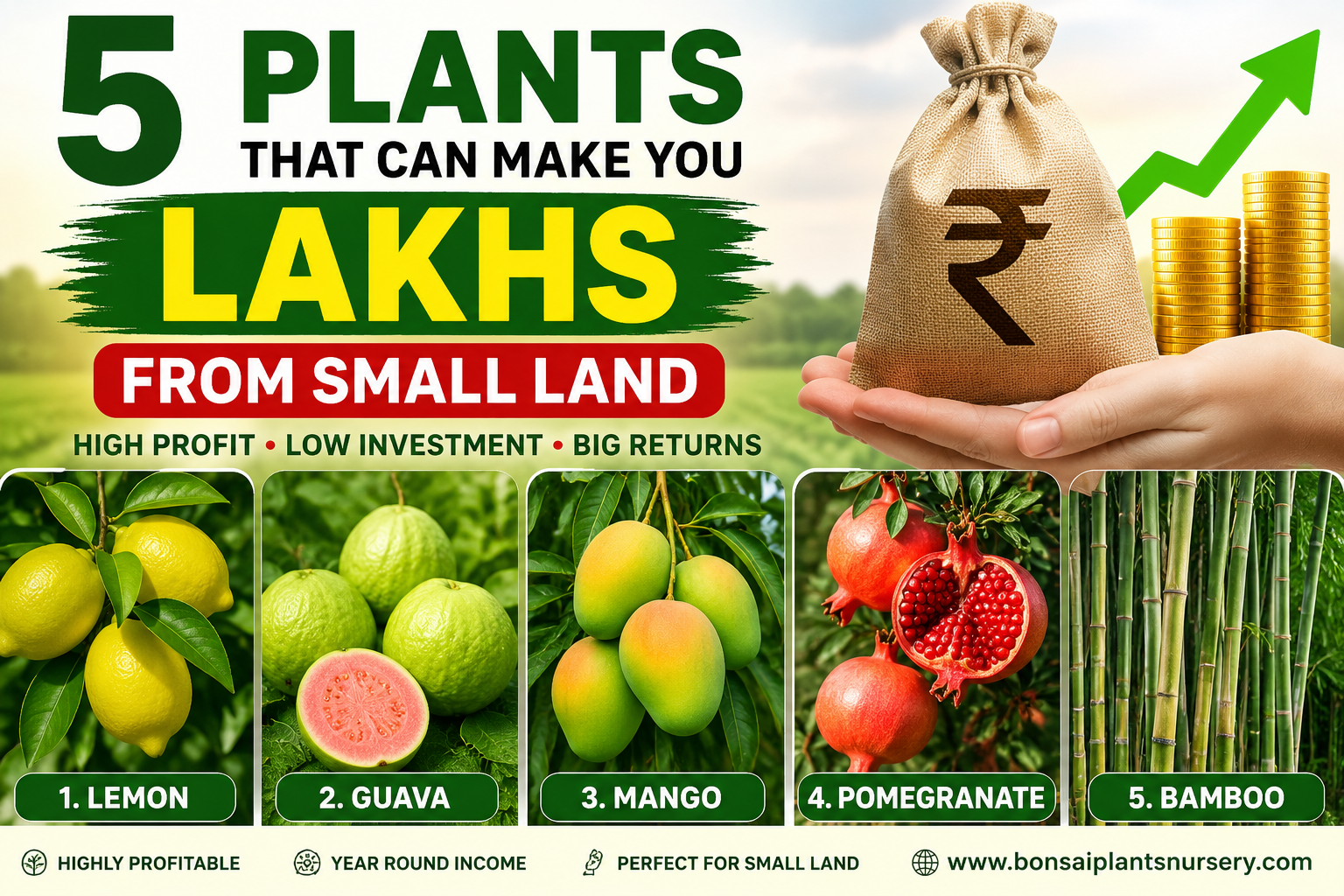
5_Plants_That_Can_Make_You_Lakhs
इस ब्लॉग में हम आपको ऐसे 5 खास पौधों के बारे में बताएंगे जो:
कम देखभाल में उगते हैं
जल्दी मुनाफा देते हैं
बाजार में हमेशा डिमांड में रहते हैं
और लंबे समय तक आय देते हैं
🌳 1. नींबू (Kagji Nimbu) – सबसे तेज और लगातार कमाई वाला पौधा
नींबू खेती भारत में सबसे ज्यादा लाभ देने वाली फसलों में से एक है। खासकर कागजी नींबू की डिमांड हर मौसम में बनी रहती है।
🍋 क्यों नींबू सबसे बेस्ट है?
साल भर फल देता है
3 साल में उत्पादन शुरू
कम पानी में भी बढ़िया ग्रोथ
मार्केट में हमेशा डिमांड
💰 कमाई कितनी हो सकती है?
अगर आप 1 एकड़ में 200–250 नींबू के पौधे लगाते हैं:
प्रति पौधा औसतन 30–50 kg फल
बाजार भाव: ₹20–₹60 प्रति kg
कुल सालाना कमाई: ₹2 लाख से ₹6 लाख+
🌿 खास टिप्स:
ड्रिप इरिगेशन लगाएं
ऑर्गेनिक खाद का उपयोग करें
नियमित pruning करें
👉 सही देखभाल से यह पौधा 15–20 साल तक उत्पादन देता है।
🌳 2. अमरूद (Guava) – कम लागत, ज्यादा मुनाफा
अमरूद को “गरीब का सेब” भी कहा जाता है, लेकिन कमाई में यह किसी भी प्रीमियम फल से कम नहीं है।
🍏 क्यों अमरूद फायदेमंद है?
2–3 साल में फल देना शुरू
कम पानी और कम देखभाल
हर मौसम में मांग
कम लागत में ज्यादा उत्पादन
💰 कमाई का अनुमान:
1 एकड़ में 300–400 पौधे:
प्रति पौधा 40–80 kg उत्पादन
बाजार मूल्य ₹15–₹40 प्रति kg
कुल कमाई: ₹3 लाख से ₹8 लाख प्रति वर्ष
🌿 बेस्ट वैरायटी:
इलाहाबादी सफेदा
लखनऊ-49
थाई अमरूद (High demand premium variety)
🌳 3. आम (Mango) – लंबे समय की सबसे सुरक्षित निवेश फसल
आम को “फलों का राजा” कहा जाता है और यह भारत की सबसे स्थिर और भरोसेमंद फसल है।
🥭 क्यों आम खेती शानदार है?
4–5 साल में उत्पादन
30+ साल तक फल
कम मेंटेनेंस
एक्सपोर्ट मार्केट में डिमांड
💰 कमाई:
1 एकड़ में 100–120 पौधे:
प्रति पौधा 80–150 kg फल
₹20–₹80 प्रति kg (क्वालिटी पर निर्भर)
कुल कमाई: ₹4 लाख से ₹10 लाख+ प्रति वर्ष
🌿 लोकप्रिय किस्में:
दशहरी
लंगड़ा
केसर
आम्रपाली (High density farming)
👉 High Density Mango Farming से कम जमीन में ज्यादा उत्पादन संभव है।
🌳 4. अनार (Pomegranate) – सबसे ज्यादा प्रॉफिट वाला क्रॉप
अनार को “Red Gold” भी कहा जाता है क्योंकि इसकी बाजार कीमत बहुत स्थिर और ऊंची रहती है।
🍎 क्यों अनार खेती?
कम पानी में उगता है
सूखे इलाकों में भी सफल
2–3 साल में उत्पादन
export quality demand
💰 कमाई:
1 एकड़ में 400–500 पौधे:
प्रति पौधा 25–40 kg फल
बाजार मूल्य ₹40–₹120 प्रति kg
कुल कमाई: ₹5 लाख से ₹12 लाख प्रति वर्ष
🌿 बेस्ट वैरायटी:
भगवा (सबसे लोकप्रिय export variety)
गणेश
अरक्ता
🌳 5. बांस (Bamboo) – सबसे ज्यादा लंबी अवधि का पैसा देने वाला प्लांट
अगर आप ऐसी खेती चाहते हैं जो एक बार लगाने के बाद सालों तक पैसा दे, तो बांस सबसे अच्छा विकल्प है।
🎋 क्यों बांस खास है?
बहुत तेजी से बढ़ता है
कम देखभाल
इंडस्ट्री में भारी डिमांड
पेपर, फर्नीचर, निर्माण में उपयोग
💰 कमाई:
1 एकड़ में 400–600 पौधे:
3–4 साल बाद कटाई शुरू
प्रति पौधा कई बार कटाई संभव
सालाना कमाई: ₹3 लाख से ₹15 लाख+
👉 लंबे समय के लिए यह “wealth building crop” है।
📊 तुलना तालिका (Best Profit Crops)
पौधा
शुरुआत
कमाई
मेंटेनेंस
नींबू
3 साल
₹2–6 लाख
कम
अमरूद
2–3 साल
₹3–8 लाख
कम
आम
4–5 साल
₹4–10 लाख
मध्यम
अनार
2–3 साल
₹5–12 लाख
मध्यम
बांस
3–4 साल
₹3–15 लाख
बहुत कम
🌿 कम जमीन में ज्यादा कमाई कैसे करें?
अगर आपके पास कम जमीन है तो इन बातों का ध्यान रखें:
Why Taiwan Pink Guava Farming is Becoming the First Choice of Farmers
Commercial fruit farming is growing rapidly in India, and farmers are now shifting from traditional crops toward high-profit horticulture farming. Among the most profitable fruit crops, Taiwan Pink Guava farming has become extremely popular because of its large fruit size, attractive pink pulp, high sweetness, excellent market demand, and huge production potential.
Compared to ordinary guava varieties, Taiwan Pink Guava produces bigger fruits, higher yields, and better profits. Its demand is increasing in local markets, supermarkets, hotels, juice industries, fruit shops, and even online fruit selling businesses.
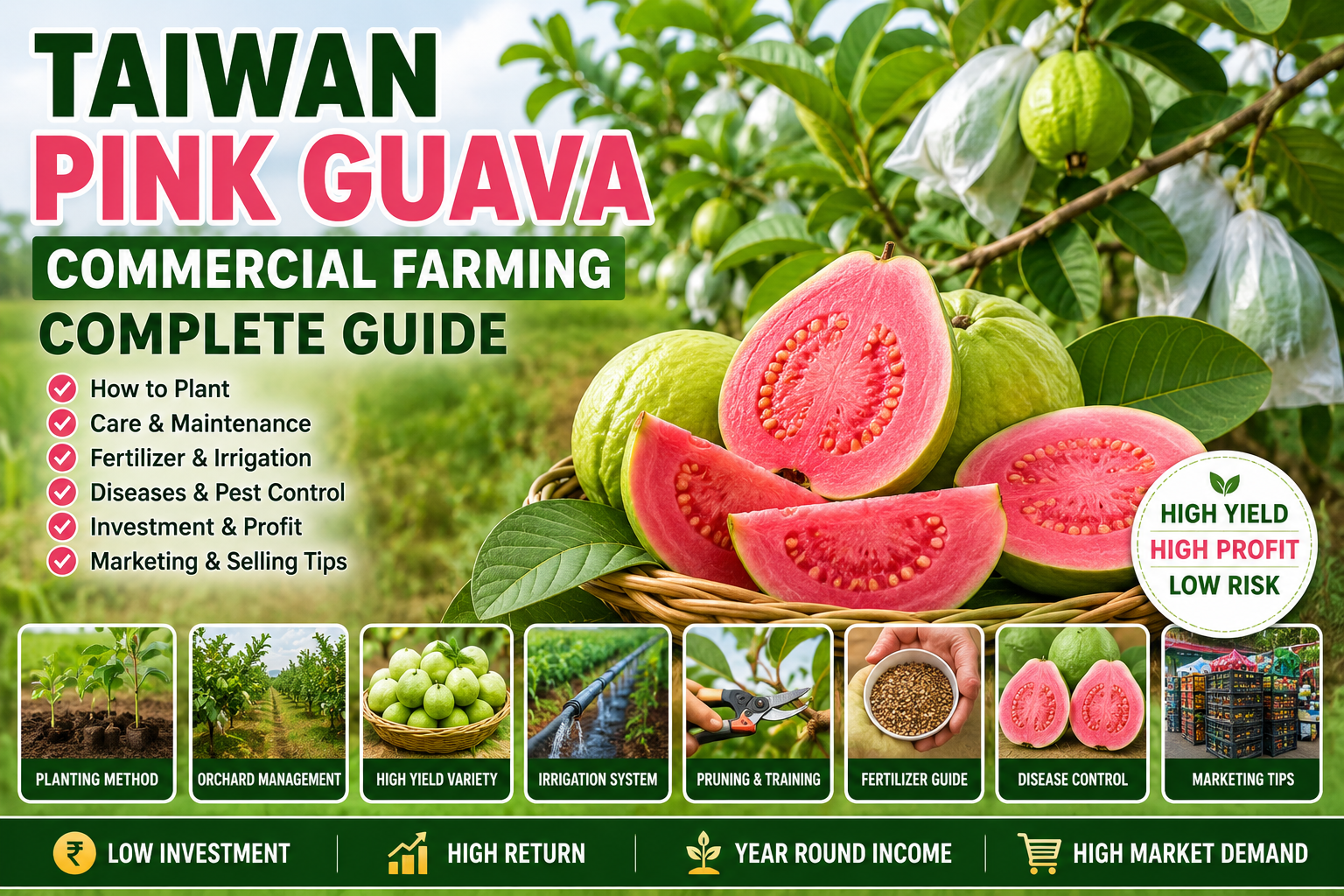
Taiwan_Pink_Guava_Commercial_Farming
Farmers looking for high income from small land holdings can earn excellent profits through Taiwan Pink Guava commercial farming. With proper plantation methods, balanced nutrition, irrigation management, pruning, and marketing strategies, farmers can generate lakhs of rupees annually.
In this complete guide, you will learn:
Features of Taiwan Pink Guava
Climate and soil requirements
Plantation methods
Field preparation
Fertilizer management
Irrigation management
Pest and disease control
Investment and profit calculation
Marketing strategies
Scientific methods for higher production
Intercropping and drip irrigation
Where to buy quality plants
What is Taiwan Pink Guava?
Taiwan Pink Guava is an improved hybrid guava variety famous for its large fruit size, pink flesh, high sweetness, and commercial productivity. It is mainly cultivated for commercial farming because of its premium market demand and excellent shelf life.
The fruits are attractive, glossy, and larger than traditional guava varieties. The inner pulp is pink in color, which makes it highly attractive to consumers.
Main Features of Taiwan Pink Guava
1. Large Fruit Size
The fruits are much bigger than normal guava varieties. A single fruit can weigh between 300 grams to 800 grams, and under proper care some fruits may even reach 1 kilogram.
2. Attractive Pink Pulp
The pink flesh increases market value and consumer demand.
3. Fewer Seeds
The fruits contain fewer seeds and are more enjoyable to eat.
4. Heavy Yield
A mature plant can produce 40 to 100 kilograms of fruits annually.
5. High Market Price
Taiwan Pink Guava generally sells at a higher price than ordinary guava.
6. Longer Shelf Life
The fruits remain fresh for longer durations, making them suitable for transportation and distant markets.
Suitable Climate for Taiwan Pink Guava Farming
Taiwan Pink Guava can be cultivated successfully in most parts of India.
Ideal Temperature
15°C to 35°C is ideal
Frost is harmful
Warm and moderately humid climate is best
Rainfall
800 to 1200 mm annual rainfall is suitable
Waterlogging must be avoided
Sunlight
Good sunlight improves sweetness and fruit quality.
Best Soil for Taiwan Pink Guava Farming
Taiwan Pink Guava grows well in many soil types, but well-drained loamy soil is considered best.
Ideal Soil pH
5.5 to 7.5
Soil Characteristics
Rich in organic matter
Proper drainage
Avoid highly alkaline or waterlogged soil
Land Preparation
Proper land preparation is essential for successful commercial farming.
First Ploughing
Do deep ploughing with a mouldboard plough.
Second and Third Ploughing
Use cultivator or rotavator to make the soil fine and loose.
Weed Removal
Remove all weeds and old crop residues.
Organic Manure
Apply 8 to 10 tons of well-decomposed cow dung manure per acre.
Where to Buy Taiwan Pink Guava Plants?
Always buy grafted and disease-free plants from trusted nurseries.
Drip irrigation is highly beneficial in Taiwan Pink Guava farming.
Advantages
Saves water
Delivers fertilizer directly to roots
Increases yield
Reduces diseases
Improves fruit quality
Irrigation Management
Summer
Irrigation every 5 to 7 days
Winter
Irrigation every 10 to 15 days
Rainy Season
Irrigate only when necessary
Avoid waterlogging at all costs.
Fertilizer and Nutrient Management
Balanced nutrition is essential for high production.
Organic Fertilizers
Per plant:
20 to 30 kg cow dung manure
Vermicompost
Neem cake
Chemical Fertilizer Management
First Year
Apply:
Urea
DAP
Potash
From Second Year
Increase fertilizer dose according to plant age.
Importance of Micronutrients
For better fruit shine and quality, spray:
Zinc
Boron
Calcium
Magnesium
Mulching Benefits
Use plastic mulch or organic mulch.
Benefits
Maintains soil moisture
Reduces weeds
Improves yield
Pruning and Training
Pruning is extremely important in Taiwan Pink Guava farming.
Benefits
Encourages new branches
Increases fruiting
Maintains plant shape
Reduces diseases
Best Time
After harvesting
Remove dry and diseased branches
Flower and Fruit Management
For high-quality fruits:
Remove excess flowers
Thin weak fruits
Provide balanced nutrition
Fruit Bagging Technique
Fruit bagging is becoming very popular in commercial guava farming.
Advantages
Cleaner fruits
Protection from insects
Better market value
Major Diseases in Taiwan Pink Guava
1. Wilt Disease
Symptoms
Drying plants
Yellow leaves
Control
Use Trichoderma
Improve drainage
2. Anthracnose
Symptoms
Black spots on fruits
Control
Spray copper oxychloride
3. Leaf Spot Disease
Control
Use suitable fungicides
Major Pests and Their Control
1. Fruit Fly
Damage
Damages fruits internally.
Control
Use pheromone traps
Maintain cleanliness
2. Mealybug
Control
Neem oil spray
Biological control methods
3. Aphids
Control
Imidacloprid spray
Organic Taiwan Pink Guava Farming
Organic fruit farming demand is increasing rapidly.
Organic Farming Inputs
Cow dung manure
Jeevamrut
Neem based formulations
Vermicompost
Trichoderma
Intercropping for Extra Income
Farmers can grow intercrops during the initial 2 to 3 years.
Suitable Crops
Vegetables
Turmeric
Ginger
Coriander
Groundnut
Fruiting Time
Fruiting starts within 1.5 to 2 years
Commercial production starts in 3 years
Full production after 5 years
Yield Per Plant
Plant Age
Average Yield
2 Years
10–20 kg
3 Years
30–50 kg
5 Years
60–100 kg
Production Per Acre
With proper management:
15 to 30 tons production per acre is possible
Investment in Taiwan Pink Guava Farming
Initial Investment
Work
Estimated Cost
Land preparation
₹10,000–20,000
Plants
₹20,000–80,000
Fertilizers
₹15,000–40,000
Drip irrigation
₹40,000–70,000
Labor
₹15,000–30,000
Miscellaneous
₹10,000–20,000
Total Investment
Around ₹1 lakh to ₹2.5 lakh per acre.
Profit and Income
Average Market Price
₹30 to ₹120 per kilogram
Per Acre Income Example
If production is 20 tons and market price is ₹50 per kilogram:
20,000 kg × ₹50 = ₹10,00,000
Net Profit
Even after expenses, farmers can earn lakhs of rupees annually.
How to Increase Profit?
1. Sell Directly to Consumers
2. Use Social Media Marketing
3. Start Online Selling
4. Supply to Hotels and Juice Shops
5. Attractive Packaging
Best States for Taiwan Pink Guava Farming
North India
Uttar Pradesh
Bihar
Haryana
Punjab
West India
Maharashtra
Gujarat
South India
Karnataka
Tamil Nadu
Telangana
East India
West Bengal
Odisha
Export Opportunities
Taiwan Pink Guava has strong export demand.
Important Export Factors
Grading
Packaging
Quality control
Limited chemical usage
Marketing Strategy
Online Platforms
Facebook
Instagram
WhatsApp Business
YouTube
Offline Markets
Fruit markets
Supermarkets
Hotels
Importance of Branding
Farmers can earn higher profits by developing a strong brand.
Examples
Branded packaging
Social media presence
Business website
Important Tips for Successful Farming
Always buy quality plants
Use drip irrigation
Prune regularly
Increase organic manure usage
Understand market demand
Sell directly to customers
Maintain farming records
Monitor plants regularly
Common Mistakes Farmers Make
1. Buying Low Quality Plants
2. Over Irrigation
3. Ignoring Pruning
4. Poor Nutrient Management
5. Delayed Disease Control
Taiwan Pink Guava vs Normal Guava
Feature
Taiwan Pink Guava
Normal Guava
Fruit Size
Large
Small
Market Price
Higher
Average
Pulp Color
Pink
White
Yield
High
Medium
Demand
High
Normal
Points to Remember While Buying Plants
Buy grafted plants
Choose disease-free plants
Purchase from trusted nurseries
Ensure healthy root systems
Modern Technologies in Guava Farming
1. Drip Irrigation
2. Mulching
3. High Density Plantation
4. Organic Farming
5. Mobile-based Monitoring
Opportunities for Women Farmers
Women farmers can also successfully participate in:
Nursery management
Fruit grading
Packaging
Online selling
Great Opportunity for Young Farmers
Modern educated youth are rapidly entering horticulture farming.
Taiwan Pink Guava farming can become a highly profitable agribusiness if combined with:
Digital marketing
Social media branding
Online sales
Modern irrigation systems
Frequently Asked Questions (FAQ)
Q1. How many years does Taiwan Pink Guava produce fruits?
With proper care, plants can produce well for 15 to 20 years.
Q2. Can Taiwan Pink Guava be grown in pots?
Yes, it can be grown in large containers, but commercial farming is best done in open fields.
Q3. How much production can one plant give?
A mature plant can produce 40 to 100 kilograms of fruits.
Q4. Is organic farming possible?
Yes, and organically grown fruits often get premium prices.
Q5. What is the market price of Taiwan Pink Guava?
Depending on quality and season, prices range from ₹30 to ₹150 per kilogram.
Conclusion
Taiwan Pink Guava commercial farming is becoming one of the most profitable fruit farming businesses in India. Its attractive fruits, high yield potential, premium market demand, and better pricing make it an excellent choice for progressive farmers.
By adopting scientific farming techniques, drip irrigation, balanced nutrition, pruning, and modern marketing strategies, farmers can earn excellent income even from small land holdings.
For farmers looking to move from traditional farming toward modern high-profit horticulture, Taiwan Pink Guava farming can become a golden opportunity.
For premium quality Taiwan Pink Guava plants and professional farming guidance contact:
ताइवान पिंक अमरूद की खेती क्यों बन रही है किसानों की पहली पसंद?
भारत में फलदार पौधों की खेती तेजी से बढ़ रही है और किसानों का रुझान अब पारंपरिक खेती से हटकर हाई प्रॉफिट हॉर्टिकल्चर की ओर जा रहा है। इसी क्रम में ताइवान पिंक अमरूद की खेती आज के समय में सबसे ज्यादा लाभ देने वाली फलों की खेती में शामिल हो चुकी है। बड़े आकार, आकर्षक गुलाबी गूदे, अधिक मिठास, बाजार में ऊँची कीमत और साल में कई बार फल देने की क्षमता के कारण यह किस्म किसानों के बीच तेजी से लोकप्रिय हो रही है।
ताइवान पिंक अमरूद सामान्य देसी अमरूद की तुलना में अधिक वजनदार, अधिक उत्पादन देने वाला और व्यापारिक दृष्टि से ज्यादा लाभदायक माना जाता है। इसकी मांग केवल स्थानीय बाजार तक सीमित नहीं है बल्कि बड़े शहरों, होटल उद्योग, जूस उद्योग, सुपरमार्केट और ऑनलाइन फल विक्रेताओं तक फैली हुई है।
अगर कोई किसान कम जमीन में ज्यादा मुनाफा कमाना चाहता है, तो ताइवान पिंक अमरूद की कमर्शियल खेती एक बेहतरीन विकल्प साबित हो सकती है। सही तकनीक, उचित पौध चयन, समय पर सिंचाई, खाद प्रबंधन और मार्केटिंग के माध्यम से किसान लाखों रुपये तक की आय प्राप्त कर सकते हैं।
Taiwan_Pink_Guava_Commercial_Farming
इस विस्तृत गाइड में हम ताइवान पिंक अमरूद की खेती से जुड़ी हर महत्वपूर्ण जानकारी विस्तार से समझेंगे, जिसमें शामिल हैं:
ताइवान पिंक अमरूद की विशेषताएँ
जलवायु और मिट्टी
पौधे लगाने का सही तरीका
खेत की तैयारी
खाद और उर्वरक प्रबंधन
सिंचाई प्रबंधन
रोग और कीट नियंत्रण
प्रति एकड़ लागत और कमाई
मार्केटिंग रणनीति
अधिक उत्पादन पाने के वैज्ञानिक तरीके
इंटरक्रॉपिंग और ड्रिप सिंचाई
पौध खरीदने की सही जगह
ताइवान पिंक अमरूद क्या है?
ताइवान पिंक अमरूद एक उन्नत हाईब्रिड अमरूद की किस्म है जो मुख्य रूप से अपने बड़े आकार, गुलाबी गूदे और अत्यधिक उत्पादन के लिए जानी जाती है। यह किस्म विशेष रूप से व्यावसायिक खेती के लिए विकसित की गई है और आज भारत के कई राज्यों में इसकी खेती सफलतापूर्वक की जा रही है।
इस अमरूद का फल आकार में बड़ा, चमकदार और देखने में आकर्षक होता है। इसके अंदर का गूदा गुलाबी रंग का होता है, जो इसे बाजार में अन्य किस्मों से अलग पहचान देता है। इसका स्वाद मीठा और कम बीज वाला होता है, जिससे उपभोक्ता इसे काफी पसंद करते हैं।
ताइवान पिंक अमरूद की मुख्य विशेषताएँ
1. बड़े आकार के फल
इस किस्म के फल सामान्य अमरूद की तुलना में काफी बड़े होते हैं। एक फल का वजन 300 ग्राम से लेकर 800 ग्राम तक हो सकता है। सही देखभाल और पोषण मिलने पर कुछ फल 1 किलो तक भी पहुँच सकते हैं।
2. गुलाबी गूदा
इसका गूदा आकर्षक गुलाबी रंग का होता है, जिससे बाजार में इसकी मांग अधिक रहती है।
3. कम बीज
इस किस्म में बीज कम होते हैं, इसलिए खाने में ज्यादा स्वादिष्ट लगती है।
4. अधिक उत्पादन
सही देखभाल के साथ प्रति पौधा 40 से 100 किलो तक उत्पादन प्राप्त किया जा सकता है।
5. बाजार में ऊँची कीमत
ताइवान पिंक अमरूद सामान्य अमरूद की तुलना में अधिक कीमत पर बिकता है। कई शहरों में इसकी कीमत 50 से 150 रुपये प्रति किलो तक मिल जाती है।
6. लंबी शेल्फ लाइफ
इस किस्म के फल अधिक समय तक खराब नहीं होते, जिससे दूर-दराज बाजारों में भी आसानी से भेजे जा सकते हैं।
ताइवान पिंक अमरूद की खेती के लिए उपयुक्त जलवायु
ताइवान पिंक अमरूद की खेती भारत के अधिकांश राज्यों में सफलतापूर्वक की जा सकती है। यह उष्णकटिबंधीय और उपोष्णकटिबंधीय जलवायु में अच्छी वृद्धि करता है।
आदर्श तापमान
15°C से 35°C तक तापमान उपयुक्त
अत्यधिक ठंड और पाला नुकसानदायक
गर्म और हल्की नमी वाली जलवायु बेहतर
वर्षा
800 से 1200 मिमी वार्षिक वर्षा उपयुक्त
जलभराव नहीं होना चाहिए
धूप
अच्छी धूप फल की गुणवत्ता और मिठास बढ़ाने में मदद करती है।
खेती के लिए उपयुक्त मिट्टी
ताइवान पिंक अमरूद लगभग सभी प्रकार की मिट्टी में उगाया जा सकता है, लेकिन अच्छी जल निकासी वाली दोमट मिट्टी सर्वोत्तम मानी जाती है।
मिट्टी का pH मान
5.5 से 7.5 उपयुक्त
मिट्टी की विशेषताएँ
जैविक पदार्थों से भरपूर
जल निकासी अच्छी हो
बहुत अधिक क्षारीय या जलभराव वाली भूमि से बचें
खेत की तैयारी कैसे करें?
अच्छी खेती की शुरुआत सही खेत तैयारी से होती है।
पहली जुताई
खेत की गहरी जुताई मिट्टी पलटने वाले हल से करें।
दूसरी और तीसरी जुताई
कल्टीवेटर या रोटावेटर से करें ताकि मिट्टी भुरभुरी हो जाए।
खरपतवार नियंत्रण
सभी खरपतवार और पुराने पौधों के अवशेष हटाएँ।
गोबर खाद का प्रयोग
प्रति एकड़ 8 से 10 टन अच्छी सड़ी हुई गोबर खाद डालें।
पौधे कहाँ से खरीदें?
कमर्शियल खेती में सबसे महत्वपूर्ण बात होती है पौधों की गुणवत्ता। हमेशा विश्वसनीय नर्सरी से ग्राफ्टेड और रोगमुक्त पौधे खरीदें।
ताइवान पिंक अमरूद में ड्रिप सिंचाई अत्यंत लाभदायक साबित होती है।
फायदे
पानी की बचत
खाद सीधे जड़ों तक
अधिक उत्पादन
रोग कम
फल का आकार बेहतर
सिंचाई प्रबंधन
गर्मियों में
5 से 7 दिन के अंतराल पर
सर्दियों में
10 से 15 दिन पर
वर्षा ऋतु
जरूरत अनुसार
जलभराव से बचना अत्यंत आवश्यक है।
खाद और उर्वरक प्रबंधन
उचित पोषण से ही अधिक उत्पादन प्राप्त किया जा सकता है।
जैविक खाद
प्रति पौधा
20 से 30 किलो गोबर खाद
वर्मी कम्पोस्ट
नीम खली
रासायनिक उर्वरक प्रबंधन
पहले वर्ष
यूरिया
डीएपी
पोटाश
दूसरे वर्ष से
उम्र के अनुसार मात्रा बढ़ाएँ।
सूक्ष्म पोषक तत्वों का महत्व
फल की गुणवत्ता और चमक बढ़ाने के लिए:
जिंक
बोरॉन
कैल्शियम
मैग्नीशियम
का स्प्रे करें।
मल्चिंग का उपयोग
प्लास्टिक मल्च या जैविक मल्च का प्रयोग करने से:
नमी बनी रहती है
खरपतवार कम होते हैं
उत्पादन बढ़ता है
पौधों की कटाई-छंटाई
ताइवान पिंक अमरूद में प्रूनिंग बहुत जरूरी होती है।
क्यों जरूरी?
नई शाखाएँ आती हैं
फल उत्पादन बढ़ता है
पौधे का आकार नियंत्रित रहता है
रोग कम लगते हैं
कब करें?
फसल के बाद
सूखी और रोगग्रस्त शाखाएँ हटाएँ
फूल और फल प्रबंधन
अधिक गुणवत्ता वाले फल पाने के लिए:
अतिरिक्त फूल हटाएँ
कमजोर फल हटाएँ
संतुलित पोषण दें
फल बैगिंग तकनीक
आजकल कमर्शियल खेती में फल बैगिंग तेजी से लोकप्रिय हो रही है।
फायदे
फल चमकदार होते हैं
कीट कम लगते हैं
बाजार मूल्य बढ़ता है
ताइवान पिंक अमरूद में लगने वाले प्रमुख रोग
1. विल्ट रोग
लक्षण
पौधा सूखना
पत्तियाँ पीली पड़ना
नियंत्रण
ट्राइकोडर्मा
जल निकासी सुधारें
2. एन्थ्रेक्नोज
लक्षण
फलों पर काले धब्बे
नियंत्रण
कॉपर ऑक्सीक्लोराइड स्प्रे
3. पत्ती धब्बा रोग
नियंत्रण
उचित फफूंदनाशी का छिड़काव
प्रमुख कीट और नियंत्रण
1. फल मक्खी
नुकसान
फल खराब हो जाते हैं।
नियंत्रण
फेरोमोन ट्रैप
स्वच्छता बनाए रखें
2. मिलीबग
नियंत्रण
नीम तेल स्प्रे
जैविक नियंत्रण
3. एफिड्स
नियंत्रण
इमिडाक्लोप्रिड स्प्रे
जैविक खेती कैसे करें?
आज जैविक अमरूद की मांग तेजी से बढ़ रही है।
जैविक खेती के तरीके
गोबर खाद
जीवामृत
नीमास्त्र
वर्मी कम्पोस्ट
ट्राइकोडर्मा
का प्रयोग करें।
इंटरक्रॉपिंग से अतिरिक्त कमाई
शुरुआती 2 से 3 वर्षों तक खाली जगह में दूसरी फसलें उगाकर अतिरिक्त आय प्राप्त की जा सकती है।
उपयुक्त फसलें
सब्जियाँ
हल्दी
अदरक
धनिया
मूंगफली
ताइवान पिंक अमरूद में फल आने का समय
1.5 से 2 वर्ष में फल आना शुरू
3 वर्ष में व्यावसायिक उत्पादन
5 वर्ष में पूर्ण उत्पादन
प्रति पौधा उत्पादन
पौधे की उम्र
औसत उत्पादन
2 वर्ष
10–20 किलो
3 वर्ष
30–50 किलो
5 वर्ष
60–100 किलो
प्रति एकड़ उत्पादन
सही प्रबंधन के साथ:
15 से 30 टन प्रति एकड़ तक उत्पादन संभव
ताइवान पिंक अमरूद की खेती में लागत
प्रारंभिक लागत
कार्य
अनुमानित लागत
खेत तैयारी
₹10,000–20,000
पौधे
₹20,000–80,000
खाद एवं उर्वरक
₹15,000–40,000
ड्रिप सिंचाई
₹40,000–70,000
मजदूरी
₹15,000–30,000
अन्य खर्च
₹10,000–20,000
कुल लागत
लगभग ₹1 लाख से ₹2.5 लाख प्रति एकड़
कमाई कितनी हो सकती है?
औसत बाजार मूल्य
₹30 से ₹120 प्रति किलो
प्रति एकड़ आय
अगर 20 टन उत्पादन और औसत ₹50 प्रति किलो मूल्य मिले:
20,000 किलो × ₹50 = ₹10,00,000
शुद्ध लाभ
खर्च निकालने के बाद भी किसान लाखों रुपये कमा सकते हैं।
अधिक मुनाफा कैसे कमाएँ?
1. सीधे ग्राहक तक बेचें
2. सोशल मीडिया मार्केटिंग करें
3. ऑनलाइन बिक्री करें
4. होटल और जूस दुकानों से संपर्क करें
5. पैकेजिंग अच्छी रखें
कौन-कौन से राज्य खेती के लिए उपयुक्त हैं?
उत्तर भारत
उत्तर प्रदेश
बिहार
हरियाणा
पंजाब
पश्चिम भारत
महाराष्ट्र
गुजरात
दक्षिण भारत
कर्नाटक
तमिलनाडु
तेलंगाना
पूर्व भारत
पश्चिम बंगाल
ओडिशा
निर्यात की संभावनाएँ
ताइवान पिंक अमरूद की मांग विदेशों में भी बढ़ रही है।
निर्यात के लिए जरूरी बातें
ग्रेडिंग
पैकिंग
क्वालिटी कंट्रोल
रसायनों का सीमित प्रयोग
मार्केटिंग रणनीति
ऑनलाइन प्लेटफॉर्म
Facebook
Instagram
WhatsApp Business
YouTube
स्थानीय मंडियाँ
फल मंडी
सुपरमार्केट
होटल
ब्रांड बनाना क्यों जरूरी है?
अगर किसान अपनी खेती को ब्रांड के रूप में विकसित करें तो उन्हें अधिक लाभ मिल सकता है।
उदाहरण
पैकिंग बॉक्स पर नाम
सोशल मीडिया पेज
वेबसाइट
सफल खेती के लिए महत्वपूर्ण सुझाव
हमेशा अच्छे पौधे खरीदें
ड्रिप सिंचाई अपनाएँ
समय पर प्रूनिंग करें
जैविक खाद का प्रयोग बढ़ाएँ
बाजार की मांग समझें
सीधे ग्राहक तक पहुँच बनाएँ
रिकॉर्ड रखें
नियमित निरीक्षण करें
शुरुआती किसानों की सामान्य गलतियाँ
1. गलत पौधे खरीदना
2. बहुत अधिक सिंचाई
3. प्रूनिंग न करना
4. पोषण प्रबंधन में लापरवाही
5. रोग नियंत्रण में देरी
ताइवान पिंक अमरूद बनाम सामान्य अमरूद
विशेषता
ताइवान पिंक
सामान्य अमरूद
फल आकार
बड़ा
छोटा
बाजार मूल्य
अधिक
सामान्य
गूदा रंग
गुलाबी
सफेद
उत्पादन
अधिक
मध्यम
मांग
अधिक
सामान्य
पौध खरीदते समय किन बातों का ध्यान रखें?
ग्राफ्टेड पौधे लें
रोगमुक्त पौधे लें
विश्वसनीय नर्सरी से खरीदें
पौधे की जड़ें स्वस्थ हों
खेती में आधुनिक तकनीकों का उपयोग
1. ड्रिप सिंचाई
2. मल्चिंग
3. हाई डेंसिटी प्लांटेशन
4. जैविक खेती
5. मोबाइल आधारित मॉनिटरिंग
महिला किसानों के लिए अवसर
ताइवान पिंक अमरूद की खेती में महिलाएँ भी सफलतापूर्वक भाग ले सकती हैं।
नर्सरी प्रबंधन
फल ग्रेडिंग
पैकिंग
ऑनलाइन बिक्री
के माध्यम से अच्छा रोजगार प्राप्त किया जा सकता है।
युवा किसानों के लिए सुनहरा अवसर
आज के समय में पढ़े-लिखे युवा आधुनिक खेती की ओर तेजी से बढ़ रहे हैं। ताइवान पिंक अमरूद की खेती कम समय में अच्छा मुनाफा देने वाली खेती है।
अगर युवा किसान:
डिजिटल मार्केटिंग
सोशल मीडिया
ऑनलाइन बिक्री
आधुनिक सिंचाई
को अपनाएँ, तो कम जमीन में भी बड़ा व्यवसाय खड़ा किया जा सकता है।
ताइवान पिंक अमरूद से जुड़े अक्सर पूछे जाने वाले प्रश्न (FAQ)
प्रश्न 1: ताइवान पिंक अमरूद का पौधा कितने साल तक उत्पादन देता है?
उत्तर: सही देखभाल के साथ 15 से 20 वर्षों तक अच्छा उत्पादन देता है।
प्रश्न 2: क्या इसकी खेती गमले में की जा सकती है?
उत्तर: हाँ, बड़े गमले में की जा सकती है लेकिन कमर्शियल उत्पादन के लिए खेत उपयुक्त है।
प्रश्न 3: एक पौधे से कितना उत्पादन मिलता है?
उत्तर: 40 से 100 किलो तक उत्पादन मिल सकता है।
प्रश्न 4: क्या इसकी खेती जैविक तरीके से संभव है?
उत्तर: हाँ, जैविक खेती में इसकी मांग और कीमत दोनों बढ़ जाती हैं।
प्रश्न 5: बाजार में इसकी कीमत कितनी मिलती है?
उत्तर: गुणवत्ता और मौसम के अनुसार ₹30 से ₹150 प्रति किलो तक।
निष्कर्ष
ताइवान पिंक अमरूद की कमर्शियल खेती आज के समय में किसानों के लिए अत्यधिक लाभदायक विकल्प बन चुकी है। बड़े आकार के आकर्षक फल, अधिक उत्पादन, ऊँची बाजार कीमत और तेजी से बढ़ती मांग इसे भविष्य की हाई प्रॉफिट खेती बनाती है।
अगर किसान सही पौध चयन, वैज्ञानिक खेती तकनीक, ड्रिप सिंचाई, संतुलित पोषण और आधुनिक मार्केटिंग रणनीतियों को अपनाएँ, तो कम जमीन में भी लाखों रुपये की आय प्राप्त की जा सकती है।
विशेष रूप से वे किसान जो पारंपरिक खेती से हटकर आधुनिक फल उत्पादन व्यवसाय शुरू करना चाहते हैं, उनके लिए ताइवान पिंक अमरूद की खेती एक सुनहरा अवसर साबित हो सकती है।
उच्च गुणवत्ता वाले ताइवान पिंक अमरूद के पौधों और खेती संबंधी मार्गदर्शन के लिए सम्पर्क करें:
Modern farming in India is changing rapidly. Farmers are no longer dependent only on traditional crops like wheat, rice, and sugarcane. Today, commercial fruit farming has become one of the most profitable agricultural businesses because of rising demand for fresh fruits, healthy food habits, juice industries, food processing units, hotels, resorts, export markets, and organic produce.
Best_Outdoor_Fruit_Plants_for_Commercial_Farming
Many outdoor fruit plants require very little maintenance while providing excellent long-term profits. These fruit crops:
Grow well with low maintenance
Need less water
Produce fruits for many years
Have strong market demand
Can generate huge profits even on small land areas
Are suitable for commercial farming and wholesale markets
If you own just 1–5 acres of land, choosing the right commercial fruit plants can help you build a highly profitable farming business.
In this complete SEO-friendly guide, we will discuss:
Best outdoor fruit plants for commercial farming
Region-wise profitable fruit crops in India
North India fruit farming
South India fruit farming
East India fruit farming
West India fruit farming
Low-maintenance fruit plantations
High-return fruit farming opportunities
Future fruit market trends
Commercial plantation strategies
This guide can help farmers, nursery owners, investors, and landowners choose the best fruit plants for long-term profits.
Why Commercial Fruit Farming Is Becoming Highly Profitable
The demand for fruits is increasing rapidly in India because:
Health-conscious consumers are growing
Juice and beverage industries are expanding
Organic fruit demand is increasing
Export opportunities are improving
Hotels and restaurants require fresh fruits daily
Food processing industries are growing fast
Because of this, commercial fruit farming is considered one of the best agricultural investments today.
Major Advantages of Commercial Fruit Farming
1. Long-Term Income
Fruit plants continue producing for many years after plantation.
2. Low Maintenance
Many fruit crops require minimal care after establishment.
3. Multiple Income Sources
Besides fresh fruit sales, farmers can earn from:
Fruit processing
Plant nurseries
Organic farming
Agro tourism
Value-added products
4. High Profit from Small Land
High-density plantations allow excellent profits even on limited land.
Important Things to Know Before Starting Fruit Farming
Before starting a commercial fruit plantation:
Select climate-suitable crops
Understand water availability
Research market demand
Conduct soil testing
Choose disease-resistant varieties
Buy healthy grafted plants
Best Fruit Plants for North India
North India includes:
Uttar Pradesh
Punjab
Haryana
Delhi
Rajasthan
Uttarakhand
Himachal Pradesh
These regions experience both hot summers and cold winters, so hardy fruit crops perform best.
1. Kagzi Lemon — Year-Round Income Fruit Plant
Kagzi Lemon is one of the most profitable commercial fruit plants in India.
Why Is It So Profitable?
Year-round market demand
Heavy use in juice industries
Low maintenance
Early fruit production
Income Sources
Fresh fruit market
Juice shops
Pickle industry
Wholesale markets
Best States
Uttar Pradesh
Punjab
Rajasthan
Haryana
2. Guava — High Profits with Low Investment
Guava is becoming extremely popular among commercial fruit farmers.
Advantages
High yield
Low water requirement
Strong market demand
Early production
Popular Varieties
Allahabad Safeda
Lucknow 49
Taiwan Pink
3. Pomegranate — High Value Export Fruit
Pomegranate is one of the best export-oriented fruit crops.
Why It Is Profitable
Excellent export demand
Premium market prices
Drought tolerance
Long shelf life
4. Mango Plantation — India’s Biggest Fruit Business
Mango is considered the king of commercial fruit farming.
Why Mango Farming Is Profitable
Huge domestic demand
Strong export opportunities
Processing industry demand
Popular Varieties
Dasheri
Langra
Amrapali
Mallika
Best Fruit Plants for West India
West India includes:
Maharashtra
Gujarat
Goa
Western Rajasthan
The warm and dry climate makes drought-tolerant fruit crops ideal.
5. Dragon Fruit — Huge Profits with Low Water
Dragon Fruit has become one of India’s fastest-growing fruit farming businesses.
Why Dragon Fruit Is Profitable
Very high market price
Low water requirement
Strong exotic fruit demand
High-density farming possible
Best States
Gujarat
Maharashtra
Rajasthan
6. Custard Apple — Low Maintenance Commercial Fruit
Custard Apple grows successfully even in poor soils.
Advantages
Minimal care required
Good nutrition demand
Processing industry uses
7. Amla — Medicinal Fruit Goldmine
Amla is highly demanded in Ayurvedic industries.
Income Sources
Juice
Candy
Powder
Herbal medicine
Best Fruit Plants for South India
South India includes:
Tamil Nadu
Kerala
Karnataka
Andhra Pradesh
Telangana
The tropical climate is excellent for many fruit crops.
8. Coconut Plantation — Lifetime Income Tree
Coconut is among the most profitable long-term crops in South India.
Why Coconut Is Profitable
Multiple product industries
Coconut oil market
Coconut water demand
Coir industry
9. Banana Farming — Fast Income Fruit Crop
Banana remains one of the most commercially successful fruit crops.
Advantages
Fast harvesting
Huge consumption market
Export opportunities
10. Sapota (Chikoo) — Low Risk Tropical Fruit
Sapota performs very well in tropical climates.
Why It Is Profitable
Sweet fruit demand
Long fruiting duration
Low maintenance
11. Jackfruit — The Future Superfood Crop
Jackfruit is becoming increasingly popular in global vegan food markets.
Best Fruit Plants for East India
East India includes:
Bihar
West Bengal
Jharkhand
Odisha
Assam
These regions have high humidity and rainfall.
12. Litchi — Premium Seasonal Fruit
Litchi is one of the most profitable seasonal fruits in Eastern India.
Why Litchi Is Profitable
Premium market price
Export opportunities
Seasonal demand
13. Papaya — Fastest Return Fruit Crop
Papaya starts producing very quickly.
Advantages
Early harvesting
High yield
Juice industry demand
14. Pineapple — High Demand Processing Fruit
Pineapple has strong demand in juice and canning industries.
Most Demanded Fruit Crops Across India
Some fruit crops remain profitable throughout India.
Fruit Plant
Major Market
Lemon
Juice & daily use
Mango
Domestic & export
Guava
Fresh fruit market
Dragon Fruit
Premium market
Papaya
Processing industry
Best Low-Maintenance Fruit Plants
If you want low-maintenance farming, these are excellent options:
Lemon
Amla
Custard Apple
Dragon Fruit
Coconut
How to Become Wealthy from a Few Acres of Fruit Farming
Strategy 1 — High Density Plantation
Plant more trees per acre using scientific spacing methods.
Strategy 2 — Mixed Fruit Farming
Grow multiple fruit crops to reduce risk and increase income.
Strategy 3 — Direct Marketing
Sell fruits directly to consumers for better profit margins.
Strategy 4 — Value Addition
Start:
Juice production
Pickle making
Dry fruit processing
Fruit packaging
for higher income.
Future of Organic Fruit Farming
Consumers increasingly prefer:
Chemical-free fruits
Organic produce
Healthy food products
Organic fruit farming may become even more profitable in the future.
Why Drip Irrigation Is Important
Benefits include:
Water saving
Better plant growth
Efficient fertilizer use
Higher production
Fruit Crops with Highest Profit Margins
High Profit Fruit Crops
Dragon Fruit
Pomegranate
Litchi
Mango
Coconut
Fastest Returning Fruit Plants
Fruit Plant
First Harvest
Papaya
8–10 months
Banana
12–15 months
Lemon
1.5–2 years
Guava
2 years
Dragon Fruit
1.5–2 years
Best Long-Term Wealth Building Fruit Plants
These fruit crops provide stable income for many years:
Mango
Coconut
Amla
Pomegranate
Side Businesses Along with Fruit Farming
You can also start:
Plant nursery business
Fruit processing units
Agro tourism
Organic compost production
Important Tips for Buying Fruit Plants
Always choose:
Healthy grafted plants
Disease-free saplings
Trusted nursery suppliers
Biggest Mistakes in Fruit Farming
1. Wrong Variety Selection
Not every variety performs well in every climate.
2. Ignoring Market Research
Understanding demand is extremely important.
3. Poor Irrigation Management
Water stress reduces fruit production significantly.
Dragon Fruit, Pomegranate, and Mango are among the most profitable fruit crops.
Which fruit plants require the least maintenance?
Lemon, Amla, and Custard Apple are low-maintenance options.
Can fruit farming be profitable on a few acres?
Yes, scientific fruit farming can generate excellent income even on small land areas.
Which fruit plants start fruiting quickly?
Papaya, Banana, and Lemon start producing relatively early.
Conclusion
Commercial outdoor fruit farming is becoming one of the fastest-growing agricultural businesses in India. By selecting the right fruit plants according to your region, understanding market demand, and using modern plantation techniques, farmers can build long-term wealth from even a few acres of land.
If you are planning to start profitable fruit farming or want healthy commercial fruit plants, contact us today.
आज के समय में पारंपरिक खेती के साथ-साथ commercial fruit farming यानी व्यावसायिक फलदार पौधों की खेती तेजी से लोकप्रिय हो रही है। बढ़ती जनसंख्या, healthy food की demand, juice industry, processing units, होटल, resorts और export market की वजह से भारत में फलदार पौधों का बाजार लगातार बढ़ रहा है। यही कारण है कि हजारों किसान अब ऐसी fruit plantation की ओर बढ़ रहे हैं जो कम maintenance में ज्यादा profit दे सके।
Best_Outdoor_Fruit_Plants_for_Commercial_Farming
सबसे बड़ी बात यह है कि कई outdoor fruit plants ऐसे हैं जिन्हें:
बहुत कम देखरेख की जरूरत होती है
कम पानी में तैयार हो जाते हैं
सालों तक लगातार फल देते हैं
market में हमेशा demand रहती है
छोटे किसानों के लिए भी लाभदायक हैं
यदि आपके पास केवल 1–5 एकड़ जमीन भी है, तो सही commercial fruit plants चुनकर आप आने वाले वर्षों में शानदार income बना सकते हैं।
इस विस्तृत SEO friendly guide में हम भारत के अलग-अलग regions — North India, South India, East India और West India — के अनुसार सबसे profitable outdoor fruit plants के बारे में विस्तार से बताएंगे।
Commercial Fruit Farming इतनी Profitable क्यों है?
भारत में:
Healthy lifestyle trend बढ़ रहा है
Fresh fruits की demand तेजी से बढ़ रही है
Juice और food processing industry बढ़ रही है
Export market मजबूत हो रहा है
Organic fruits की popularity बढ़ रही है
इन सभी कारणों से fruit farming भविष्य की सबसे profitable agricultural businesses में गिनी जा रही है।
Outdoor Fruit Plants Farming के मुख्य फायदे
1. Long-Term Income
एक बार पौधे लग जाने के बाद कई सालों तक फल देते रहते हैं।
2. कम Maintenance
कुछ fruit plants बहुत कम देखरेख में भी अच्छे उत्पादन देते हैं।
3. Multiple Income Sources
फल बेचने के अलावा:
nursery plants
processed products
organic farming
agro tourism
से भी कमाई हो सकती है।
4. कम जमीन में अधिक Profit
High-density plantation से कम area में भी भारी income संभव है।
Commercial Fruit Plantation शुरू करने से पहले ध्यान देने योग्य बातें
Climate अनुसार plants चुनें
Water availability देखें
Market demand समझें
Soil testing करवाएँ
सही variety चुनें
Disease-resistant plants लें
North India के लिए सबसे Profitable Outdoor Fruit Plants
North India में:
उत्तर प्रदेश
पंजाब
हरियाणा
दिल्ली
राजस्थान
उत्तराखंड
हिमाचल प्रदेश
शामिल हैं।
यहाँ गर्मी और सर्दी दोनों होती हैं, इसलिए hardy fruit plants सबसे अच्छे रहते हैं।
1. Kagzi Lemon – सालभर Income देने वाला पौधा
Kagzi Lemon भारत के सबसे profitable commercial fruit plants में गिना जाता है।
क्यों इतना profitable?
सालभर demand
Juice industry में भारी उपयोग
कम maintenance
जल्दी फल देना
Income Sources
Fresh market
Juice shops
Pickle industry
Wholesale mandi
Best States
उत्तर प्रदेश
पंजाब
राजस्थान
हरियाणा
2. Guava (Amrood) – कम लागत में शानदार कमाई
Guava भारत में तेजी से लोकप्रिय commercial fruit crop बन चुका है।
फायदे
High yield
कम पानी
Strong market demand
जल्दी production
सबसे लोकप्रिय varieties
Allahabad Safeda
Lucknow 49
Taiwan Pink
3. Pomegranate – High Value Export Fruit
Pomegranate commercial farming के लिए बेहद profitable माना जाता है।
क्यों profitable?
Export demand
High market price
Drought tolerant
Long shelf life
4. Mango Plantation – भारत का सबसे बड़ा Fruit Business
Mango commercial fruit farming का king माना जाता है।
क्यों profitable?
Huge domestic demand
Export opportunities
Processing industry
Popular varieties
Dasheri
Langra
Amrapali
Mallika
West India के लिए सबसे ज्यादा Return देने वाले Fruit Plants
West India में:
महाराष्ट्र
गुजरात
गोवा
पश्चिमी राजस्थान
शामिल हैं।
यहाँ dry और warm climate रहता है इसलिए drought-tolerant fruit crops बेहतर रहती हैं।
5. Dragon Fruit – कम पानी में लाखों की कमाई
Dragon Fruit आज भारत की सबसे trending fruit farming बन चुकी है।
क्यों profitable?
Very high market price
कम पानी
Exotic fruit demand
High density farming possible
Best States
गुजरात
महाराष्ट्र
राजस्थान
6. Custard Apple (Sitaphal) – Low Maintenance Fruit Plant
Custard Apple poor soil में भी grow कर सकता है।
फायदे
कम देखरेख
High nutrition demand
Processing use
7. Amla – Medicinal Goldmine
Amla Ayurvedic industry में भारी demand रखता है।
Income Sources
Candy
Juice
Powder
Ayurveda
South India के लिए सबसे Profitable Outdoor Fruit Plants
South India में:
तमिलनाडु
केरल
कर्नाटक
आंध्र प्रदेश
तेलंगाना
शामिल हैं।
यहाँ tropical climate exotic fruits के लिए ideal माना जाता है।
8. Coconut Plantation – Lifetime Income Tree
Coconut South India की सबसे profitable long-term crops में से एक है।
क्यों profitable?
Multiple product use
Oil industry
Water market
Coir industry
9. Banana Farming – Fast Income Fruit Crop
Banana सालभर demand वाला crop है।
फायदे
Fast harvesting
Huge consumption
Export potential
10. Sapota (Chikoo) – Low Risk Commercial Fruit
Sapota tropical regions में शानदार perform करता है।
क्यों profitable?
Sweet fruit demand
Long fruiting
Low maintenance
11. Jackfruit – Future Superfood Crop
Jackfruit international vegan food market में तेजी से popular हो रहा है।
East India के लिए सबसे ज्यादा कमाई देने वाले Fruit Plants
East India में:
बिहार
पश्चिम बंगाल
झारखंड
ओडिशा
असम
जैसे राज्य शामिल हैं।
यहाँ humidity और rainfall अधिक होती है।
12. Litchi – Premium Seasonal Fruit
Litchi बिहार और पूर्वी भारत की profitable crop है।
क्यों profitable?
Premium market price
Export potential
Seasonal demand
13. Papaya – Fastest Return Fruit Crop
Papaya कम समय में production शुरू कर देता है।
फायदे
जल्दी harvesting
High yield
Juice industry demand
14. Pineapple – High Demand Processing Fruit
Pineapple juice और canning industry में heavy demand रखता है।
पूरे भारत में सबसे ज्यादा Demand वाले Outdoor Fruit Plants
कुछ fruit crops पूरे भारत में profitable हैं:
Fruit Plant
Main Market
Lemon
Juice & daily use
Mango
Domestic & export
Guava
Fresh market
Dragon Fruit
Premium market
Papaya
Processing
सबसे कम Maintenance वाले Fruit Plants
यदि आप कम मेहनत में खेती करना चाहते हैं:
Lemon
Amla
Custard Apple
Dragon Fruit
Coconut
बेहद अच्छे विकल्प हैं।
कुछ एकड़ जमीन में करोड़ों कैसे कमाएँ?
Strategy 1 – High Density Plantation
कम area में ज्यादा पौधे लगाएँ।
Strategy 2 – Mixed Fruit Farming
एक से अधिक fruit crops लगाएँ।
Strategy 3 – Direct Selling
Farm to customer model अपनाएँ।
Strategy 4 – Processing Unit जोड़ें
Juice, pickle, candy बनाकर value addition करें।
Organic Fruit Farming का Future
आज consumers:
chemical-free fruits
organic produce
healthy food
को prefer कर रहे हैं।
इसलिए organic fruit farming future में और profitable बन सकती है।
Fruit Plantation में Drip Irrigation क्यों जरूरी है?
Benefits:
Water saving
Better growth
Fertilizer efficiency
Higher production
Fruit Farming में सबसे ज्यादा Profit Margin किन Crops में है?
High Profit Crops
Dragon Fruit
Pomegranate
Litchi
Mango
Coconut
जल्दी Return देने वाले Fruit Plants
Plant
First Harvest
Papaya
8–10 months
Banana
12–15 months
Lemon
1.5–2 years
Guava
2 years
Dragon Fruit
1.5–2 years
Long-Term Wealth बनाने वाले Fruit Plants
Mango
Coconut
Amla
Pomegranate
इनसे कई वर्षों तक stable income मिलती रहती है।
Fruit Farming के साथ कौन से Side Businesses करें?
Nursery business
Fruit processing
Agro tourism
Organic manure production
Fruit Plants खरीदते समय किन बातों का ध्यान रखें?
हमेशा:
Grafted plants लें
Disease-free saplings चुनें
Trusted nursery से खरीदें
Fruit Farming में सबसे बड़ी गलतियाँ
1. गलत variety selection
हर variety हर climate में successful नहीं होती।
2. Market research न करना
Demand समझना जरूरी है।
3. Poor irrigation management
Water stress production कम कर देता है।
Government Support और Subsidies
भारत में:
Horticulture mission
Fruit farming subsidy
Drip irrigation subsidy
जैसी योजनाएँ उपलब्ध हैं।
Fruit Farming में Buyers कौन होते हैं?
Wholesale mandi
Juice companies
Hotels
Retail chains
Exporters
Online fruit sellers
Fruit Farming + Nursery Business = Double Income
यदि आप:
commercial fruit farming करें
साथ में fruit plants बेचें
तो income कई गुना बढ़ सकती है।
Future में सबसे ज्यादा Demand किन Fruits की रहेगी?
2026 और आगे:
Dragon Fruit
Lemon
Avocado
Pomegranate
Exotic fruits
की demand तेजी से बढ़ सकती है।
Commercial Fruit Plantation शुरू करने का सबसे अच्छा समय
Dragon Fruit, Pomegranate और Mango बहुत profitable माने जाते हैं।
कौन से fruit plants कम maintenance वाले हैं?
Lemon, Amla और Custard Apple।
क्या कुछ एकड़ जमीन में fruit farming profitable है?
हाँ, सही planning से बहुत अच्छी income संभव है।
कौन से fruit plants जल्दी फल देते हैं?
Papaya, Banana और Lemon जल्दी production देते हैं।
निष्कर्ष
Commercial outdoor fruit farming भारत में भविष्य का सबसे तेजी से बढ़ता agricultural business बनता जा रहा है। सही region के अनुसार सही fruit plants चुनकर, smart plantation techniques अपनाकर और market demand को समझकर किसान कुछ एकड़ जमीन में भी शानदार wealth create कर सकते हैं।
यदि आप commercial fruit plants खरीदना चाहते हैं या profitable fruit farming शुरू करना चाहते हैं, तो आज ही संपर्क करें।
India’s farming sector is changing rapidly. Earlier, most farmers depended only on traditional crops like wheat, rice, and sugarcane. But today, smart farmers are shifting toward long-term profitable plantation businesses that require less maintenance and provide excellent financial returns. One of the fastest-growing sectors in modern agriculture is Commercial Timber Farming.
Best_Outdoor_Timber_Plants
Due to the massive growth of the furniture industry, plywood factories, real estate construction, packaging industries, paper mills, and luxury interior markets, the demand for timber wood is increasing every year in India. This has created a huge opportunity for farmers, landowners, nursery businesses, and investors to earn substantial profits through commercial timber plantations.
The best part is that many timber trees:
Require very little maintenance
Grow well with low water supply
Survive in difficult climates
Need minimal labor after establishment
Have strong long-term market demand
Continue increasing in value year after year
If you own even 1 acre, 2 acres, or 5 acres of land, the right timber plantation can become a lifetime wealth-building asset.
In this complete SEO-friendly guide, we will discuss:
The best timber trees for different regions of India
North India timber plants
South India timber plants
East India timber plants
West India timber plants
Fast-growing timber trees
Low-maintenance commercial plantation ideas
High-return agroforestry opportunities
Future timber market trends
Timber farming profits and strategies
If you are planning to start a profitable plantation business, this article can become your roadmap.
What Is Timber Farming?
Timber farming means growing trees commercially for wood production. The harvested wood is used for:
Furniture
Plywood
Construction
Doors and windows
Paper industry
Packaging
Decorative interiors
Export industries
Timber plantations are considered one of the most stable long-term agricultural investments in India.
Why Timber Farming Is Becoming Extremely Profitable
India’s timber demand is rising rapidly because:
The furniture market is expanding
Construction projects are increasing
Luxury housing is growing
Imported wood is becoming expensive
Natural forests are protected by regulations
Plywood and paper industries need continuous raw material
This creates a strong future for private timber plantations.
Major Advantages of Commercial Timber Farming
1. Low Maintenance Farming
Once the trees are established, they require very little care compared to regular crops.
2. Long-Term Wealth Creation
Timber trees become more valuable with age, making them excellent long-term assets.
3. Low Water Requirement
Many commercial timber species can survive with limited irrigation.
4. Multiple Income Opportunities
Besides wood, many timber trees generate income from:
Seeds
Leaves
Branches
Biomass
Nursery saplings
5. Increasing Market Demand
Wood demand is expected to increase significantly in coming years.
Important Things to Know Before Starting Timber Farming
Before starting a timber plantation:
Choose region-specific trees
Understand market demand
Study harvesting duration
Learn local regulations
Maintain proper spacing
Buy healthy saplings
Best Timber Trees for North India
North India includes:
Uttar Pradesh
Punjab
Haryana
Delhi
Uttarakhand
Himachal Pradesh
Parts of Rajasthan
The climate here includes both hot summers and cold winters, so hardy species perform best.
1. Poplar Tree — The Timber King of North India
Poplar Tree is one of the most profitable timber trees in North India.
Why Is It So Popular?
Very fast growth
Huge plywood industry demand
Ready in 6–8 years
Contract farming opportunities available
Best States
Uttar Pradesh
Punjab
Haryana
Profit Potential
Even a few acres can generate substantial profits.
2. Eucalyptus — High Returns with Low Maintenance
Eucalyptus is widely used in paper mills and plywood industries.
Advantages
Fast-growing
Drought-tolerant
Low maintenance
Performs well in poor soils
Commercial Uses
Paper manufacturing
Biomass
Furniture
Plywood
3. Teak (Sagwan) — Premium Long-Term Investment Tree
Teak is considered one of the most valuable timber species in the world.
Why Teak Is Valuable
Premium furniture wood
Water resistant
Termite resistant
Long lifespan
High export demand
Important
Teak is a long-term investment but provides exceptional returns.
4. Shisham — Strong Hardwood for Furniture Industry
Shisham is highly valued in the furniture market.
Benefits
Strong durable wood
Excellent furniture quality
High market value
Best Timber Trees for West India
West India includes:
Maharashtra
Gujarat
Goa
Western Rajasthan
The climate is generally hot and dry, making drought-tolerant trees ideal.
5. Bamboo — The Green Gold of India
Bamboo Plant is becoming one of the most profitable plantation businesses.
Why Bamboo Is Profitable
Fastest growing plant
Huge furniture demand
Construction uses
Paper industry demand
Decorative market value
Biggest Advantage
Harvesting can begin much earlier than traditional timber trees.
6. Melia Dubia — Fast Growing Millionaire Tree
Melia Dubia is becoming extremely popular in commercial plantations.
Growth Period
Ready for harvest in around 6–8 years.
Commercial Uses
Plywood
Packing industry
Biomass fuel
7. Neem Tree — Low Maintenance Income Tree
Neem performs well in dry climates.
Income Sources
Timber
Neem oil
Seeds
Organic pesticide industry
Best Timber Trees for South India
South India includes:
Tamil Nadu
Karnataka
Kerala
Telangana
Andhra Pradesh
The tropical climate is highly favorable for timber farming.
8. Sandalwood — One of the Most Expensive Trees in the World
Sandalwood is among the world’s most valuable commercial trees.
Why It Is Valuable
Perfume industry demand
Ayurvedic uses
Export market
Luxury fragrance industry
Important
Always understand local legal regulations before sandalwood farming.
9. Mahogany — Luxury Hardwood Tree
Mahogany is highly demanded in luxury furniture markets.
Benefits
Strong export potential
Premium wood quality
Long-term value growth
10. Silver Oak — Fast Growing Commercial Plantation Tree
Silver Oak is commonly planted in South India.
It is also widely used in coffee plantation shade systems.
Best Timber Trees for East India
East India includes:
Bihar
West Bengal
Odisha
Jharkhand
Assam
These regions have high humidity and rainfall.
11. Gamhar Tree — Fast Growing Hardwood Tree
Gamhar is gaining popularity in furniture industries.
Benefits
Fast growth
Quality timber
Good market demand
12. Acacia — Low Maintenance Commercial Timber Tree
Acacia is widely used in:
Paper industry
Fuelwood
Industrial wood
13. Kadam Tree — Fast Growing Multipurpose Tree
Kadam is becoming increasingly profitable in East India.
Timber Trees with Highest Demand Across India
Some timber species remain profitable across all Indian regions.
Timber Tree
Major Industry
Teak
Luxury furniture
Poplar
Plywood
Eucalyptus
Paper mills
Bamboo
Multiple industries
Melia Dubia
Commercial plywood
Best Low-Maintenance Timber Trees
If you want low-effort commercial plantations, these are ideal:
Eucalyptus
Bamboo
Neem
Acacia
Melia Dubia
Highest Profit Margin Timber Trees
Premium Long-Term Trees
Sandalwood
Teak
Mahogany
Fast Return Trees
Bamboo
Poplar
Eucalyptus
Melia Dubia
How a Few Acres Can Make You Wealthy
Strategy 1 — Mixed Plantation
Combine fast-growing trees with premium hardwood trees.
Strategy 2 — Agroforestry Model
Grow seasonal crops between timber rows during early years.
Teak, Sandalwood, and Mahogany are among the highest-value timber trees.
Which timber trees grow fastest?
Bamboo, Eucalyptus, Poplar, and Melia Dubia grow rapidly.
Can timber farming be profitable on small land?
Yes, even a few acres can generate substantial long-term income.
Which timber trees need the least maintenance?
Neem, Bamboo, Eucalyptus, and Acacia are low-maintenance options.
Conclusion
Commercial timber farming is becoming one of the most profitable long-term agricultural businesses in India. By selecting the right timber species according to your region, maintaining proper plantation management, and using smart marketing strategies, farmers can create sustainable wealth from even a few acres of land.
If you are looking for healthy commercial timber saplings and professional plantation guidance, contact us today.
भारत में खेती का तरीका तेजी से बदल रहा है। पहले जहाँ किसान केवल पारंपरिक फसलों जैसे गेहूँ, धान और गन्ने पर निर्भर रहते थे, वहीं आज लाखों किसान long-term profitable farming की ओर बढ़ रहे हैं। इन्हीं में सबसे तेजी से लोकप्रिय हो रही है — Commercial Timber Farming यानी लकड़ी देने वाले पेड़ों की व्यावसायिक खेती।
Best_Outdoor_Timber_Plants
आज भारत में furniture industry, plywood factories, construction sector, paper mills, packaging industry और luxury interior market के बढ़ने के कारण timber plants की मांग लगातार बढ़ रही है। यही कारण है कि बहुत से किसान अब कम मेहनत और कम maintenance में अधिक profit देने वाले timber plants लगा रहे हैं।
सबसे खास बात यह है कि कई timber trees ऐसे हैं जिन्हें:
बहुत कम देखभाल की जरूरत होती है
एक बार लगाने के बाद सालों तक maintenance कम रहता है
सूखे और गर्म मौसम में भी survive कर जाते हैं
कम पानी में तैयार हो जाते हैं
market में उनकी लकड़ी की हमेशा demand रहती है
यदि आपके पास 1 एकड़, 2 एकड़ या 5 एकड़ जमीन भी है, तो सही timber plantation करके आने वाले वर्षों में लाखों से करोड़ों रुपये तक की income बनाई जा सकती है।
इस detailed guide में हम आपको भारत के अलग-अलग regions — North India, South India, East India और West India — के अनुसार सबसे profitable timber plants के बारे में बताएंगे।
Timber Farming क्या है?
Timber farming का मतलब है commercial purpose के लिए लकड़ी वाले पेड़ों की खेती करना। इन पेड़ों की लकड़ी का उपयोग:
Furniture
Doors & windows
Plywood
Construction
Interior decoration
Paper industry
Packaging
जैसे कार्यों में किया जाता है।
Timber Plantation इतना Profitable क्यों है?
आज भारत में:
लकड़ी की demand लगातार बढ़ रही है
जंगलों से कटाई पर restrictions हैं
Imported wood महंगी हो रही है
Furniture industry तेजी से बढ़ रही है
इसलिए commercial timber farming future का बेहद profitable business माना जा रहा है।
Timber Farming के सबसे बड़े फायदे
1. कम Maintenance
एक बार पौधे स्थापित हो जाएँ तो बहुत कम देखभाल की जरूरत पड़ती है।
2. Long-Term Wealth Creation
पेड़ समय के साथ asset बनते जाते हैं।
3. कम पानी में खेती
कई timber trees drought resistant होते हैं।
4. Multiple Income Sources
लकड़ी के अलावा:
पत्तियाँ
शाखाएँ
biomass
nursery plants
से भी income हो सकती है।
5. कम Competition
अब भी बहुत कम किसान professional timber farming कर रहे हैं।
Timber Farming शुरू करने से पहले ध्यान देने योग्य बातें
अपने region के अनुसार plant चुनें
market demand समझें
growth duration जानें
legal permissions की जानकारी रखें
spacing सही रखें
North India के लिए सबसे Profitable Timber Plants
North India में:
उत्तर प्रदेश
पंजाब
हरियाणा
दिल्ली
उत्तराखंड
हिमाचल
राजस्थान का कुछ भाग
शामिल हैं।
यहाँ गर्मी और ठंड दोनों होती है इसलिए hardy timber plants अच्छे perform करते हैं।
1. Poplar Tree – North India का Timber King
Poplar Tree उत्तर भारत में सबसे ज्यादा commercial timber plantation के लिए लगाया जाता है।
क्यों इतना profitable है?
बहुत तेजी से growth
Plywood industry में भारी demand
6–8 साल में तैयार
Contract farming possible
कहाँ सबसे ज्यादा सफल?
उत्तर प्रदेश
पंजाब
हरियाणा
Profit Potential
1 एकड़ में लाखों रुपये की income संभव।
2. Eucalyptus – कम Maintenance में शानदार Return
Eucalyptus paper mills और plywood industry में बहुत demand में रहता है।
फायदे
Fast growth
कम पानी
कम देखभाल
poor soil में भी grow
Commercial Use
Paper industry
Biomass
Furniture
3. Teak (Sagwan) – Long-Term Rich Farmer Tree
Teak दुनिया की सबसे premium लकड़ियों में गिना जाता है।
क्यों इतना valuable?
High quality furniture wood
पानी और दीमक resistant
लकड़ी की कीमत बहुत अधिक
ध्यान रखें
Teak long-term investment है लेकिन return भी extraordinary होता है।
4. Shisham Tree – मजबूत लकड़ी का बादशाह
Shisham furniture industry में बेहद popular है।
फायदे
Strong hardwood
Long life
Premium furniture demand
West India के लिए सबसे ज्यादा Return देने वाले Timber Trees
West India में:
महाराष्ट्र
गुजरात
गोवा
राजस्थान का पश्चिमी भाग
शामिल हैं।
यहाँ dry और hot climate रहता है इसलिए drought-tolerant trees सबसे बेहतर रहते हैं।
5. Bamboo – Green Gold of India
Bamboo Plant आज timber farming में सबसे तेजी से बढ़ता business बन चुका है।
क्यों profitable?
Fastest growing
Furniture demand
Construction use
Paper industry
Decorative market
सबसे बड़ी खासियत
हर साल harvesting संभव।
6. Melia Dubia – Fast Growing Millionaire Tree
Melia Dubia South और West India में बहुत तेजी से popular हो रहा है।
Growth Time
6–8 साल में harvesting possible।
Commercial Use
Plywood
Packing industry
Biomass
7. Neem Tree – Low Maintenance Profitable Tree
Neem कम पानी और poor soil में भी survive करता है।
Income Sources
Timber
Neem oil
Seeds
Organic pesticides
South India के लिए सबसे ज्यादा Profitable Timber Plants
South India में:
तमिलनाडु
कर्नाटक
तेलंगाना
आंध्र प्रदेश
केरल
शामिल हैं।
यहाँ tropical climate timber farming के लिए बेहद उपयुक्त माना जाता है।
8. Sandalwood – सबसे महंगा Timber Tree
Sandalwood दुनिया की सबसे महंगी लकड़ियों में से एक है।
क्यों इतना valuable?
Perfume industry
Ayurveda
Export market
Important
चंदन plantation के लिए local regulations जरूर समझें।
9. Mahogany – Luxury Furniture Wood
Mahogany luxury furniture market में बहुत demand में रहता है।
फायदे
Premium export quality
Strong wood
High resale value
10. Silver Oak – Fast Growing Commercial Tree
Silver Oak South India में coffee plantations के साथ भी लगाया जाता है।
East India के लिए सबसे अच्छे Timber Plants
East India में:
बिहार
पश्चिम बंगाल
झारखंड
ओडिशा
असम
शामिल हैं।
यहाँ humidity और rainfall अधिक होती है।
11. Gamhar Tree – Fast Growing Hardwood Tree
Gamhar furniture industry में काफी popular है।
फायदे
Fast growth
Good timber quality
High demand
12. Acacia – कम Maintenance Timber Plant
Acacia paper और fuel industry में भारी demand रखता है।
13. Kadam Tree – Fast Growing Profitable Tree
Kadam East India में तेजी से popular हो रहा है।
पूरे भारत में सबसे ज्यादा Demand वाले Timber Trees
कुछ timber plants ऐसे हैं जिनकी demand पूरे भारत में बनी रहती है।
Plant
Demand
Teak
Luxury furniture
Poplar
Plywood
Eucalyptus
Paper industry
Bamboo
Multiple industries
Melia Dubia
Commercial plywood
सबसे कम Maintenance वाले Timber Trees
यदि आप कम मेहनत में अधिक income चाहते हैं तो ये plants ideal हैं:
Eucalyptus
Neem
Bamboo
Acacia
Melia Dubia
Timber Farming में सबसे ज्यादा Profit Margin किन Trees में है?
High-value timber:
Sandalwood
Teak
Mahogany
Fast-return timber:
Poplar
Eucalyptus
Bamboo
Melia Dubia
कुछ एकड़ जमीन में करोड़ों कैसे कमाएँ?
Strategy 1 – Mixed Plantation
Fast-growing + premium timber trees साथ लगाएँ।
Strategy 2 – Contract Farming
Plywood companies से contract करें।
Strategy 3 – Nursery Business
Timber saplings भी बेचें।
Strategy 4 – Agroforestry Model
बीच में seasonal crops उगाएँ।
Agroforestry क्यों Future है?
आज भारत में agroforestry तेजी से popular हो रही है क्योंकि:
extra income
soil improvement
long-term security
climate benefits
मिलते हैं।
Timber Plantation में दूरी कितनी रखें?
यह tree species पर depend करता है लेकिन सामान्यतः:
8×8 feet
10×10 feet
12×12 feet
spacing रखी जाती है।
कौन से Timber Trees जल्दी तैयार हो जाते हैं?
Tree
Harvest Time
Bamboo
3–4 years
Eucalyptus
5–7 years
Poplar
6–8 years
Melia Dubia
6–8 years
कौन से Trees Long-Term Wealth बनाते हैं?
Teak
Sandalwood
Mahogany
इनकी लकड़ी समय के साथ और महंगी होती जाती है।
Timber Farming के लिए जमीन कैसी होनी चाहिए?
Best soil:
अच्छी drainage
मध्यम fertility
water logging न हो
Timber Farming में सिंचाई कितनी जरूरी है?
पहले 1–2 साल irrigation महत्वपूर्ण होती है। बाद में कई trees rain-fed survive कर जाते हैं।
Timber Farming से जुड़ी सबसे बड़ी गलतियाँ
1. गलत species selection
हर tree हर region में successful नहीं होता।
2. Market research न करना
Demand समझना जरूरी है।
3. Poor spacing
गलत spacing growth रोक देती है।
Government Support और Subsidy
भारत में कई राज्यों में:
agroforestry promotion
plantation subsidy
free saplings
जैसी schemes उपलब्ध हैं।
Timber Farming में Risk कैसे कम करें?
Multiple species plantation करें
Insurance देखें
Local buyers से connection बनाएं
Timber Trees बेचने के Buyers कौन होते हैं?
Plywood factories
Furniture makers
Construction companies
Paper mills
Exporters
Timber Farming + Nursery Business = Double Income
यदि आप:
Timber plantation करें
साथ में saplings भी बेचें
तो आपकी income कई गुना बढ़ सकती है।
Timber Plantation के साथ कौन सी Intercrops उगा सकते हैं?
पहले वर्षों में:
हल्दी
अदरक
दालें
सब्जियाँ
उगाई जा सकती हैं।
Timber Farming से Monthly Income कैसे बनाएं?
Nursery sales
Bamboo harvesting
Intercropping
Organic compost sales
Future में सबसे ज्यादा Demand किन Timber Trees की रहेगी?
2026 और आगे:
Teak
Bamboo
Melia Dubia
Sandalwood
Mahogany
की demand तेजी से बढ़ने की संभावना है।
Timber Plantation शुरू करने के लिए Best Time
बारिश का मौसम
जुलाई–अगस्त
सबसे उपयुक्त माना जाता है।
Timber Saplings खरीदते समय किन बातों का ध्यान रखें?
Teak, Sandalwood और Mahogany सबसे high-value trees माने जाते हैं।
कौन से trees जल्दी तैयार हो जाते हैं?
Bamboo, Eucalyptus और Poplar जल्दी harvesting देते हैं।
क्या कम जमीन में timber farming profitable है?
हाँ, सही planning से कुछ एकड़ जमीन में भी लाखों की income संभव है।
सबसे कम maintenance वाला timber tree कौन सा है?
Neem, Bamboo और Eucalyptus।
निष्कर्ष
Commercial timber farming भारत में future का सबसे profitable agricultural business बनता जा रहा है। सही region के अनुसार सही timber trees चुनकर, कम maintenance और smart planning के साथ किसान long-term wealth create कर सकते हैं।
यदि आप commercial timber plants या saplings खरीदना चाहते हैं, तो आज ही संपर्क करें।
Kagzi lemon is one of the most popular citrus fruits grown in India and many other tropical countries. It is widely used in homes, restaurants, beverages, pickles, salads, medicines, and beauty products. Due to its juicy pulp, thin peel, refreshing aroma, and high vitamin C content, Kagzi lemon has become an essential fruit in every household.
In recent years, the demand for Kagzi lemon plants has increased significantly because people are now more interested in home gardening, terrace gardening, organic farming, and kitchen gardening. Whether you have a large farm, a backyard garden, a rooftop, or a balcony, Kagzi lemon can be successfully grown almost everywhere with proper care.
This detailed guide explains everything about Kagzi lemon including its features, benefits, planting methods, soil preparation, watering schedule, fertilizers, pruning, disease control, organic care methods, and expert tips to get maximum fruit production.
If you want healthy, fast-growing, and highly productive lemon plants, this article will help you achieve excellent results.
What is Kagzi Lemon?
Kagzi lemon is a popular citrus fruit variety scientifically known as Citrus aurantifolia. It is commonly called lime in English. The plant belongs to the Rutaceae family and grows best in warm climates.
The fruit is smaller in size compared to regular lemons but contains more juice and a stronger aroma. Its peel is thin and smooth, making it ideal for commercial as well as household use.
Kagzi lemons contain a large amount of juice compared to many other lemon varieties. This makes them highly valuable in the market.
2. Thin Peel
The peel is thin and soft, allowing better juice extraction.
3. Strong Aroma
Its refreshing citrus fragrance makes it ideal for beverages and cooking.
4. Multiple Fruiting
With proper care, Kagzi lemon plants can produce fruits several times a year.
5. Suitable for Pots and Farms
It can be successfully grown in containers, grow bags, terraces, balconies, and open fields.
6. Rich in Vitamin C
Kagzi lemon improves immunity and provides many health benefits.
7. Long Productive Life
A healthy lemon plant can continue fruiting for 15 to 20 years or even longer.
Health Benefits of Kagzi Lemon
Kagzi lemon is not only useful in cooking but also highly beneficial for health.
Rich Source of Vitamin C
It strengthens the immune system and helps fight infections.
Improves Digestion
Lemon water is widely used to improve digestion and detoxify the body.
Good for Skin
The antioxidants present in lemon help improve skin glow.
Helps in Hydration
Lemon drinks are refreshing during summer.
Supports Weight Management
Many people include lemon in their daily diet for fitness purposes.
Best Climate for Kagzi Lemon
Kagzi lemon grows best in tropical and subtropical climates.
Ideal Conditions
Temperature: 20°C to 35°C
Sunlight: 6 to 8 hours daily
Moderate rainfall
Frost-free environment
Extreme cold and frost can damage the plant badly.
Best Soil for Kagzi Lemon Plants
Kagzi lemon grows in different soil types, but well-drained loamy soil is considered ideal.
Soil Requirements
Good drainage
Rich organic matter
pH between 5.5 and 7.5
Loose and fertile texture
Avoid waterlogged soil because excess moisture causes root rot.
Best Time to Plant Kagzi Lemon
The ideal planting seasons are:
February to March
July to August
Rainy season planting helps the roots establish quickly.
Container-grown plants can be planted throughout the year if proper watering is available.
How to Select a Healthy Kagzi Lemon Plant
Choosing the right plant is very important for better fruit production.
Always Select:
Grafted plants
Disease-free plants
Healthy green leaves
Strong stem
Active growth
Avoid weak or yellow plants.
How to Plant Kagzi Lemon in Ground
Step 1: Prepare the Pit
Dig a pit of:
2 feet depth
2 feet width
2 feet length
Step 2: Prepare Soil Mixture
Mix:
Garden soil
Well-rotted cow dung manure
Neem cake
Sand
Vermicompost
Step 3: Planting
Remove the plant carefully from the nursery bag
Keep roots undamaged
Place the plant upright
Fill soil around roots
Press lightly
Water immediately
How to Grow Kagzi Lemon in Pots
Kagzi lemon is one of the best fruit plants for terrace gardening.
Pot Size
Use a pot of at least:
18 to 24 inches
Potting Mix
40% garden soil
30% cow dung manure
20% sand
10% cocopeat or vermicompost
Important Tips
Ensure drainage holes
Keep in partial shade for 2 days after planting
Shift gradually to sunlight
Watering Schedule for Kagzi Lemon
Proper watering is essential for healthy growth and fruit production.
Summer Watering
Water every 3 to 4 days
Do not let soil dry completely
Winter Watering
Water every 7 to 10 days
Rainy Season
Prevent waterlogging
Overwatering can cause root diseases.
Fertilizer Management for Maximum Fruits
Nutrient management plays a major role in increasing lemon production.
Organic Fertilizers
Apply every 2 to 3 months:
Cow dung manure
Vermicompost
Neem cake
Mustard cake
Chemical Fertilizers
Commercial growers may use balanced:
Nitrogen
Phosphorus
Potassium
Micronutrients
Lemon plants often suffer from deficiencies of:
Zinc
Iron
Magnesium
Use micronutrient sprays when required.
Flowering and Fruiting in Kagzi Lemon
Grafted plants generally start fruiting within 1.5 to 3 years.
Healthy plants can flower multiple times a year.
During flowering:
Avoid water stress
Apply balanced nutrition
Ensure good sunlight
Best Tips to Get Maximum Fruits in Kagzi Lemon
1. Provide Full Sunlight
The plant needs at least 6 to 8 hours of sunlight daily.
2. Use Organic Fertilizers Regularly
Organic matter improves soil health and fruit production.
3. Prune Regularly
Remove weak and dry branches to encourage new growth.
4. Apply Potash
Potassium helps increase flowering and fruit size.
5. Maintain Proper Watering
Irregular watering leads to flower and fruit drop.
6. Use Neem Cake
Neem cake improves root health and protects from pests.
7. Mulching
Mulching conserves moisture and improves root activity.
8. Spray Seaweed Solution
Seaweed extracts encourage flowering and vigorous growth.
9. Improve Pollination
In container plants, hand pollination may help fruit setting.
10. Avoid Stress Conditions
Extreme dryness, excessive heat, and poor nutrition reduce fruiting.
Pruning and Training of Kagzi Lemon Plants
Pruning keeps the plant healthy and productive.
Best Time for Pruning
After harvesting
Before new growth season
Remove:
Dry branches
Diseased shoots
Crossing branches
Weak stems
Pruning increases air circulation and sunlight penetration.
Common Diseases and Their Control
1. Yellow Leaves
Causes
Nutrient deficiency
Waterlogging
Solution
Apply micronutrients
Improve drainage
2. Root Rot
Causes
Excess watering
Solution
Reduce irrigation
Use fungicides if necessary
3. Fruit Drop
Causes
Water stress
Poor nutrition
High temperature
Solution
Balanced watering
Potash application
Organic nutrition
4. Leaf Miner
This pest damages leaves.
Control
Neem oil spray
Remove affected leaves
5. Citrus Canker
Symptoms
Brown spots on leaves and fruits
Control
Copper fungicide spray
Remove infected branches
Summer Care for Kagzi Lemon Plants
Summer season requires extra attention.
Important Care Tips
Water during morning or evening
Use mulch
Protect young plants from extreme heat
Continue organic feeding
Mulching helps retain moisture.
Winter Care for Kagzi Lemon Plants
Cold weather may damage lemon plants.
Protection Tips
Cover small plants with cloth
Avoid cold winds
Water lightly in evenings
Keep plants in sunny locations
Why Flowers Fall Without Fruiting?
Many gardeners complain that flowers appear but fruits do not develop.
Main Reasons
Lack of nutrients
Insufficient sunlight
Water stress
Poor pollination
Excessive heat
Solutions
Provide balanced fertilizers
Maintain proper watering
Ensure sunlight exposure
Use organic growth boosters
Organic Farming of Kagzi Lemon
Organic lemon cultivation is becoming highly popular.
Organic Inputs
Cow dung manure
Vermicompost
Neem cake
Jeevamrit
Panchgavya
Neem oil spray
Organic farming improves soil fertility and fruit quality.
Improved Varieties of Kagzi Lemon
1. Ordinary Kagzi Lemon
Most common and widely grown variety.
2. Vikram Variety
Known for high production.
3. PKM Variety
Produces excellent quality fruits.
4. Sai Sharbati
Large juicy fruits with good market demand.
Importance of Mulching in Lemon Plants
Mulching means covering the soil around the plant using:
Dry leaves
Straw
Coconut husk
Grass
Benefits
Conserves moisture
Prevents weed growth
Protects roots
Reduces temperature stress
Homemade Organic Fertilizers for Lemon Plants
Banana Peel Fertilizer
Rich in potassium and excellent for flowering.
Tea Waste Compost
Improves soil fertility.
Eggshell Powder
Provides calcium.
Buttermilk Solution
Useful against fungal diseases.
Special Organic Solutions for Better Fruiting
Jeevamrit
Improves microbial activity in soil.
Vermiwash
Promotes rapid growth.
Seaweed Extract
Boosts flowering and fruiting.
Harvesting Kagzi Lemons
Harvest fruits when:
They attain proper size
Color changes from dark green to light green or yellowish
Do not keep overripe fruits on the plant for too long.
Precautions During Harvesting
Use pruning scissors
Avoid branch damage
Harvest during morning or evening
Keep fruits in shade
Market Demand and Business Potential
Kagzi lemon has year-round demand.
Demand increases significantly during summer.
Business Opportunities
Fresh fruit selling
Pickle industry
Juice industry
Nursery plant business
Online plant selling
Organic fruit farming
With proper management, lemon cultivation can become highly profitable.
Benefits of Growing Kagzi Lemon at Home
1. Fresh Chemical-Free Fruits
Homegrown lemons are healthier and fresher.
2. Decorative Plant
The plant looks beautiful in balconies and gardens.
3. Easy Maintenance
Compared to many fruit trees, lemon plants are easier to maintain.
4. Daily Household Use
Lemons are useful almost every day.
Uses of Kagzi Lemon
Kagzi lemon has multiple uses.
Lemon juice
Pickles
Salads
Soft drinks
Herbal remedies
Beauty products
Food industry
Common Mistakes While Growing Kagzi Lemon
1. Using Small Pots
Small containers restrict root growth.
2. Overwatering
Too much water causes root damage.
3. Lack of Sunlight
Poor sunlight reduces flowering.
4. Irregular Fertilization
Nutrient deficiency weakens the plant.
5. Ignoring Pruning
Old branches reduce productivity.
How to Increase Plant Growth Faster
If your lemon plant grows slowly:
Add organic fertilizer monthly
Improve sunlight exposure
Use neem cake
Loosen compact soil
Spray micronutrients
Remove dry branches
Can Kagzi Lemon Be Grown on Terrace?
Yes, Kagzi lemon is one of the best terrace gardening fruit plants.
Requirements
Large container
Proper sunlight
Regular watering
Periodic feeding
Even terrace-grown plants can produce excellent fruits.
Lifespan of Kagzi Lemon Plant
With proper care, Kagzi lemon plants can produce fruits for 15 to 20 years or even longer.
Regular pruning, fertilization, and disease control are essential.
Kitchen Gardening with Kagzi Lemon
Kagzi lemon is a perfect plant for kitchen gardens.
Why?
Compact growth
Useful throughout the year
Easy maintenance
High productivity
Attractive appearance
Importance of Proper Drainage
Good drainage is extremely important.
Waterlogged soil causes:
Root rot
Yellow leaves
Slow growth
Fruit drop
Always ensure excess water can escape easily.
Best Companion Plants for Lemon Trees
Some plants grow well near lemon trees.
Good Companion Plants
Marigold
Basil
Mint
Garlic
These plants help repel pests naturally.
How to Protect Lemon Plants from Pests Naturally
Neem Oil Spray
Neem oil is highly effective against many pests.
Garlic-Chili Spray
A homemade organic pest repellent.
Soap Water Spray
Useful against aphids and soft-bodied insects.
Why Kagzi Lemon Plants Stop Fruiting?
Sometimes plants stop producing fruits due to:
Old age
Lack of pruning
Nutrient deficiency
Poor sunlight
Pest attack
Regular maintenance helps restore productivity.
Commercial Farming Tips for Better Yield
For large-scale farming:
Use drip irrigation
Follow balanced fertilizer schedule
Perform regular pruning
Maintain plant spacing
Monitor pests regularly
Good farm management increases profit significantly.
Online Selling of Lemon Plants
Nowadays many nursery owners sell lemon plants online.
Online Selling Platforms
Nursery websites
Social media
WhatsApp business
E-commerce marketplaces
Healthy grafted plants have excellent customer demand.
Why Kagzi Lemon is Profitable for Nursery Business
Kagzi lemon plants are always in demand because:
Easy to grow
Fast fruiting
Suitable for pots
Useful for every household
Attractive plant appearance
Nursery owners can generate good income through lemon plant sales.
Expert Tips for Healthy Lemon Plants
Always use healthy grafted plants
Avoid overwatering
Feed plants regularly
Ensure proper sunlight
Monitor diseases early
Use organic fertilizers whenever possible
Repot container plants when roots become crowded
Conclusion
Kagzi lemon is one of the most useful and profitable citrus plants for home gardeners, nursery owners, and farmers. Its juicy fruits, strong aroma, easy maintenance, and high productivity make it a perfect choice for both commercial farming and household gardening.
Whether you grow it in pots, terraces, kitchen gardens, or farms, proper care can help the plant produce abundant fruits for many years. By maintaining good sunlight, balanced watering, timely pruning, organic nutrition, and disease management, you can enjoy healthy and highly productive lemon plants.
With the increasing demand for fresh lemons and gardening plants, Kagzi lemon cultivation and nursery business are becoming excellent income opportunities.
For high-quality plants and gardening products, contact:
भारत में नींबू एक ऐसा फल है जिसका उपयोग लगभग हर घर में प्रतिदिन किया जाता है। चाहे सलाद हो, शिकंजी हो, अचार हो, चाट हो या फिर स्वास्थ्य से जुड़ी घरेलू नुस्खे—नींबू हर जगह उपयोगी माना जाता है। इनमें भी कागजी नींबू अपनी अधिक रसदार गुणवत्ता, पतले छिलके और तेज खुशबू के कारण सबसे अधिक लोकप्रिय है। आज के समय में कागजी नींबू की खेती और घरों में इसका पौधा लगाना दोनों ही तेजी से बढ़ रहे हैं क्योंकि इसकी मांग पूरे साल बनी रहती है।
यदि आप अपने घर, खेत, बगीचे या नर्सरी में कागजी नींबू का पौधा लगाना चाहते हैं और उससे अधिक से अधिक फल प्राप्त करना चाहते हैं, तो यह विस्तृत जानकारी आपके लिए बेहद उपयोगी साबित होगी। इस लेख में हम कागजी नींबू की विशेषताएं, पौधा लगाने का सही तरीका, मिट्टी की तैयारी, सिंचाई, खाद प्रबंधन, रोग नियंत्रण, फल झड़ने की समस्या और अधिक फल पाने के वैज्ञानिक उपायों के बारे में विस्तार से जानेंगे।
कागजी नींबू का पौधा कम जगह में भी अच्छी तरह लगाया जा सकता है। यह गमले, छत, किचन गार्डन और खेत—सभी जगह सफलतापूर्वक उगाया जा सकता है। सही देखभाल मिलने पर यह पौधा साल में कई बार फल देता है और लंबे समय तक उत्पादन करता है।
कागजी नींबू क्या है?
कागजी नींबू एक लोकप्रिय खट्टे फल वाली प्रजाति है जिसे अंग्रेजी में Lime कहा जाता है। इसका वैज्ञानिक नाम Citrus aurantifolia है। यह पौधा मुख्य रूप से गर्म जलवायु वाले क्षेत्रों में अच्छी तरह बढ़ता है। भारत में उत्तर प्रदेश, महाराष्ट्र, गुजरात, राजस्थान, मध्य प्रदेश और बिहार जैसे राज्यों में इसकी खेती बड़े पैमाने पर की जाती है।
कागजी नींबू का आकार सामान्य नींबू से थोड़ा छोटा होता है लेकिन इसमें रस अधिक मात्रा में होता है। इसका छिलका पतला और चमकदार होता है। इसका उपयोग पेय पदार्थ, मसाले, अचार, सौंदर्य उत्पाद और औषधीय उपयोगों में किया जाता है।
कागजी नींबू की सबसे बड़ी विशेषता यह है कि इसमें रस बहुत अधिक मात्रा में पाया जाता है। इसी कारण बाजार में इसकी मांग हमेशा बनी रहती है।
2. पतला छिलका
इसका छिलका पतला होता है जिससे फल का उपयोग आसान हो जाता है और रस अधिक निकलता है।
3. तेज सुगंध
इस नींबू की खुशबू बहुत आकर्षक होती है। इसका उपयोग कई प्रकार के पेय और खाद्य पदार्थों में किया जाता है।
4. बार-बार फल देने वाला पौधा
सही देखभाल मिलने पर कागजी नींबू साल में कई बार फल देता है। यह इसे घरेलू बागवानी के लिए बेहद उपयुक्त बनाता है।
5. कम जगह में खेती संभव
इसे गमले, ग्रो बैग और छोटे बगीचों में भी सफलतापूर्वक उगाया जा सकता है।
6. औषधीय गुणों से भरपूर
नींबू में विटामिन C, एंटीऑक्सीडेंट और खनिज तत्व पाए जाते हैं जो शरीर की रोग प्रतिरोधक क्षमता बढ़ाने में मदद करते हैं।
कागजी नींबू लगाने का सही समय
कागजी नींबू का पौधा लगाने के लिए सबसे अच्छा समय फरवरी-मार्च और जुलाई-अगस्त माना जाता है। बरसात के मौसम में पौधा तेजी से जड़ पकड़ता है। हालांकि उचित सिंचाई की व्यवस्था होने पर इसे अन्य मौसमों में भी लगाया जा सकता है।
यदि आप गमले में पौधा लगा रहे हैं तो अत्यधिक ठंड या बहुत अधिक गर्मी के समय पौधा लगाने से बचें।
कागजी नींबू के लिए उपयुक्त जलवायु
कागजी नींबू गर्म और आर्द्र जलवायु में सबसे अच्छा विकास करता है।
तापमान: 20°C से 35°C सबसे उपयुक्त
धूप: प्रतिदिन 6 से 8 घंटे धूप आवश्यक
वर्षा: मध्यम वर्षा वाले क्षेत्र अच्छे रहते हैं
पाला: अत्यधिक ठंड और पाला पौधे को नुकसान पहुंचा सकता है
यदि आपके क्षेत्र में अधिक ठंड पड़ती है तो सर्दियों में पौधे को सुरक्षित रखना जरूरी है।
कागजी नींबू के लिए मिट्टी कैसी होनी चाहिए?
कागजी नींबू लगभग सभी प्रकार की मिट्टी में उगाया जा सकता है लेकिन अच्छी जल निकासी वाली दोमट मिट्टी सबसे उपयुक्त मानी जाती है।
आदर्श मिट्टी की विशेषताएं
मिट्टी का pH: 5.5 से 7.5
पानी निकासी अच्छी हो
मिट्टी जैविक पदार्थों से भरपूर हो
मिट्टी बहुत कठोर या जलभराव वाली न हो
यदि मिट्टी भारी है तो उसमें रेत और गोबर की खाद मिलानी चाहिए।
कागजी नींबू का पौधा कैसे लगाएं?
1. पौधे का चयन
हमेशा अच्छी नर्सरी से स्वस्थ और ग्राफ्टेड पौधा खरीदें। ग्राफ्टेड पौधे जल्दी फल देना शुरू करते हैं और उनकी गुणवत्ता बेहतर होती है।
2. गड्ढे की तैयारी
यदि खेत में पौधा लगा रहे हैं तो 2 फीट लंबा, 2 फीट चौड़ा और 2 फीट गहरा गड्ढा तैयार करें।
गड्ढे में निम्न मिश्रण भरें:
20-25 किलो सड़ी गोबर खाद
नीम खली
बोनमील
थोड़ी रेत
उपजाऊ मिट्टी
3. पौधा लगाना
पौधे को सावधानी से पॉलीबैग से निकालें
जड़ों को नुकसान न पहुंचे
पौधे को सीधा रखें
मिट्टी दबाकर पौधे को स्थिर करें
तुरंत हल्की सिंचाई करें
गमले में कागजी नींबू लगाने का तरीका
आजकल लोग छत और बालकनी में भी कागजी नींबू उगा रहे हैं।
सही गमले का चयन
कम से कम 18 से 24 इंच का गमला लें
नीचे ड्रेनेज होल होना जरूरी है
मिट्टी मिश्रण
40% गार्डन मिट्टी
30% गोबर खाद
20% रेत
10% कोकोपीट या वर्मी कम्पोस्ट
पौधा लगाने के बाद
2-3 दिन हल्की छाया में रखें
फिर धीरे-धीरे धूप में रखें
कागजी नींबू की सिंचाई कैसे करें?
सही सिंचाई पौधे की वृद्धि और फल उत्पादन के लिए बेहद महत्वपूर्ण है।
गर्मियों में
3 से 4 दिन के अंतराल पर पानी दें
मिट्टी पूरी तरह सूखने न दें
सर्दियों में
7 से 10 दिन में सिंचाई पर्याप्त
बरसात में
जलभराव बिल्कुल न होने दें
अधिक पानी देने से जड़ सड़न की समस्या हो सकती है।
कागजी नींबू के लिए खाद और उर्वरक प्रबंधन
अधिक फल पाने के लिए पौधे को सही समय पर पोषण देना जरूरी है।
जैविक खाद
हर 2 से 3 महीने में:
गोबर खाद
वर्मी कम्पोस्ट
नीम खली
सरसों खली
रासायनिक उर्वरक
यदि व्यावसायिक खेती कर रहे हैं तो:
नाइट्रोजन
फास्फोरस
पोटाश
संतुलित मात्रा में दें।
माइक्रोन्यूट्रिएंट्स
नींबू में जिंक, आयरन और मैग्नीशियम की कमी अक्सर देखने को मिलती है। इसके लिए माइक्रोन्यूट्रिएंट स्प्रे उपयोगी रहता है।
कागजी नींबू में फूल और फल आने का समय
ग्राफ्टेड पौधे सामान्यतः 1.5 से 3 साल में फल देना शुरू कर देते हैं। सही देखभाल मिलने पर साल में कई बार फूल और फल आते हैं।
फूल आने के समय पौधे को अतिरिक्त पोषण और हल्की सिंचाई की जरूरत होती है।
अधिक फल पाने के सबसे प्रभावी उपाय
यदि आप चाहते हैं कि आपके कागजी नींबू के पौधे में भरपूर फल आएं तो निम्न उपाय बेहद उपयोगी हैं।
1. भरपूर धूप दें
नींबू के पौधे को प्रतिदिन कम से कम 6-8 घंटे धूप मिलनी चाहिए। धूप की कमी से फूल कम आते हैं।
2. समय पर कटाई-छंटाई करें
सूखी और कमजोर शाखाओं को हटाते रहें। इससे नई शाखाएं निकलती हैं और फल उत्पादन बढ़ता है।
3. फूल आने पर अतिरिक्त पोषण दें
फूल बनने के समय पोटाश और जैविक खाद देना लाभदायक होता है।
4. नीम खली का उपयोग
नीम खली जड़ों को मजबूत बनाती है और कीटों से सुरक्षा देती है।
5. जैविक तरल खाद का प्रयोग
जीवामृत, छाछ घोल और वर्मीवॉश जैसे जैविक घोल उपयोगी रहते हैं।
6. समय पर पानी दें
बहुत अधिक या बहुत कम पानी दोनों ही नुकसानदायक हैं।
7. परागण में सहायता करें
यदि पौधा गमले में है और फूल गिर रहे हैं तो हल्के ब्रश की मदद से परागण किया जा सकता है।
8. फल झड़ने से बचाव
पौधे में पोषक तत्वों की कमी न होने दें। नियमित देखभाल जरूरी है।
कागजी नींबू की कटाई-छंटाई कैसे करें?
कटाई-छंटाई पौधे को स्वस्थ और उत्पादक बनाए रखने के लिए जरूरी है।
कब करें?
फल तुड़ाई के बाद
सूखी शाखाएं दिखाई देने पर
क्या हटाएं?
सूखी शाखाएं
रोगग्रस्त भाग
जमीन की ओर बढ़ती शाखाएं
आपस में टकराने वाली शाखाएं
कटाई-छंटाई के बाद फफूंदनाशक का हल्का छिड़काव कर सकते हैं।
कागजी नींबू में लगने वाले प्रमुख रोग और नियंत्रण
1. पत्तियां पीली पड़ना
कारण
पोषक तत्वों की कमी
अधिक पानी
समाधान
माइक्रोन्यूट्रिएंट स्प्रे करें
जलभराव रोकें
2. जड़ सड़न
कारण
अत्यधिक सिंचाई
समाधान
मिट्टी की जल निकासी सुधारें
फफूंदनाशक उपयोग करें
3. फल गिरना
कारण
पानी की कमी
पोषण की कमी
अत्यधिक गर्मी
समाधान
नियमित सिंचाई
पोटाश और जैविक खाद दें
4. लीफ माइनर
यह कीट पत्तियों को नुकसान पहुंचाता है।
नियंत्रण
नीम तेल स्प्रे करें
प्रभावित पत्तियां हटाएं
5. साइट्रस कैंकर
लक्षण
पत्तियों और फलों पर धब्बे
नियंत्रण
कॉपर आधारित फफूंदनाशक
रोगग्रस्त भाग हटाएं
कागजी नींबू के पौधे की देखभाल गर्मियों में
गर्मियों में नींबू के पौधे को विशेष देखभाल की आवश्यकता होती है।
जरूरी बातें
सुबह या शाम पानी दें
मल्चिंग करें
तेज धूप में छोटे पौधों को सुरक्षा दें
जैविक खाद देते रहें
मल्चिंग से मिट्टी की नमी लंबे समय तक बनी रहती है।
सर्दियों में कागजी नींबू की देखभाल
सर्दियों में अत्यधिक ठंड पौधे को नुकसान पहुंचा सकती है।
बचाव उपाय
शाम के समय हल्की सिंचाई करें
छोटे पौधों को कपड़े से ढकें
ठंडी हवाओं से बचाएं
कागजी नींबू में फूल झड़ने की समस्या और समाधान
कई बार पौधे में फूल तो खूब आते हैं लेकिन फल नहीं बनते।
मुख्य कारण
पोषण की कमी
पानी की अनियमितता
धूप की कमी
अत्यधिक गर्मी
समाधान
संतुलित खाद दें
नियमित सिंचाई करें
पौधे को धूप वाली जगह रखें
जैविक तरल खाद का उपयोग करें
जैविक तरीके से कागजी नींबू की खेती
आजकल लोग रसायन मुक्त खेती की ओर तेजी से बढ़ रहे हैं। जैविक तरीके से उगाए गए नींबू की मांग भी अधिक होती है।
जैविक खेती के प्रमुख उपाय
गोबर खाद का उपयोग
वर्मी कम्पोस्ट
नीम खली
जीवामृत
पंचगव्य
नीम तेल स्प्रे
इससे मिट्टी की गुणवत्ता भी बेहतर रहती है।
कागजी नींबू की उन्नत किस्में
भारत में कागजी नींबू की कई उन्नत किस्में उपलब्ध हैं।
1. कागजी नींबू साधारण
सबसे अधिक लोकप्रिय किस्म।
2. विक्रम
अधिक उत्पादन देने वाली किस्म।
3. पीकेएम
अच्छी गुणवत्ता और अधिक फल उत्पादन।
4. साई शरबती
रसदार और बड़े आकार के फल।
कागजी नींबू की खेती से कमाई
कागजी नींबू की मांग पूरे वर्ष बनी रहती है। सही तरीके से खेती करने पर किसान अच्छी आय प्राप्त कर सकते हैं।
कमाई के प्रमुख स्रोत
ताजा फल बिक्री
अचार उद्योग
जूस उद्योग
नर्सरी पौधे बिक्री
ऑनलाइन बिक्री
यदि पौधों की अच्छी देखभाल की जाए तो प्रति पौधा काफी उत्पादन प्राप्त किया जा सकता है।
घर में कागजी नींबू लगाने के फायदे
1. ताजा और शुद्ध फल
घर पर उगाए गए नींबू रसायन मुक्त होते हैं।
2. सजावटी पौधा
यह पौधा घर की सुंदरता बढ़ाता है।
3. स्वास्थ्य लाभ
नींबू विटामिन C का अच्छा स्रोत है।
4. कम देखभाल
अन्य फलों की तुलना में इसकी देखभाल अपेक्षाकृत आसान है।
कागजी नींबू के उपयोग
कागजी नींबू का उपयोग कई प्रकार से किया जाता है।
शिकंजी
सलाद
अचार
चाय
घरेलू उपचार
सौंदर्य उत्पाद
खाद्य उद्योग
कागजी नींबू से जुड़े महत्वपूर्ण सुझाव
हमेशा स्वस्थ पौधा खरीदें
जलभराव न होने दें
समय पर खाद दें
धूप की उचित व्यवस्था रखें
नियमित निरीक्षण करें
रोग दिखाई देने पर तुरंत उपचार करें
कागजी नींबू की खेती में होने वाली सामान्य गलतियां
1. बहुत छोटे गमले का उपयोग
छोटे गमले में पौधे की जड़ें ठीक से विकसित नहीं हो पातीं।
2. अधिक पानी देना
इससे जड़ें सड़ सकती हैं।
3. धूप की कमी
धूप न मिलने पर फल कम आते हैं।
4. समय पर खाद न देना
पोषक तत्वों की कमी से पौधा कमजोर हो जाता है।
5. कटाई-छंटाई न करना
पुरानी शाखाएं उत्पादन कम कर देती हैं।
कागजी नींबू के पौधे में तेजी से वृद्धि कैसे करें?
यदि आपका पौधा धीरे बढ़ रहा है तो निम्न उपाय करें:
हर महीने जैविक खाद दें
मिट्टी को भुरभुरी रखें
धूप की मात्रा बढ़ाएं
नीम खली डालें
सूखी शाखाएं हटाएं
समय-समय पर माइक्रोन्यूट्रिएंट स्प्रे करें
क्या कागजी नींबू को छत पर उगाया जा सकता है?
हाँ, बिल्कुल। छत पर कागजी नींबू बहुत सफलतापूर्वक उगाया जा सकता है।
ध्यान रखने योग्य बातें
बड़ा गमला लें
नियमित सिंचाई करें
तेज धूप उपलब्ध हो
हर 2 महीने में खाद दें
छत पर उगाए गए पौधे से भी भरपूर फल प्राप्त किए जा सकते हैं।
कागजी नींबू का पौधा कितने साल तक फल देता है?
सही देखभाल मिलने पर कागजी नींबू का पौधा 15 से 20 साल या उससे अधिक समय तक फल दे सकता है। नियमित खाद, कटाई-छंटाई और रोग नियंत्रण जरूरी है।
कागजी नींबू के पौधे में मल्चिंग का महत्व
मल्चिंग का मतलब पौधे के आसपास सूखी पत्तियां, भूसा या नारियल छिलका बिछाना है।
लाभ
मिट्टी में नमी बनी रहती है
खरपतवार कम उगते हैं
जड़ों की सुरक्षा होती है
गर्मियों में तापमान नियंत्रित रहता है
कागजी नींबू के पौधे के लिए घरेलू जैविक खाद
आप घर पर भी आसानी से जैविक खाद बना सकते हैं।
केले के छिलके की खाद
पोटाश से भरपूर होती है और फूल-फल बढ़ाने में मदद करती है।
चायपत्ती खाद
मिट्टी की उर्वरता बढ़ाती है।
अंडे के छिलके
कैल्शियम प्रदान करते हैं।
छाछ घोल
फफूंद नियंत्रण में उपयोगी।
अधिक नींबू पाने के लिए विशेष जैविक घोल
जीवामृत
मिट्टी में सूक्ष्मजीवों की संख्या बढ़ाता है।
वर्मीवॉश
पौधे की वृद्धि तेज करता है।
समुद्री शैवाल घोल
फूल और फल बढ़ाने में सहायक।
कागजी नींबू की तुड़ाई कब करें?
जब फल हल्के हरे से पीले रंग में बदलने लगें और आकार पूरा हो जाए तो तुड़ाई की जा सकती है।
बहुत अधिक देर तक फल पौधे पर छोड़ने से गुणवत्ता प्रभावित हो सकती है।
नींबू तोड़ते समय सावधानियां
कैंची का उपयोग करें
शाखा को नुकसान न पहुंचाएं
सुबह या शाम तुड़ाई करें
फलों को छाया में रखें
कागजी नींबू की मार्केट डिमांड
कागजी नींबू की मांग पूरे साल रहती है लेकिन गर्मियों में इसकी कीमत और मांग दोनों बढ़ जाती हैं।
ऑनलाइन प्लेटफॉर्म और सोशल मीडिया के माध्यम से भी नींबू और पौधों की बिक्री तेजी से बढ़ रही है।
किचन गार्डन में कागजी नींबू क्यों लगाना चाहिए?
यदि आप घर में किचन गार्डन बनाना चाहते हैं तो कागजी नींबू एक बेहतरीन विकल्प है।
कारण
कम जगह में उगता है
सालभर उपयोगी
कम देखभाल
सुंदर पौधा
स्वास्थ्य के लिए लाभकारी
बच्चों और परिवार के लिए उपयोगी पौधा
कागजी नींबू का पौधा बच्चों को बागवानी सिखाने के लिए भी अच्छा है। यह जल्दी बढ़ता है और फल आने पर बच्चों में उत्साह पैदा करता है।
निष्कर्ष
कागजी नींबू एक अत्यंत उपयोगी, लाभदायक और आसानी से उगाया जाने वाला पौधा है। चाहे आप इसे घर की छत, बालकनी, किचन गार्डन या खेत में लगाएं—सही देखभाल मिलने पर यह भरपूर उत्पादन देता है। इसकी सबसे बड़ी खासियत यह है कि यह कम जगह में भी सफलतापूर्वक उगाया जा सकता है और लंबे समय तक फल देता है।
यदि आप स्वस्थ और रसदार कागजी नींबू प्राप्त करना चाहते हैं तो सही मिट्टी, पर्याप्त धूप, संतुलित सिंचाई, नियमित खाद और समय पर कटाई-छंटाई पर विशेष ध्यान दें। जैविक तरीकों का उपयोग करके आप रसायन मुक्त और अधिक गुणवत्ता वाले फल प्राप्त कर सकते हैं।
आज के समय में कागजी नींबू की खेती और पौधों की बिक्री दोनों ही लाभदायक व्यवसाय बनते जा रहे हैं। इसलिए यदि आप बागवानी के शौकीन हैं या खेती से अतिरिक्त आय प्राप्त करना चाहते हैं, तो कागजी नींबू का पौधा जरूर लगाएं।
उच्च गुणवत्ता वाले पौधे खरीदने के लिए संपर्क करें:
Best Plants to Grow During Summer for a Healthy and Beautiful Garden
May and June are among the hottest months in India, but they are also one of the most important seasons for planting many fruit plants, vegetables, flowering plants, herbs, and ornamental plants. If the right plants are selected and proper care is given, these months can help establish a strong and productive garden before the monsoon season begins.
Plants grown during May–June benefit greatly from the early rains of the monsoon, which helps roots establish quickly and promotes faster growth.
Many gardening enthusiasts and farmers often ask:
Which plants should be planted in May and June?
How should plants be cared for during summer?
Which plants grow well in hot weather?
Which fruit plants are best for this season?
How can plants be protected from extreme heat?
In this detailed guide, you will learn:
Best fruit plants for May–June plantation
Vegetables suitable for summer gardening
Flowering and ornamental plants for hot weather
Proper watering techniques
Fertilizer recommendations
Organic plant care methods
Professional gardening tips for better growth and yield
Plants established during May and June become stronger before the rainy season arrives. Their roots spread rapidly, helping them survive and grow better throughout the year.
Benefits of Planting During May–June
Faster root development
Better monsoon growth
Stronger plant establishment
Higher survival rate
Improved long-term productivity
Important Things to Remember Before Planting
1. Plant During Morning or Evening
Avoid planting during the afternoon because extreme heat can stress young plants.
2. Prepare Healthy Soil
Good soil is the foundation of successful gardening.
Ideal Soil Mix
50% garden soil
30% organic compost or cow dung manure
20% sand or cocopeat
This mixture improves drainage, moisture retention, and root growth.
3. Use Mulching
Mulching helps protect plants from summer heat.
Best Mulching Materials
Dry leaves
Straw
Coconut husk
Dry grass
4. Regular Watering is Essential
Summer plants need more attention because water evaporates quickly in high temperatures.
Best Fruit Plants to Grow in May–June
1. Mango Plant
Summer is one of the best seasons to plant mango trees.
Benefits of Mango Plantation
Long lifespan
High market demand
Excellent long-term investment
Low maintenance after establishment
How to Plant Mango Trees
Pit Preparation
Dig a 3×3 feet pit
Add organic compost and neem cake
Spacing
Maintain 10–15 feet distance between plants.
Mango Plant Care
Watering
Water 2–3 times weekly during the initial growth stage.
Fertilizers
Cow dung manure
Vermicompost
Bone meal
Professional Tips
Apply mulch around the plant
Use shade nets for young plants
Prune regularly for better branching
2. Guava Plant
Guava is one of the easiest and fastest fruit plants to grow.
Why Grow Guava?
Fast fruiting
Multiple harvests annually
Suitable for small spaces
High market demand
Planting Method
Prepare a 2×2 feet pit
Use organic-rich soil
Choose a sunny location
Guava Plant Care
Water regularly
Add compost monthly
Remove dry branches
Tips for More Fruits
Regular pruning
Potash fertilizer during flowering
Neem oil spray for pest control
3. Lemon Plant
Lemon plants are highly useful and profitable because lemons are needed throughout the year.
Benefits
Continuous demand
Suitable for pots and ground planting
Year-round production
Planting Method
Use 18–24 inch pots or open ground
Ensure proper drainage
Lemon Plant Care
Regular watering
Full sunlight
Monthly organic fertilizer
Professional Tips
Maintain soil moisture during flowering
Use micronutrient sprays
4. Papaya Plant
May–June is ideal for papaya plantation.
Advantages
Fast fruit production
High-profit crop
Suitable for small areas
Planting Method
Well-drained soil
Maintain 6–8 feet spacing
Papaya Care
Avoid waterlogging
Use balanced fertilizers
Professional Tips
Remove male plants
Use organic manure regularly
5. Dragon Fruit Plant
Dragon fruit farming has become one of the most profitable modern farming businesses.
Benefits
Low water requirement
Premium market price
Long productive lifespan
Planting Method
Use cement pole support system
Sandy soil works best
Dragon Fruit Care
Light irrigation
Full sunlight required
Professional Tips
Use organic mulch
Install drip irrigation system
Best Vegetable Plants to Grow in May–June
6. Okra (Lady Finger)
Okra grows rapidly in hot weather.
Planting Method
Sow seeds directly
Maintain 1-foot spacing
Care Tips
Water regularly
Remove weeds frequently
Professional Tips
Use organic fertilizer
Harvest regularly for continuous production
7. Bottle Gourd
Bottle gourd performs well in both summer and monsoon.
Planting Method
Provide support for climbing vines
Use fertile organic soil
Plant Care
Regular watering
Periodic pruning
8. Bitter Gourd
Bitter gourd is highly nutritious and profitable.
Benefits
Strong market demand
Medicinal value
Care Tips
Use support structure
Requires good sunlight
9. Tomato Plant
Heat-tolerant tomato varieties can also be planted during May–June.
Tomato Care
Use mulching
Protect from extreme heat
10. Chilli Plant
Chilli plants grow very well in warm weather.
Professional Tips
Pinch top shoots for bushier growth
Use organic liquid fertilizers
Best Flowering Plants for May–June
11. Hibiscus Plant
Benefits
Flowers throughout the year
Low maintenance
12. Rose Plant
Care Tips
Morning sunlight is ideal
Regular pruning improves flowering
13. Jasmine Plant
Produces fragrant flowers during summer.
14. Marigold Plant
Benefits
Helps control pests naturally
Used for decoration and religious purposes
Best Ornamental Plants for Summer
15. Areca Palm
Excellent indoor and outdoor decorative plant.
16. Snake Plant
Requires very little water and maintenance.
17. Money Plant
Perfect for both indoor and outdoor spaces.
18. Croton Plant
Known for colorful decorative leaves.
Best Medicinal Plants for May–June
19. Tulsi (Holy Basil)
Benefits
Medicinal value
Spiritual importance
Easy maintenance
20. Aloe Vera
Benefits
Useful for skin and health
Requires less water
How to Care for Plants During Summer
1. Water Plants in Morning or Evening
Avoid afternoon watering because:
Water evaporates quickly
Plants may experience stress
2. Use Shade Nets
Especially important for young plants.
3. Mulching is Very Important
Benefits of Mulching
Keeps soil cool
Retains moisture
Reduces weed growth
4. Use Liquid Fertilizers
Liquid fertilizers work faster during summer.
Recommended Organic Liquid Fertilizers
Compost tea
Cow dung liquid manure
Vermiwash
Seaweed fertilizer
How to Protect Plants from Summer Heat
Important Tips
Water regularly
Use shade nets
Apply mulch
Loosen soil regularly
Best Time to Apply Fertilizers
Apply fertilizers:
During evening hours
After watering plants
Best Organic Fertilizers for Summer Plants
Recommended Organic Fertilizers
Cow dung manure
Vermicompost
Neem cake
Bone meal
Mustard cake fertilizer
Common Summer Plant Problems
Typical Issues
Leaf burning
Fungal infections
Pest attacks
Wilting
Natural Pest Control Methods
Neem Oil Spray
One of the safest and most effective organic pest control solutions.
Buttermilk Spray
Helps prevent fungal diseases naturally.
Garlic-Chilli Spray
Useful for controlling insects and pests.
Terrace Garden Care During May–June
Concrete rooftops become extremely hot during summer.
Problems
Pots heat up quickly
Soil dries faster
Root stress increases
Solutions
Use white grow bags
Double potting method
Mulching
Temporary shading
How to Select Healthy Plants from Nursery
Signs of Healthy Plants
Green leaves
Strong stems
Disease-free growth
Healthy roots
Benefits of Buying Plants from a Trusted Nursery
Better survival rate
Faster growth
Early flowering and fruiting
Disease resistance
Why Drip Irrigation is Important in Summer
Advantages
Saves water
Maintains proper moisture
Reduces labor
Improves plant health
Best Kitchen Garden Plan for May–June
Fruit Plants
Lemon
Guava
Papaya
Vegetables
Okra
Chilli
Bottle gourd
Herbs
Mint
Tulsi
Coriander
Professional Gardening Tips
1. Companion Planting
Examples:
Tomato + Basil
Chilli + Coriander
This helps reduce pests naturally.
2. Regular Pruning
Encourages fresh growth and improves productivity.
3. Focus on Organic Gardening
Organic gardening produces healthier and safer vegetables and fruits.
Common Mistakes Beginners Make
Overwatering
Using poor-quality soil
Ignoring sunlight needs
Choosing very small pots
Lack of mulching
Avoiding these mistakes can greatly improve plant growth.
Final Thoughts
May and June are among the best months to establish a strong and productive garden. With the right plants and proper care, you can enjoy healthy growth, beautiful flowers, and excellent fruit and vegetable production throughout the year.
The key factors for success are:
Healthy soil
Proper watering
Mulching
Organic fertilizers
Quality plants
If you are looking for high-quality fruit plants, terrace garden plants, decorative plants, exotic plants, or professional gardening guidance, contact:
Bonsai Plants Nursery
🌿 Fast Growing Quality Plants 🌿 Fruit Plants | Terrace Garden Plants | Decorative Plants 🌿 Wholesale & Retail Available
मई और जून का महीना भारत में गर्मी का सबसे महत्वपूर्ण समय माना जाता है। इस मौसम में तापमान अधिक होता है, लेकिन यही समय कई फलदार, फूलदार, सब्जी और सजावटी पौधों को लगाने के लिए भी सबसे अच्छा होता है। यदि सही पौधों का चयन किया जाए और उनकी उचित देखरेख की जाए तो मानसून शुरू होते ही पौधों की वृद्धि तेजी से होने लगती है और आने वाले महीनों में शानदार परिणाम मिलते हैं।
बहुत से लोग यह जानना चाहते हैं:
मई–जून में कौन से पौधे लगाना सबसे अच्छा रहता है?
गर्मियों में पौधों की देखभाल कैसे करें?
कौन से पौधे कम पानी में अच्छे बढ़ते हैं?
फलदार पौधों के लिए कौन सा मौसम सही है?
गर्मी में पौधों को सूखने से कैसे बचाएं?
इस विस्तृत लेख में हम मई–जून के महीने में लगाए जाने वाले मुख्य पौधों, उनकी देखरेख, खाद, सिंचाई, रोग नियंत्रण और अधिक उत्पादन की प्रोफेशनल तकनीकों के बारे में विस्तार से जानेंगे।
गुणवत्ता वाले पौधे और प्रोफेशनल गार्डनिंग सलाह के लिए संपर्क करें: 🌿 www.bonsaiplantsnursery.com 📱 WhatsApp: 8299790172
मई–जून में पौधे लगाने का सही समय क्यों महत्वपूर्ण है?
मई और जून के दौरान लगाए गए पौधों को मानसून की शुरुआती बारिश का फायदा मिलता है। इस समय पौधों की जड़ें तेजी से विकसित होती हैं और पौधा जल्दी मजबूत बनता है।
इस मौसम के फायदे
जड़ों की तेजी से वृद्धि
मानसून में बेहतर विकास
पौधों की अच्छी पकड़
लंबे समय तक स्वस्थ वृद्धि
कम transplant shock
मई–जून में पौधे लगाते समय किन बातों का ध्यान रखें?
1. सुबह या शाम में पौधे लगाएं
दोपहर की तेज धूप में पौधे लगाने से पौधे कमजोर हो सकते हैं।
2. मिट्टी तैयार करें
अच्छी मिट्टी पौधों की सफलता की सबसे बड़ी कुंजी है।
आदर्श मिट्टी मिश्रण
50% गार्डन सॉयल
30% गोबर खाद या वर्मी कम्पोस्ट
20% रेत या कोकोपीट
3. मल्चिंग करें
मल्चिंग मिट्टी में नमी बनाए रखने में मदद करती है।
मल्चिंग के लिए उपयोग करें
सूखी पत्तियां
भूसा
नारियल भूसी
सूखी घास
4. नियमित सिंचाई जरूरी
गर्मियों में पौधों को अधिक ध्यान की जरूरत होती है।
मई–जून में लगाए जाने वाले मुख्य फलदार पौधे
1. आम का पौधा (Mango Plant)
गर्मी का मौसम आम लगाने के लिए बहुत अच्छा माना जाता है।
आम लगाने के फायदे
लंबी उम्र वाला पौधा
बाजार में हमेशा मांग
कम देखरेख में अच्छा उत्पादन
लगाने की विधि
गड्ढे की तैयारी
3×3 फीट गड्ढा खोदें
उसमें गोबर खाद और नीम खली मिलाएं
दूरी
10–15 फीट की दूरी रखें
देखरेख
पानी
शुरुआती दिनों में सप्ताह में 2–3 बार पानी दें।
खाद
गोबर खाद
बोनमील
वर्मी कम्पोस्ट
प्रोफेशनल टिप्स
पौधे के चारों ओर मल्चिंग करें
तेज धूप में shade net उपयोग करें
समय-समय पर pruning करें
2. अमरूद का पौधा (Guava Plant)
अमरूद तेजी से बढ़ने वाला और जल्दी फल देने वाला पौधा है।
क्यों लगाएं?
कम जगह में खेती संभव
साल में कई बार फल
कम रखरखाव
लगाने की विधि
2×2 फीट गड्ढा
अच्छी जैविक मिट्टी
धूप वाली जगह
देखभाल
नियमित पानी
महीने में एक बार जैविक खाद
सूखी शाखाएं हटाएं
ज्यादा फल पाने की टिप्स
pruning जरूरी
फूल आने पर पोटाश दें
नीम ऑयल स्प्रे करें
3. नींबू का पौधा (Lemon Plant)
नींबू का पौधा पूरे साल उपयोगी रहता है।
फायदे
हर मौसम में मांग
गमले में भी उगाया जा सकता है
लगातार उत्पादन
लगाने की विधि
18–24 इंच गमला या जमीन
जल निकासी अच्छी हो
देखभाल
नियमित सिंचाई
धूप जरूरी
हर महीने खाद दें
प्रोफेशनल टिप्स
फूल गिरने से बचाने के लिए नमी बनाए रखें
माइक्रो न्यूट्रिएंट स्प्रे करें
4. पपीता (Papaya)
मई–जून पपीता लगाने के लिए आदर्श समय है।
फायदे
जल्दी फल
हाई प्रॉफिट
कम जगह में खेती
लगाने की विधि
अच्छी drainage वाली मिट्टी
6–8 फीट दूरी
देखरेख
पानी भराव से बचाएं
संतुलित खाद दें
अधिक उत्पादन के टिप्स
नर पौधे हटाएं
जैविक खाद उपयोग करें
5. ड्रैगन फ्रूट (Dragon Fruit)
ड्रैगन फ्रूट आधुनिक हाई प्रॉफिट खेती का हिस्सा बन चुका है।
फायदे
कम पानी
ऊंची बाजार कीमत
लंबे समय तक उत्पादन
लगाने की विधि
सीमेंट पोल सिस्टम
रेतीली मिट्टी बेहतर
देखभाल
हल्की सिंचाई
धूप जरूरी
प्रोफेशनल टिप्स
जैविक मल्चिंग करें
drip irrigation उपयोग करें
मई–जून में लगाए जाने वाले मुख्य सब्जी पौधे
6. भिंडी (Okra)
गर्मी में तेजी से बढ़ती है।
लगाने की विधि
सीधे बीज बोएं
1 फीट दूरी रखें
देखभाल
नियमित पानी
खरपतवार हटाएं
अधिक उत्पादन के उपाय
जैविक खाद
समय पर कटाई
7. लौकी (Bottle Gourd)
गर्मी और मानसून दोनों में अच्छी बढ़ती है।
लगाने की विधि
बेल के लिए support दें
जैविक मिट्टी उपयोग करें
देखरेख
पानी नियमित दें
pruning करें
8. करेला (Bitter Gourd)
फायदे
औषधीय गुण
बाजार में अच्छी मांग
देखभाल
बेल को support दें
धूप जरूरी
9. टमाटर (Tomato)
कुछ गर्मी सहनशील varieties मई–जून में लगाई जा सकती हैं।
देखरेख
mulch करें
ज्यादा गर्मी से बचाएं
10. मिर्च (Chilli)
मिर्च गर्म मौसम में अच्छी बढ़ती है।
प्रोफेशनल टिप्स
top pinching करें
जैविक liquid fertilizer दें
मई–जून में लगाए जाने वाले फूलदार पौधे
11. गुड़हल (Hibiscus)
फायदे
पूरे साल फूल
कम रखरखाव
12. गुलाब (Rose)
देखभाल
सुबह धूप
नियमित pruning
13. मोगरा (Jasmine)
गर्मी में शानदार खुशबू वाले फूल देता है।
14. गेंदा (Marigold)
फायदे
कीट नियंत्रण में मदद
पूजा और सजावट में उपयोग
मई–जून में लगाए जाने वाले सजावटी पौधे
15. एरेका पाम (Areca Palm)
घर और ऑफिस सजावट के लिए बेहतरीन।
16. स्नेक प्लांट (Snake Plant)
कम पानी में बढ़ता है।
17. मनी प्लांट (Money Plant)
इनडोर और आउटडोर दोनों के लिए अच्छा।
18. क्रोटन (Croton)
रंगीन पत्तियों वाला आकर्षक पौधा।
मई–जून में लगाए जाने वाले औषधीय पौधे
19. तुलसी (Tulsi)
फायदे
धार्मिक महत्व
औषधीय गुण
20. एलोवेरा (Aloe Vera)
फायदे
त्वचा और स्वास्थ्य के लिए उपयोगी
कम पानी में बढ़ता है
गर्मियों में पौधों की देखरेख कैसे करें?
1. सुबह और शाम पानी दें
दोपहर में पानी देने से:
पानी जल्दी उड़ जाता है
पौधे stress में आ सकते हैं
2. Shade Net का उपयोग करें
विशेषकर छोटे पौधों के लिए।
3. Mulching जरूर करें
फायदे
मिट्टी ठंडी रहती है
नमी बनी रहती है
खरपतवार कम होते हैं
4. Liquid Fertilizer दें
गर्मी में liquid fertilizers जल्दी असर करते हैं।
उपयोग करें
गोबर खाद घोल
seaweed fertilizer
vermiwash
गर्मियों में पौधों को सूखने से कैसे बचाएं?
महत्वपूर्ण उपाय
सुबह सिंचाई
shade net
mulch
गमले की मिट्टी ढीली करें
पौधों में खाद कब दें?
सबसे अच्छा समय
शाम के समय
पानी देने के बाद
मई–जून में कौन सी जैविक खाद सबसे अच्छी है?
1. गोबर खाद
2. वर्मी कम्पोस्ट
3. नीम खली
4. बोनमील
5. सरसों खली
गर्मियों में पौधों को रोगों से कैसे बचाएं?
सामान्य समस्याएं
पत्तियां जलना
फंगल रोग
कीट हमला
प्राकृतिक उपाय
नीम ऑयल स्प्रे
सबसे सुरक्षित और प्रभावी।
छाछ स्प्रे
फंगल रोग रोकता है।
लहसुन-मिर्च स्प्रे
कीट नियंत्रण में मदद।
टेरेस गार्डन में मई–जून की विशेष देखरेख
गमले जल्दी गर्म क्यों होते हैं?
कंक्रीट की छत गर्मी को बढ़ाती है।
समाधान
सफेद grow bags
double potting
mulch
shading
मई–जून में पौधे खरीदते समय किन बातों का ध्यान रखें?
स्वस्थ पौधे की पहचान
हरी पत्तियां
मजबूत तना
रोग मुक्त पौधा
अच्छी nursery से पौधे लेने के फायदे
healthy plants
fast growth
better survival
जल्दी फल और फूल
गर्मियों में drip irrigation क्यों जरूरी है?
फायदे
पानी की बचत
पौधे स्वस्थ रहते हैं
समय की बचत
Kitchen Garden के लिए मई–जून का सबसे अच्छा प्लान
फलदार पौधे
नींबू
अमरूद
पपीता
सब्जियां
भिंडी
मिर्च
लौकी
हर्ब्स
पुदीना
तुलसी
धनिया
प्रोफेशनल गार्डनिंग टिप्स
1. Companion Planting
उदाहरण:
टमाटर + तुलसी
मिर्च + धनिया
2. नियमित pruning
नई growth बढ़ती है।
3. जैविक खेती अपनाएं
स्वस्थ और सुरक्षित उत्पादन।
शुरुआत करने वाले लोग कौन सी गलतियां करते हैं?
ज्यादा पानी देना
छोटे गमले उपयोग करना
धूप की अनदेखी
खराब मिट्टी
निष्कर्ष
मई–जून का मौसम सही पौधे लगाने और मजबूत गार्डन तैयार करने का सबसे अच्छा समय है। यदि इस समय सही पौधे लगाए जाएं और उनकी उचित देखरेख की जाए तो आने वाले महीनों में शानदार growth, फल और फूल मिल सकते हैं।
सबसे महत्वपूर्ण बातें:
अच्छी मिट्टी तैयार करें
नियमित सिंचाई करें
mulch उपयोग करें
जैविक खाद दें
quality plants चुनें
यदि आप गुणवत्ता वाले फलदार पौधे, सजावटी पौधे, terrace garden plants, exotic plants या professional gardening guidance चाहते हैं तो संपर्क करें:
Bonsai Plants Nursery
🌿 Fast Growing Quality Plants 🌿 Fruit Plants | Terrace Garden Plants | Decorative Plants 🌿 Wholesale & Retail Available
How to Earn High Profit from Small Agricultural Land
Modern farming is no longer limited to traditional crops like wheat and rice. Today, fruit farming has become one of the most profitable agricultural businesses due to increasing demand for fresh fruits, healthy lifestyles, and organic produce.
If you own only 1 bigha of land, you can still generate excellent income by selecting the right fruit plants and using smart farming techniques.
1_Bigha_Land_to_Earn_Maximum_Profit
Many farmers and beginners ask:
Which fruit plants are most profitable for 1 bigha land?
Which plants provide income throughout the year?
Which fruit farming business gives quick returns?
Which crops require less maintenance but offer high profit?
How can small landowners maximize income?
In this detailed guide, you will learn:
Best fruit plants for maximum profit
High-density farming techniques
Year-round income farming models
Organic farming methods
Professional tips for higher production
Intercropping ideas for extra earnings
Modern irrigation and plant care methods
For quality fruit plants and professional gardening guidance: 🌿 www.bonsaiplantsnursery.com 📱 WhatsApp: 8299790172
Why Fruit Farming is More Profitable Than Traditional Farming
Fruit farming has several advantages:
Higher market value
Long-term income source
Lower labor cost after establishment
Increasing demand in cities
Export opportunities
Organic fruit market growth
With proper planning, even 1 bigha land can generate lakhs of rupees annually.
Important Things to Consider Before Planting Fruit Trees
1. Soil Testing
Before starting fruit farming, test your soil for:
pH level
Water holding capacity
Organic matter
Drainage quality
Most fruit plants grow best in soil with pH between 6.0 and 7.5.
2. Water Availability
Installing a drip irrigation system is highly recommended because:
It saves water
Improves plant growth
Increases yield
Reduces fertilizer wastage
3. Market Demand
Always grow fruits that have strong local market demand and stable pricing.
4. Mixed Farming Approach
Instead of growing only one crop, combine multiple fruit plants for:
Year-round income
Reduced financial risk
Better land utilization
Most Profitable Fruit Plants for 1 Bigha Land
Now let’s explore the best fruit plants for maximum profit.
1. Guava Farming – Highly Profitable and Easy to Manage
Guava is one of the best fruit crops for small landowners.
Why Grow Guava?
Fast fruit production
High market demand
Easy maintenance
Suitable for fresh sale and processing
Best Guava Varieties
Allahabad Safeda
Taiwan Pink Guava
Lucknow-49
Red Flesh Guava
Number of Plants in 1 Bigha
Approximately 80–120 plants can be grown.
Expected Income
With proper management:
₹2 lakh to ₹5 lakh annually
Professional Tips for Higher Yield
Drip Irrigation
Improves fruit quality and reduces water wastage.
Pruning
Regular pruning increases branching and fruit production.
Organic Fertilizers
Use vermicompost and cow dung manure.
2. Lemon Farming – Continuous Year-Round Demand
Lemon farming is highly profitable because lemons are used throughout the year.
Benefits of Lemon Farming
Constant market demand
Long productive life
Low maintenance
Good shelf life
Best Lemon Varieties
Kagzi Lemon
Thai Lemon
Seedless Lemon
Production Capacity
One mature plant can produce over 1000 lemons annually.
Income from 1 Bigha
Potential earnings:
₹1.5 lakh to ₹4 lakh per year
Professional Tips
Use Potash Fertilizer
Improves fruit size and production.
Neem Oil Spray
Protects plants from pests naturally.
Consistent Watering
Especially during flowering season.
3. Dragon Fruit Farming – High Income Modern Farming
Dragon fruit farming is one of the fastest-growing high-profit farming businesses today.
Why Dragon Fruit Farming is Profitable
Premium market price
Low water requirement
Fewer diseases
Long productive lifespan
Plant Density
Approximately 400–500 plants can be grown in 1 bigha.
Modern mango farming techniques allow more plants in smaller areas.
Advantages
More plants per acre
Faster fruiting
Higher productivity
Best Varieties
Amrapali
Mallika
Dasheri
Potential Income
₹2 lakh to ₹6 lakh annually.
7. Banana Farming – Fast and Reliable Income
Banana farming is always in demand.
Advantages
Fast growth
Continuous demand
High production
Best Variety
G9 Banana
Expected Income
₹1.5 lakh to ₹3 lakh annually.
8. Custard Apple Farming – Low Water Requirement Crop
Custard apple is ideal for dry regions.
Benefits
Drought tolerant
Low maintenance
Good market price
Income Potential
₹1 lakh to ₹3 lakh annually.
9. Amla Farming – Medicinal and Commercial Crop
Amla has huge demand in Ayurvedic industries.
Benefits
Medicinal value
Long productive life
Low maintenance
Additional Income Opportunities
You can also sell:
Amla juice
Candy
Powder
Pickles
10. Jackfruit Farming – Emerging High Demand Crop
Jackfruit demand is growing rapidly due to healthy food trends.
Benefits
Low cultivation cost
Processing industry demand
Strong market growth
Best Mixed Farming Model for Year-Round Income
For continuous monthly income, mixed fruit farming is the best strategy.
Example Mixed Farming Model
Main Fruit Plants
Guava
Lemon
Dragon Fruit
Between Rows
Papaya
Banana
Boundary Plants
Curry Leaf
Aloe Vera
Drumstick (Moringa)
This model creates multiple income sources throughout the year.
Intercropping for Extra Income
Empty spaces between fruit plants can generate additional profit.
Best Intercrops
Coriander
Spinach
Chilli
Turmeric
Ginger
Intercropping improves land efficiency and monthly cash flow.
Why Drip Irrigation is Essential
Benefits
Saves up to 50% water
Increases yield
Reduces weed growth
Improves fertilizer efficiency
Organic Farming for Higher Profit
Organic fruits are increasingly popular in urban markets.
Best Organic Fertilizers
Cow dung manure
Vermicompost
Neem cake
Bone meal
Best Time to Apply Fertilizer
Important stages:
New growth stage
Before flowering
During fruit development
Professional Techniques for Higher Fruit Production
1. Mulching
Helps retain soil moisture and controls weeds.
2. Pruning
Encourages fresh growth and better fruiting.
3. Micronutrient Spray
Zinc, calcium, and boron improve fruit quality.
4. Bee Farming
Beekeeping improves pollination and increases yield.
Natural Pest Control Methods
Avoid harmful chemical pesticides whenever possible.
Best Organic Solutions
Neem Oil Spray
Natural insect control.
Trichoderma
Controls fungal diseases.
Buttermilk Spray
Helps prevent fungal infections naturally.
How to Sell Fruits for Better Profit
Selling Options
Local markets
Fruit wholesalers
Hotels and restaurants
Online sales
WhatsApp marketing
Direct farm sales
Value Addition Increases Profit
Instead of selling raw fruits only, you can also produce:
Juice
Jam
Pickles
Fruit pulp
Dried fruit products
Processing can significantly increase income.
Most Profitable Farming Models for 1 Bigha Land
Model 1 – High-Profit Modern Farming
Dragon Fruit + Papaya + Vegetables
Model 2 – Low-Risk Stable Farming
Guava + Lemon + Banana
Model 3 – Organic Farming Model
Amla + Moringa + Aloe Vera
Budget Planning Before Starting
Major Expenses
Plant purchase
Irrigation setup
Fertilizers
Labor
Support structures
Planning your budget carefully is very important.
Government Subsidies and Schemes
Many states offer subsidies for:
Drip irrigation systems
Fruit plant cultivation
Polyhouse farming
Organic farming
Check your local agriculture department for details.
Common Mistakes New Farmers Make
Choosing poor quality plants
Overwatering
Ignoring soil testing
Lack of market research
Poor pest management
Avoiding these mistakes can dramatically improve profits.
Why High-Quality Plants Matter
Buying plants from a trusted nursery ensures:
Faster growth
Early fruiting
Better disease resistance
Higher production
Future of Fruit Farming in India
Fruit farming is becoming one of the strongest agricultural businesses due to:
Rising health awareness
Growing urban demand
Export opportunities
Organic farming trends
Farmers adopting modern methods today are likely to earn significantly higher profits in the future.
Final Thoughts
With proper planning and smart crop selection, even 1 bigha land can become a highly profitable farming business.
The keys to success are:
Choose high-demand fruit plants
Use drip irrigation
Practice mixed farming
Focus on organic methods
Buy quality plants from trusted nurseries
If you are looking for high-quality fruit plants, dragon fruit plants, guava plants, lemon plants, mango plants, papaya plants, exotic plants, or professional gardening advice, contact:
Bonsai Plants Nursery
🌿 Fast Growing Quality Plants 🌿 Fruit Plants | Terrace Garden Plants | Exotic Plants 🌿 Wholesale & Retail Available
आज के समय में खेती केवल पारंपरिक अनाज उगाने तक सीमित नहीं रह गई है। बढ़ती जनसंख्या, बदलती जीवनशैली और फल-फूलों की बढ़ती मांग ने फलदार पौधों की खेती को बेहद लाभदायक बना दिया है। यदि आपके पास केवल 1 बीघा जमीन है, तब भी आप सही योजना और सही फलदार पौधों के चयन से लाखों रुपये तक की कमाई कर सकते हैं।
बहुत से किसान और नए निवेशक यह जानना चाहते हैं कि:
1 बीघा जमीन में कौन से फलदार पौधे सबसे ज्यादा लाभ देंगे?
कौन से पौधे कम देखरेख में ज्यादा उत्पादन देते हैं?
साल भर लगातार कमाई कैसे हो?
कौन से पौधे जल्दी फल देना शुरू करते हैं?
कौन सी खेती भविष्य में सबसे ज्यादा मुनाफा दे सकती है?
इस विस्तृत लेख में हम इन्हीं सभी सवालों के जवाब विस्तार से जानेंगे।
1_Bigha_Land_to_Earn_Maximum_Profit
गुणवत्ता वाले फलदार पौधों और प्रोफेशनल गार्डनिंग सलाह के लिए संपर्क करें: 🌿 www.bonsaiplantsnursery.com 📱 WhatsApp: 8299790172
1 बीघा जमीन में खेती करते समय किन बातों का ध्यान रखें?
फलदार पौधे लगाने से पहले सही योजना बनाना बहुत जरूरी है।
1. मिट्टी की जांच
सबसे पहले मिट्टी की जांच कराएं:
मिट्टी का pH
पानी रोकने की क्षमता
जैविक पदार्थों की मात्रा
अधिकांश फलदार पौधे 6.0–7.5 pH वाली मिट्टी में अच्छे बढ़ते हैं।
2. पानी की उपलब्धता
ड्रिप इरिगेशन सिस्टम लगाना सबसे बेहतर रहता है क्योंकि:
पानी की बचत होती है
पौधों को सही मात्रा में पानी मिलता है
उत्पादन बढ़ता है
3. बाजार की मांग समझें
ऐसे फलदार पौधे चुनें जिनकी स्थानीय बाजार में लगातार मांग हो।
4. मिश्रित खेती अपनाएं
सिर्फ एक प्रकार के पौधे लगाने की बजाय मिश्रित खेती करें ताकि:
साल भर आय बनी रहे
जोखिम कम हो
जमीन का बेहतर उपयोग हो
1 बीघा जमीन में सबसे ज्यादा मुनाफा देने वाले फलदार पौधे
अब जानते हैं उन पौधों के बारे में जो कम जमीन में अधिक मुनाफा दे सकते हैं।
1. अमरूद की खेती (Guava Farming)
अमरूद सबसे ज्यादा मुनाफा देने वाले फलदार पौधों में से एक है।
अमरूद क्यों लगाएं?
जल्दी फल देता है
पूरे साल मांग रहती है
कम देखरेख में अच्छा उत्पादन
प्रोसेसिंग इंडस्ट्री में भी उपयोग
कौन सी किस्म सबसे अच्छी है?
इलाहाबादी सफेदा
लाल गूदा अमरूद
लखनऊ-49
Taiwan Pink Guava
1 बीघा में कितने पौधे लग सकते हैं?
लगभग 80–120 पौधे।
कमाई कितनी हो सकती है?
अच्छी देखरेख से:
₹2 लाख से ₹5 लाख सालाना तक
प्रोफेशनल टिप्स
ड्रिप सिंचाई करें
समय-समय पर प्रूनिंग करें
जैविक खाद उपयोग करें
2. नींबू की खेती (Lemon Farming)
नींबू की मांग पूरे साल रहती है।
फायदे
बारह महीने बाजार
लंबे समय तक उत्पादन
कम लागत में खेती
बेस्ट वैरायटी
कागजी नींबू
Thai Lemon
Seedless Lemon
उत्पादन
एक पौधा साल में 1000+ नींबू दे सकता है।
1 बीघा से कमाई
₹1.5 लाख से ₹4 लाख तक संभव।
ज्यादा उत्पादन के टिप्स
पोटाश का उपयोग करें
फूल आने पर नियमित सिंचाई करें
नीम ऑयल स्प्रे करें
3. ड्रैगन फ्रूट की खेती (Dragon Fruit Farming)
ड्रैगन फ्रूट खेती आज के समय की सबसे तेजी से बढ़ती हुई हाई-प्रॉफिट खेती है।
ड्रैगन फ्रूट क्यों फायदेमंद है?
बाजार में ऊंची कीमत
कम पानी में खेती
रोग कम लगते हैं
लंबे समय तक उत्पादन
1 बीघा में पौधों की संख्या
400–500 पौधे तक।
बाजार भाव
₹80–₹300 प्रति किलो तक।
संभावित कमाई
₹4 लाख से ₹10 लाख सालाना तक।
प्रोफेशनल टिप्स
सीमेंट पोल सिस्टम लगाएं
ड्रिप इरिगेशन करें
जैविक खाद उपयोग करें
4. पपीता की खेती (Papaya Farming)
पपीता जल्दी कमाई देने वाली खेती है।
विशेषताएं
8–10 महीने में फल
कम लागत
हाई डिमांड
बेस्ट वैरायटी
Red Lady 786
Taiwan Papaya
1 बीघा से कमाई
₹2 लाख तक संभव।
अधिक उत्पादन के उपाय
संतुलित खाद दें
जलभराव न होने दें
नर पौधों को हटाएं
5. अनार की खेती (Pomegranate Farming)
अनार की खेती लंबे समय तक स्थिर आय देती है।
फायदे
हाई मार्केट वैल्यू
एक्सपोर्ट डिमांड
कम पानी की जरूरत
लोकप्रिय किस्में
भगवा
गणेश
संभावित आय
₹3 लाख से ₹7 लाख तक।
महत्वपूर्ण टिप्स
नियमित प्रूनिंग करें
फंगल रोग से बचाव करें
अच्छी धूप जरूरी
6. आम की हाई डेंसिटी खेती (High Density Mango Farming)
नई तकनीक से आम की खेती अब कम जगह में भी संभव है।
फायदे
कम जगह में ज्यादा पौधे
जल्दी फल
उच्च उत्पादन
बेस्ट वैरायटी
अमरपाली
मल्लिका
दशहरी
1 बीघा से आय
₹2 लाख से ₹6 लाख तक।
7. केला की खेती (Banana Farming)
केला हमेशा मांग में रहने वाली फसल है।
फायदे
तेजी से बढ़ती है
कम समय में उत्पादन
हर मौसम में मांग
बेस्ट किस्म
G9 Banana
कमाई
₹1.5 लाख से ₹3 लाख तक।
8. सीताफल की खेती (Custard Apple Farming)
कम पानी वाले क्षेत्रों के लिए बेहतरीन विकल्प।
फायदे
कम रखरखाव
अच्छी बाजार कीमत
सूखा सहनशील
आय
₹1 लाख से ₹3 लाख तक।
9. आंवला की खेती (Amla Farming)
आंवला औषधीय गुणों के कारण बहुत लोकप्रिय है।
फायदे
आयुर्वेदिक उपयोग
लंबे समय तक उत्पादन
कम देखभाल
प्रोसेसिंग से अतिरिक्त कमाई
कैंडी
जूस
पाउडर
10. कटहल की खेती (Jackfruit Farming)
कटहल का बाजार तेजी से बढ़ रहा है।
फायदे
कम लागत
हाई डिमांड
प्रोसेसिंग इंडस्ट्री में उपयोग
साल भर कमाई के लिए मिश्रित खेती मॉडल
यदि आप चाहते हैं कि हर महीने आय आती रहे, तो मिश्रित खेती सबसे बेहतर है।
उदाहरण मॉडल
मुख्य फलदार पौधे
अमरूद
नींबू
ड्रैगन फ्रूट
बीच में लगाएं
पपीता
केला
किनारों पर
करी पत्ता
सहजन
एलोवेरा
इंटरक्रॉपिंग से अतिरिक्त कमाई
फलदार पौधों के बीच खाली जगह में:
धनिया
पालक
मिर्च
हल्दी
अदरक
उगाकर अतिरिक्त आय प्राप्त कर सकते हैं।
ड्रिप इरिगेशन क्यों जरूरी है?
फायदे
50% तक पानी की बचत
ज्यादा उत्पादन
कम खरपतवार
खाद की बचत
जैविक खेती से अधिक लाभ
आजकल ऑर्गेनिक फलों की मांग तेजी से बढ़ रही है।
जैविक खाद
गोबर खाद
वर्मी कम्पोस्ट
नीम खली
बोनमील
फलदार पौधों में खाद कब दें?
महत्वपूर्ण समय
नई ग्रोथ के समय
फूल आने से पहले
फल बनने के समय
अधिक फल पाने की प्रोफेशनल तकनीक
1. मल्चिंग
मिट्टी में नमी बनाए रखती है।
2. प्रूनिंग
नई शाखाएं और ज्यादा फल लाने में मदद।
3. माइक्रो न्यूट्रिएंट स्प्रे
जिंक, बोरॉन, कैल्शियम जरूरी।
4. मधुमक्खी पालन
परागण बढ़ाकर उत्पादन बढ़ाता है।
फलदार पौधों को रोगों से कैसे बचाएं?
प्राकृतिक उपाय
नीम ऑयल स्प्रे
ट्राइकोडर्मा
छाछ स्प्रे
मार्केटिंग कैसे करें?
बेचने के तरीके
मंडी
लोकल मार्केट
होटल
ऑनलाइन बिक्री
WhatsApp ऑर्डर
Nursery & Plant Selling
प्रोसेसिंग से ज्यादा कमाई
फल बेचने के अलावा:
जूस
जैम
अचार
ड्राई फ्रूट
पल्प
से भी अच्छी कमाई हो सकती है।
1 बीघा जमीन के लिए सबसे लाभदायक मॉडल
मॉडल 1 – हाई प्रॉफिट
ड्रैगन फ्रूट + पपीता + सब्जियां
मॉडल 2 – कम रिस्क
अमरूद + नींबू + केला
मॉडल 3 – ऑर्गेनिक मॉडल
आंवला + सहजन + एलोवेरा
खेती शुरू करने से पहले बजट योजना
संभावित खर्च
पौधे
सिंचाई
खाद
मजदूरी
बांस/सपोर्ट
सरकार की योजनाएं और सब्सिडी
कई राज्यों में:
ड्रिप इरिगेशन सब्सिडी
फलदार पौधों पर सहायता
पॉलीहाउस सब्सिडी
उपलब्ध होती है।
नए किसान कौन सी गलतियां करते हैं?
गलत पौधे चुनना
ज्यादा पानी देना
मिट्टी जांच न कराना
बाजार रिसर्च न करना
खराब गुणवत्ता वाले पौधे खरीदना
गुणवत्ता वाले पौधे क्यों जरूरी हैं?
अच्छी नर्सरी से पौधे लेने के फायदे:
रोग मुक्त पौधे
तेजी से वृद्धि
जल्दी फल
ज्यादा उत्पादन
निष्कर्ष
यदि सही योजना और सही पौधों का चयन किया जाए तो केवल 1 बीघा जमीन से भी शानदार कमाई की जा सकती है। आज के समय में फलदार पौधों की खेती पारंपरिक खेती की तुलना में कई गुना अधिक लाभदायक साबित हो रही है।
सबसे महत्वपूर्ण बातें:
बाजार की मांग समझें
मिश्रित खेती अपनाएं
ड्रिप इरिगेशन उपयोग करें
जैविक खेती पर ध्यान दें
गुणवत्ता वाले पौधे लगाएं
यदि आप उच्च गुणवत्ता वाले फलदार पौधे, ड्रैगन फ्रूट पौधे, अमरूद, नींबू, आम, पपीता, सजावटी पौधे या गार्डनिंग सलाह चाहते हैं तो संपर्क करें:
Bonsai Plants Nursery
🌿 Fast Growing Quality Plants 🌿 Fruit Plants | Terrace Garden Plants | Exotic Plants 🌿 Wholesale & Retail Available
Turn Your Terrace Into a Green and Healthy Paradise
In today’s world, terrace gardening and kitchen gardening are not just hobbies anymore — they are becoming an essential part of a healthy lifestyle. Due to increasing pollution, chemical-filled vegetables, and limited space in cities, many people are now growing fresh vegetables, herbs, and fruits on their rooftops, balconies, and small home gardens.
With the right plant selection and proper care, you can enjoy fresh, organic, chemical-free produce throughout the year right from your home.
In this detailed guide, you will learn about:
The 10 best plants every terrace garden should have
Terrace gardens and kitchen gardens offer many benefits:
Fresh and organic vegetables at home
Better health and nutrition
Reduced grocery expenses
Cleaner air around your home
Stress relief and mental peace
Better use of unused rooftop space
Even a small terrace or balcony can produce a surprising amount of vegetables and herbs if managed properly.
1. Tomato Plant – The King of Kitchen Gardens
Tomatoes are one of the most commonly used vegetables in every kitchen. They grow very well in pots, grow bags, and containers.
How to Grow Tomato Plants
Container Size
Use a 12–15 inch pot or grow bag.
Best Soil Mix
Prepare soil using:
50% garden soil
30% organic compost or cow dung manure
20% sand or cocopeat
Planting Method
Sow seeds 1 inch deep
Keep soil moist
Germination starts within 5–10 days
Transplant seedlings when they become 4–5 inches tall
Sunlight Requirement
Tomatoes need at least 5–6 hours of direct sunlight daily.
Tomato Plant Care Tips
Water only when the top soil feels dry
Avoid overwatering
Use support sticks for better growth
Remove yellow leaves regularly
Best Fertilizers
Vermicompost
Banana peel fertilizer
Mustard cake liquid fertilizer
Professional Tips for Higher Tomato Yield
1. Use Epsom Salt Spray
Magnesium improves flowering and fruit production.
2. Pruning is Important
Remove unnecessary side shoots.
3. Add Bone Meal
Bone meal increases flowering and fruit size.
4. Mulching
Cover the soil with dry leaves or straw to maintain moisture.
2. Chilli Plant – Easy and Highly Productive
Green chilli plants are perfect for terrace gardening because they require less space and produce continuously.
Planting Method
Use 10–12 inch containers
Well-drained soil is essential
Place in sunny location
Care Instructions
Avoid excessive watering
Feed organic fertilizer every 20 days
Prune dry branches regularly
Professional Tips for More Chillies
Pinching Method
Cut the top growing tip when the plant is young. This encourages branching and more chillies.
Organic Fertilizers
Use:
Vermicompost
Mustard cake
Compost tea
Sunlight
Minimum 6 hours of sunlight is necessary.
3. Coriander – Essential Kitchen Herb
Coriander is one of the easiest herbs to grow at home.
How to Grow Coriander
Seed Preparation
Lightly crush coriander seeds before sowing.
Soil
Use loose and fertile soil.
Container
Wide trays or shallow containers work best.
Coriander Care
Keep soil slightly moist
Avoid strong afternoon sunlight
Harvest within 25–30 days
Professional Tips
Succession Planting
Sow new seeds every 15 days for continuous harvest.
Liquid Fertilizer
Use organic liquid compost once every 2 weeks.
4. Mint Plant – Fast Growing and Refreshing
Mint grows rapidly and is ideal for beginners.
How to Grow Mint
Mint grows best from cuttings.
Steps
Take healthy stem cuttings
Plant in moist soil
Keep in partial sunlight
Mint Plant Care
Water regularly
Keep soil moist
Trim frequently for bushy growth
Professional Growing Tips
Frequent Harvesting
Regular trimming increases production.
Best Growing Condition
Mint prefers partial shade in hot summers.
5. Lemon Plant – Long-Term Fruit Producer
A healthy lemon plant can produce fruits for many years.
Planting Method
Container
Use a large 18–24 inch pot or drum.
Soil Mix
Garden soil
Organic compost
Sand
Sunlight
Full sunlight is essential.
Lemon Plant Care
Water 2–3 times weekly
Add compost every month
Prune weak branches
Professional Tips for More Lemons
Use Potash Fertilizer
Potash improves fruiting.
Neem Oil Spray
Protects against pests naturally.
Flower Drop Prevention
Maintain consistent watering during flowering.
6. Curry Leaf Plant – Aromatic and Useful
Curry leaves are widely used in Indian cooking and easy to maintain.
Planting Method
Use medium-sized pots
Place in sunny location
Use organic-rich soil
Care Tips
Avoid waterlogging
Feed organic manure monthly
Trim regularly for bushy growth
Professional Tips
Buttermilk Solution
Diluted buttermilk helps improve leaf growth.
Pruning
Frequent pruning encourages fresh leaves.
7. Spinach – Fast Growing Leafy Vegetable
Spinach is highly nutritious and grows quickly.
How to Grow Spinach
Use wide trays
Sow seeds directly
Keep soil moist
Spinach Care
Provide 4–5 hours sunlight
Avoid excessive water
Remove weeds regularly
Professional Tips for Higher Harvest
Cut and Come Again Method
Harvest outer leaves only so the plant keeps growing.
Organic Nutrition
Use vermicompost regularly.
8. Aloe Vera – Medicinal Wonder Plant
Aloe vera is one of the best medicinal plants for homes.
Planting Method
Use sandy soil
Plant suckers or small offsets
Ensure proper drainage
Aloe Vera Care
Water only when soil dries
Avoid excessive moisture
Keep in sunlight
Professional Tips
Minimal Watering
Overwatering is the biggest mistake with aloe vera.
Winter Care
Reduce watering during winter season.
9. Brinjal (Eggplant) – Heavy Yielding Vegetable
Brinjal plants can produce continuously for months.
Planting Method
Use 15-inch containers
Rich organic soil is best
Full sunlight required
Plant Care
Water regularly
Provide support if needed
Watch for pests
Professional Tips for More Brinjals
Mustard Cake Fertilizer
Improves flowering and fruiting.
Neem Spray
Controls insects naturally.
10. Tulsi (Holy Basil) – Sacred and Medicinal Plant
Tulsi is one of the most beneficial plants for every home.
How to Grow Tulsi
Grow from seeds or cuttings
Requires sunlight
Grows well in small pots
Tulsi Plant Care
Water lightly every day
Remove flowers regularly
Loosen soil occasionally
Professional Tips
Regular Pruning
Helps produce more leaves.
Avoid Waterlogging
Too much water damages roots.
Best Soil Mix for Terrace Gardening
Healthy soil is the foundation of successful gardening.
Ideal Soil Formula
50% garden soil
30% organic compost
20% sand or cocopeat
Importance of Organic Fertilizers
Organic gardening keeps vegetables chemical-free and healthy.
Best Organic Fertilizers
Cow dung manure
Vermicompost
Mustard cake
Neem cake
Bone meal
Correct Watering Techniques
Improper watering is one of the biggest reasons plants fail.
Important Rules
Water early morning or evening
Never overwater
Check soil before watering
Natural Pest Control Methods
Avoid harmful chemical pesticides.
Natural Solutions
Neem Oil Spray
Best natural pesticide.
Garlic-Chilli Spray
Works against sucking insects.
Buttermilk Spray
Helps prevent fungal diseases.
Importance of Sunlight
Most vegetables need 5–6 hours of sunlight daily.
Lack of Sunlight Causes
Weak plants
Low fruit production
Increased diseases
Professional Terrace Gardening Tips
1. Mulching
Helps maintain moisture and reduces heat.
2. Regular Pruning
Encourages fresh growth.
3. Seasonal Planting
Always grow plants according to season.
4. Companion Planting
Example:
Tomato + Basil
Chilli + Coriander
This reduces pests naturally.
How to Grow More in Small Spaces
Even small terraces can become productive gardens.
Smart Space Saving Ideas
Vertical Gardening
Use wall planters and vertical stands.
Hanging Pots
Perfect for herbs and flowers.
Multi-Level Stands
Increase growing area efficiently.
Common Mistakes Beginners Make
Overwatering
Poor soil quality
Lack of sunlight
Using very small pots
Ignoring pests
Avoiding these mistakes can dramatically improve plant health.
Benefits of Having a Kitchen Garden
Fresh Organic Food
You know exactly what you are eating.
Healthier Lifestyle
Gardening reduces stress and improves mental health.
Saves Money
Reduces vegetable expenses.
Better Environment
Plants improve air quality and reduce heat.
Final Thoughts
A beautiful terrace garden or kitchen garden can completely transform your lifestyle. With the right care, even a small rooftop can produce fresh vegetables, herbs, and fruits throughout the year.
The 10 plants mentioned above are easy to grow, highly useful, and perfect for beginners as well as experienced gardeners.
Success in gardening depends on:
Good soil
Proper sunlight
Balanced watering
Organic fertilizers
Regular care
If you are looking for quality plants, fruit plants, terrace garden plants, bonsai plants, or professional gardening guidance, contact:
Bonsai Plants Nursery
🌿 Fast Growing Quality Plants 🌿 Terrace Garden & Kitchen Garden Plants 🌿 Wholesale & Retail Available
आज के समय में टेरेस गार्डन और किचन गार्डन केवल शौक नहीं बल्कि स्वस्थ जीवनशैली का हिस्सा बन चुके हैं। शहरों में बढ़ते प्रदूषण, मिलावटी सब्जियों और सीमित जगह के कारण लोग अपने घर की छत, बालकनी या आंगन में पौधे उगाना पसंद कर रहे हैं। यदि सही पौधों का चुनाव और उनकी सही देखरेख की जाए तो आप पूरे साल ताजी सब्जियां, फल और हर्ब्स अपने घर पर ही उगा सकते हैं।
यदि आप भी अपने घर में एक सफल किचन गार्डन बनाना चाहते हैं, तो यह लेख आपके लिए बेहद उपयोगी है। इसमें हम बताएंगे ऐसे 10 जरूरी पौधों के बारे में जो हर टेरेस गार्डन में होने चाहिए। साथ ही जानेंगे:
टमाटर लगभग हर किचन में उपयोग होने वाली सबसे जरूरी सब्जी है। इसे गमले, ग्रो बैग या ड्रम में आसानी से उगाया जा सकता है।
टमाटर लगाने की विधि
12 से 15 इंच का गमला लें
मिट्टी में 50% गार्डन सॉयल, 30% गोबर खाद और 20% रेत मिलाएं
बीज या पौधा 1 इंच गहराई में लगाएं
रोज 5 से 6 घंटे धूप जरूरी है
देखरेख कैसे करें
मिट्टी सूखने पर ही पानी दें
पौधे को सहारा देने के लिए स्टिक लगाएं
हर 15 दिन में जैविक खाद दें
अधिक फल पाने की प्रोफेशनल टिप्स
केले के छिलके की खाद दें
फूल आने पर एप्सम साल्ट का हल्का स्प्रे करें
पुराने पीले पत्ते हटाते रहें
आम समस्याएं
पत्तियां पीली होना
फल में कीड़े लगना
फंगल इंफेक्शन
नीम ऑयल स्प्रे से अधिकांश समस्याओं का समाधान हो जाता है।
2. मिर्च का पौधा (Chilli Plant)
हरी मिर्च का पौधा बहुत कम जगह में अच्छी पैदावार देता है।
लगाने की विधि
10–12 इंच का गमला पर्याप्त है
अच्छी ड्रेनेज वाली मिट्टी उपयोग करें
पौधे को धूप वाली जगह रखें
देखरेख
ज्यादा पानी न दें
हर 20 दिन में वर्मी कम्पोस्ट डालें
समय-समय पर सूखी शाखाएं काटें
ज्यादा मिर्च पाने के उपाय
फूल आने पर सरसों खली का घोल दें
पौधे की टॉप कटिंग करें
नियमित धूप बहुत जरूरी है
3. धनिया (Coriander)
धनिया हर भारतीय रसोई की जरूरत है और इसे उगाना बहुत आसान है।
लगाने का तरीका
बीज को हल्का कुचलकर बोएं
चौड़े ट्रे या गमले का उपयोग करें
हल्की मिट्टी सबसे बेहतर रहती है
देखरेख
मिट्टी हमेशा हल्की नम रखें
तेज धूप से बचाएं
25–30 दिन में कटाई शुरू हो जाती है
प्रोफेशनल टिप्स
हर 15 दिन में नए बीज बोएं
जैविक तरल खाद उपयोग करें
सुबह के समय पानी दें
4. पुदीना (Mint Plant)
पुदीना तेजी से बढ़ने वाला पौधा है और गर्मियों में बहुत उपयोगी होता है।
लगाने की विधि
कटिंग से आसानी से उगाया जा सकता है
चौड़े गमले का उपयोग करें
मिट्टी में नमी बनाए रखें
देखभाल
नियमित पानी दें
आधी धूप और आधी छांव बेहतर है
सूखी पत्तियां हटाते रहें
ज्यादा उत्पादन के टिप्स
समय-समय पर कटाई करें
जैविक खाद देते रहें
पौधे को फैलने की जगह दें
5. नींबू का पौधा (Lemon Plant)
एक अच्छा नींबू का पौधा वर्षों तक फल देता है।
लगाने की विधि
बड़े ड्रम या 18 इंच गमले का उपयोग करें
अच्छी जल निकासी जरूरी है
पौधे को सीधी धूप में रखें
देखरेख
सप्ताह में 2–3 बार पानी दें
हर महीने गोबर खाद डालें
समय-समय पर प्रूनिंग करें
अधिक फल पाने के उपाय
बोनमील और पोटाश का उपयोग करें
फूल गिरने से बचाने के लिए नियमित सिंचाई करें
नीम ऑयल स्प्रे करें
6. करी पत्ता (Curry Leaf Plant)
करी पत्ता भारतीय भोजन का महत्वपूर्ण हिस्सा है।
लगाने की विधि
मध्यम आकार के गमले में लगाएं
धूप वाली जगह रखें
अच्छी जैविक मिट्टी उपयोग करें
देखरेख
ज्यादा पानी से बचें
सूखी टहनियां काटें
महीने में एक बार खाद दें
प्रोफेशनल टिप्स
छाछ का हल्का घोल डालें
पौधे को समय-समय पर ट्रिम करें
गर्मियों में मल्चिंग करें
7. पालक (Spinach)
पालक तेजी से बढ़ती है और पोषण से भरपूर होती है।
लगाने का तरीका
चौड़े ट्रे में बीज बोएं
मिट्टी को हल्का नम रखें
4–5 घंटे धूप जरूरी है
देखरेख
ज्यादा पानी न भरने दें
समय-समय पर खरपतवार हटाएं
जैविक खाद उपयोग करें
अधिक उत्पादन की टिप्स
हर 20 दिन में नई बुवाई करें
कट एंड कम अगेन तकनीक अपनाएं
वर्मी कम्पोस्ट डालें
8. एलोवेरा (Aloe Vera)
एलोवेरा औषधीय गुणों से भरपूर पौधा है।
लगाने की विधि
रेतीली मिट्टी उपयोग करें
छोटे पौधों से आसानी से उगता है
कम पानी की जरूरत होती है
देखभाल
ज्यादा पानी से जड़ सड़ सकती है
तेज धूप पसंद करता है
महीने में एक बार खाद पर्याप्त है
प्रोफेशनल टिप्स
मिट्टी पूरी सूखने पर ही पानी दें
पुरानी पत्तियां हटाते रहें
सर्दियों में पानी कम करें
9. बैंगन (Brinjal Plant)
बैंगन का पौधा लंबे समय तक फल देता है।
लगाने की विधि
15 इंच गमला उपयोग करें
जैविक खाद वाली मिट्टी लें
पर्याप्त धूप जरूरी है
देखरेख
नियमित पानी दें
पौधे को सपोर्ट दें
कीट नियंत्रण जरूरी है
अधिक फल के टिप्स
सरसों खली खाद उपयोग करें
समय-समय पर प्रूनिंग करें
नीम ऑयल स्प्रे करें
10. तुलसी (Tulsi Plant)
तुलसी धार्मिक और औषधीय दोनों दृष्टि से महत्वपूर्ण है।
लगाने की विधि
छोटे गमले में आसानी से उगती है
धूप जरूरी है
बीज या कटिंग दोनों से उग सकती है
देखभाल
रोज हल्का पानी दें
फूल आने पर कटिंग करें
समय-समय पर मिट्टी ढीली करें
अधिक बढ़वार के टिप्स
सूखी पत्तियां हटाएं
गोबर खाद डालें
बारिश में जलभराव न होने दें
टेरेस गार्डन के लिए सही मिट्टी कैसे तैयार करें
अच्छी मिट्टी सफल गार्डनिंग की सबसे बड़ी कुंजी है।
आदर्श मिट्टी मिश्रण
50% गार्डन सॉयल
30% गोबर खाद या वर्मी कम्पोस्ट
20% रेत या कोकोपीट
मिट्टी की विशेषताएं
हल्की हो
पानी निकासी अच्छी हो
जैविक पदार्थों से भरपूर हो
जैविक खाद का महत्व
रासायनिक खाद पौधों को नुकसान पहुंचा सकती है। इसलिए जैविक खाद का उपयोग बेहतर होता है।
सबसे अच्छी जैविक खाद
गोबर खाद
वर्मी कम्पोस्ट
सरसों खली
बोनमील
नीम खली
घर पर बनने वाली खाद
किचन वेस्ट कम्पोस्ट
केले के छिलके की खाद
चाय पत्ती खाद
पौधों में पानी देने का सही तरीका
गलत तरीके से पानी देना पौधों की सबसे बड़ी समस्या है।
ध्यान रखने योग्य बातें
सुबह या शाम को पानी दें
दोपहर में पानी न दें
मिट्टी जांचकर ही पानी दें
ज्यादा पानी के नुकसान
जड़ सड़ना
फंगल रोग
पौधे की वृद्धि रुकना
पौधों को कीट और रोगों से कैसे बचाएं
प्राकृतिक उपाय
नीम ऑयल स्प्रे
लहसुन और मिर्च स्प्रे
छाछ का घोल
नियमित निरीक्षण जरूरी
पत्तियों को चेक करें
संक्रमित भाग तुरंत हटाएं
साफ-सफाई बनाए रखें
टेरेस गार्डन में धूप का महत्व
अधिकांश सब्जियों को 5–6 घंटे धूप चाहिए।
धूप कम होने पर समस्याएं
फल कम लगना
पौधे कमजोर होना
रोग बढ़ना
प्रोफेशनल गार्डनिंग टिप्स
1. मल्चिंग करें
सूखी पत्तियां या घास मिट्टी पर बिछाने से नमी बनी रहती है।
2. नियमित प्रूनिंग करें
पुरानी शाखाएं हटाने से नई ग्रोथ बढ़ती है।
3. सीजन के अनुसार पौधे लगाएं
गलत मौसम में पौधे कमजोर हो जाते हैं।
4. साथी पौधों का उपयोग करें
जैसे टमाटर के साथ तुलसी लगाने से कीट कम लगते हैं।
छोटे स्थान में ज्यादा उत्पादन कैसे लें
यदि आपके पास कम जगह है तो:
वर्टिकल गार्डन बनाएं
हैंगिंग पॉट्स उपयोग करें
रेलिंग प्लांटर लगाएं
मल्टी लेयर स्टैंड उपयोग करें
टेरेस गार्डन के फायदे
1. ताजी और ऑर्गेनिक सब्जियां
2. मानसिक शांति
3. घर का तापमान कम होना
4. प्रदूषण कम करना
5. पैसे की बचत
शुरुआती लोग कौन सी गलतियां करते हैं
बहुत ज्यादा पानी देना
छोटे गमले में बड़े पौधे लगाना
खराब मिट्टी उपयोग करना
धूप की अनदेखी करना
समय पर खाद न देना
निष्कर्ष
यदि सही तरीके से पौधों की देखरेख की जाए तो आपका टेरेस गार्डन पूरे परिवार के लिए ताजी और स्वस्थ सब्जियों का स्रोत बन सकता है। ऊपर बताए गए 10 पौधे लगभग हर भारतीय घर के लिए उपयोगी हैं और इन्हें उगाना भी आसान है।
सफल गार्डनिंग का राज है:
सही मिट्टी
उचित धूप
संतुलित पानी
जैविक खाद
नियमित देखभाल
यदि आप गुणवत्ता वाले पौधे, फलदार पौधे, टेरेस गार्डन पौधे या गार्डनिंग सलाह चाहते हैं तो संपर्क करें:
Bonsai Plants Nursery
🌿 Fast Growing Quality Plants 🌿 Terrace Garden & Kitchen Garden Plants 🌿 Wholesale & Retail Available
👉 आज ही शुरू करें और अपने गार्डनिंग शौक को कमाई में बदलें 🌱💰
🚀 क्या आप घर बैठे पौधों का बिजनेस शुरू करना चाहती हैं?
अब सिर्फ पौधे लगाना ही नहीं, उनसे हर महीने कमाई करना भी सीखिए! 🌱💰
आज ही जुड़ें हमारे Professional Online Plant Selling Course के साथ और सीखें step-by-step पूरा सिस्टम।
🎯 इस कोर्स में आपको क्या मिलेगा?
✔ Nursery setup from home (zero से शुरू करने का तरीका) ✔ Best selling plants selection (high demand plants) ✔ Plant propagation (cutting, grafting techniques) ✔ Online selling mastery (WhatsApp, Instagram, Website) ✔ Packaging & all India delivery methods ✔ Pricing + profit strategies ✔ Ready-made business model
💡 ये कोर्स किनके लिए है?
✔ Housewives ✔ Gardening lovers ✔ Students ✔ Part-time income चाहने वाले ✔ Small business शुरू करने वाले
🔥 Limited Time Opportunity
👉 अभी शुरुआत करें और अपने खाली समय को ₹10,000 से ₹1,00,000+ monthly income में बदलें
Summer (April to June in India) is one of the most challenging seasons for plants. During this time, high temperatures, strong sunlight, hot winds (loo), and water loss can severely affect plant growth.
Many gardeners face common issues such as:
• Plants drying out • Yellowing leaves • Flower drop • Stunted growth
However, with the right techniques and proper care, you can keep your plants healthy, green, and thriving even in extreme summer conditions.
summer_plant_care
🌿 Why Plants Suffer Most in Summer
Plants face multiple stress factors during summer: