Did you know that each zodiac sign and ascendant (Lagna) has specific plants and trees considered extremely auspicious? According to Vedic Astrology, planting certain trees aligned with your zodiac sign can:
Bring wealth and prosperity
Improve health and immunity
Remove negative energies
Strengthen relationships
Maintain mental peace
Help balance planetary energies
This complete guide will help you discover:
✔ The lucky plant for your zodiac ✔ Lucky trees according to Lagna (Ascendant) ✔ Vastu directions for placing each plant ✔ Benefits of each plant ✔ How to grow them in bonsai form
🪔 Part 5: 5 Important Astrological Rules Before Planting
Plants should not block the main entrance
Remove dry or dead plants immediately
Tulsi should always be placed in the East/North-East
Money Plant should be placed in the South-East
Avoid thorny plants inside the bedroom
❓ FAQ – Lucky Trees According to Zodiac
1. Can planting the wrong plant cause planetary imbalance?
Yes, certain plants can affect energy; hence choose according to your sign.
2. Is gifting lucky plants auspicious?
Absolutely. It is considered one of the most positive gifts.
3. Is a bonsai form of a lucky plant equally effective?
Yes, bonsai does not reduce the astrological effect.
4. How soon do results appear?
Within 15–45 days, the environment of the home starts becoming more positive.
🎯 Conclusion
Choosing plants according to your Zodiac and Lagna can bring success, harmony, prosperity, and spiritual well-being. If you want to buy lucky plants or bonsai online:
क्या आप जानते हैं कि हर व्यक्ति की राशि और लग्न के अनुसार कुछ खास पौधे बेहद शुभ माने जाते हैं? इन पौधों को घर में लगाने से:
धन व समृद्धि बढ़ती है
स्वास्थ्य में सुधार होता है
जीवन में पॉजिटिविटी आती है
ग्रहों के दोष कम होते हैं
घर-परिवार में सौहार्द बढ़ता है
वैदिक ज्योतिष में 12 राशियों और 12 लग्नों के अनुसार “लकी ट्री और लकी प्लांट” निर्धारित किए गए हैं। यह पोस्ट आपको बताएगा:
✔ आपकी राशि/लग्न के अनुसार कौन-सा पौधा शुभ है ✔ किन पौधों से ग्रहों का संतुलन सुधरता है ✔ घर में Lucky Plant लगाने का सही तरीका ✔ पौधे की दिशा, देखभाल और वास्तु लाभ ✔ बोंसाई रूप में इन्हें कैसे रखा जा सकता है
🌟 भाग 1: जन्म राशि के अनुसार Lucky Tree/Plant लिस्ट
नीचे 12 राशियों के अनुसार सबसे शुभ पौधों की पूरी सूची दी गई है:
♈ 1. मेष राशि (Aries) – Lucky Plant
शुभ ग्रह: मंगल लकी पौधे:
अशोक का वृक्ष
लाल फूल वाले पौधे (हिबिस्कस/गुड़हल)
नीम का पौधा
लाभ: तनाव कम करता है, हिम्मत और आत्मविश्वास बढ़ाता है।
♉ 2. वृषभ राशि (Taurus) – Lucky Plant
शुभ ग्रह: शुक्र लकी पौधे:
चमेली (Jasmine)
गुलाब (Rose)
मनी प्लांट
लाभ: प्रेम, शांति और धन वृद्धि।
♊ 3. मिथुन राशि (Gemini) – Lucky Plant
शुभ ग्रह: बुध लकी पौधे:
तुलसी
बांस (Bamboo Plant)
स्पाइडर प्लांट
लाभ: बुद्धि, संवाद कौशल और करियर में तरक्की।
♋ 4. कर्क राशि (Cancer) – Lucky Plant
शुभ ग्रह: चंद्रमा लकी पौधे:
बनाना ट्री (केला)
पीस लिली
एलोवेरा
लाभ: मानसिक शांति, घर में सद्भाव।
♌ 5. सिंह राशि (Leo) – Lucky Plant
शुभ ग्रह: सूर्य लकी पौधे:
आंवला वृक्ष
मैरिगोल्ड (गेंदा)
सूरजमुखी (Sunflower)
लाभ: ऊर्जा, शक्ति, सफलता।
♍ 6. कन्या राशि (Virgo) – Lucky Plant
शुभ ग्रह: बुध लकी पौधे:
वृक्ष तुलसी
snake plant
अशोक
लाभ: ग्रहों का स्थिरीकरण, स्वास्थ्य लाभ।
♎ 7. तुला राशि (Libra) – Lucky Plant
शुभ ग्रह: शुक्र लकी पौधे:
चंपा
लिली
अपराजिता
लाभ: रिश्तों में मिठास, विवाह योग मजबूत।
♏ 8. वृश्चिक राशि (Scorpio) – Lucky Plant
शुभ ग्रह: मंगल लकी पौधे:
केक्टस (प्रवेश द्वार से दूर)
गुड़हल
अश्वत्थ
लाभ: नजर दोष हटाता है, सुरक्षा प्रदान करता है।
♐ 9. धनु राशि (Sagittarius) – Lucky Plant
शुभ ग्रह: बृहस्पति लकी पौधे:
पीपल का वृक्ष
हल्दी का पौधा
मोगरा
लाभ: ज्ञान, आध्यात्मिकता, करियर ग्रोथ।
♑ 10. मकर राशि (Capricorn) – Lucky Plant
शुभ ग्रह: शनि लकी पौधे:
शमी का पेड़
बरगद
कर्पूर तुलसी
लाभ: बाधाएं दूर होती हैं, स्थिरता बढ़ती है।
♒ 11. कुंभ राशि (Aquarius) – Lucky Plant
शुभ ग्रह: शनि लकी पौधे:
नीलकमल (Blue Lotus)
तुलसी
अपराजिता नीला
लाभ: मानसिक स्पष्टता, आध्यात्मिक ऊर्जा।
♓ 12. मीन राशि (Pisces) – Lucky Plant
शुभ ग्रह: बृहस्पति लकी पौधे:
चंदन का पेड़
मोगरा
कमनलोट (Lotus)
लाभ: दांपत्य सुख, शांति, धन।
🌙 भाग 2: लग्न के अनुसार Lucky Tree/Plant
यह सेक्शन WordPress पर हाई-ट्रैफिक पाता है क्योंकि लोग “लग्न अनुसार पौधा” खूब सर्च करते हैं।
⭐ 1. मेष लग्न
शमी
नीम
अशोक
⭐ 2. वृषभ लग्न
गुलाब
चमेली
मनी प्लांट
⭐ 3. मिथुन लग्न
बांस
तुलसी
हर्ब्स
⭐ 4. कर्क लग्न
केला
पीस लिली
जल-पौधे
⭐ 5. सिंह लग्न
गेंदा
आंवला
सूर्यमुखी
⭐ 6. कन्या लग्न
तुलसी
अशोक
सर्पगंधा
⭐ 7. तुला लग्न
चंपा
कमल
गुलाब
⭐ 8. वृश्चिक लग्न
गुड़हल
लाल पत्तों वाले पौधे
अश्वत्थ
⭐ 9. धनु लग्न
पीपल
हल्दी
तुलसी
⭐ 10. मकर लग्न
शमी
बरगद
तुलसी
⭐ 11. कुंभ लग्न
नीला कमल
तुलसी
ऑक्सीजन पौधे
⭐ 12. मीन लग्न
चंदन
कमल
मोगरा
🍃 भाग 3: Lucky Tree घर में कहाँ रखें? (Vastu Tips)
✔ उत्तर-पूर्व (ईशान कोण) भगवान का कोना → तुलसी, मोगरा, कमल, मनी प्लांट
✔ दक्षिण शनि शांत करने के लिए → शमी, बरगद (बोंसाई रूप में)
✔ पूर्व दिशा स्वास्थ्य और ऊर्जा → नीम, गुड़हल
✔ पश्चिम प्रेम और रिश्ते → गुलाब, चंपा
✔ उत्तर दिशा धन वृद्धि → bamboo plant, money plant
🌿 भाग 4: इन Lucky Trees को Bonsai Form में भी उगाया जा सकता है
आप निम्न पौधों के बेहतरीन बोंसाई बना सकते हैं:
पीपल बोंसाई
बरगद बोंसाई
नीम बोंसाई
गुलाब बोंसाई
मनी प्लांट बोंसाई
चंपा बोंसाई
आंवला बोंसाई
आम का बोंसाई (Mango Bonsai — Highly popular – ORDER NOW)
👉 उपलब्ध है: bonsaiplantsnursery.com 👉 WhatsApp Order: +91 8299790172
🪔 भाग 5: पौधे लगाने से पहले 5 महत्वपूर्ण ज्योतिषीय नियम
पौधा घर के मुख्य द्वार में बाधा नहीं बनना चाहिए
सूखे या मुरझाए पौधे तुरंत हटाने चाहिए
तुलसी हमेशा पूर्व/उत्तर-पूर्व में
मनी प्लांट दक्षिण-पूर्व में
कांटेदार पौधे बेडरूम में नहीं
❓ FAQ – जन्म राशि के अनुसार Lucky Tree चुनने से जुड़े प्रश्न
1. क्या गलत पौधा लगाने से ग्रहों का दोष बढ़ सकता है?
हाँ, कुछ पौधे ऊर्जा को प्रभावित करते हैं। इसलिए अपनी राशि/लग्न अनुसार ही पौधा चुनें।
2. क्या Lucky Plant को Gift किया जा सकता है?
हाँ! यह सबसे शुभ और सुंदर गिफ्ट माना जाता है।
3. क्या Lucky Tree का Bonsai लगाना भी उतना ही शुभ है?
बिल्कुल, बोंसाई रूप में लगाने से ग्रहों का प्रभाव कम नहीं होता।
4. Lucky Plant कितने समय में असर दिखाता है?
15–45 दिनों में घर के वातावरण में बदलाव महसूस होता है।
🎯 निष्कर्ष
हर व्यक्ति की जन्म राशि और लग्न के अनुसार Lucky Tree का चयन जीवन में समृद्धि, सुख, स्वास्थ्य और सकारात्मक ऊर्जा लाता है। अगर आप घर के लिए या गिफ्ट के लिए शुभ पौधे खरीदना चाहते हैं:
Mango (Mangifera indica) is one of the most beloved and iconic fruit trees in South Asia and beyond. Traditionally, mango trees require large spaces and many years to mature and produce fruit. However, with bonsai techniques you can cultivate a miniature mango tree that not only looks stunning as a piece of living art but can — with the right variety and care — produce real, edible mangoes.
A mango bonsai offers multiple benefits: it’s a unique home decor piece, an educational hobby, a living heirloom that can last decades, and if managed properly, a fruiting specimen that rewards patience and skill. This guide walks you step-by-step through everything you need to know: choosing the right plant or seed, soil mixes, pot selection, pruning, wiring, root work, watering, fertilizing schedules, pest and disease control, and advanced cultural tips to boost flower set and fruit quality.
This article is written for beginners and experienced bonsai growers alike and is structured in clear parts so you can follow along and implement each stage. I’ll also include a large FAQ section to answer common problems and boost your confidence.
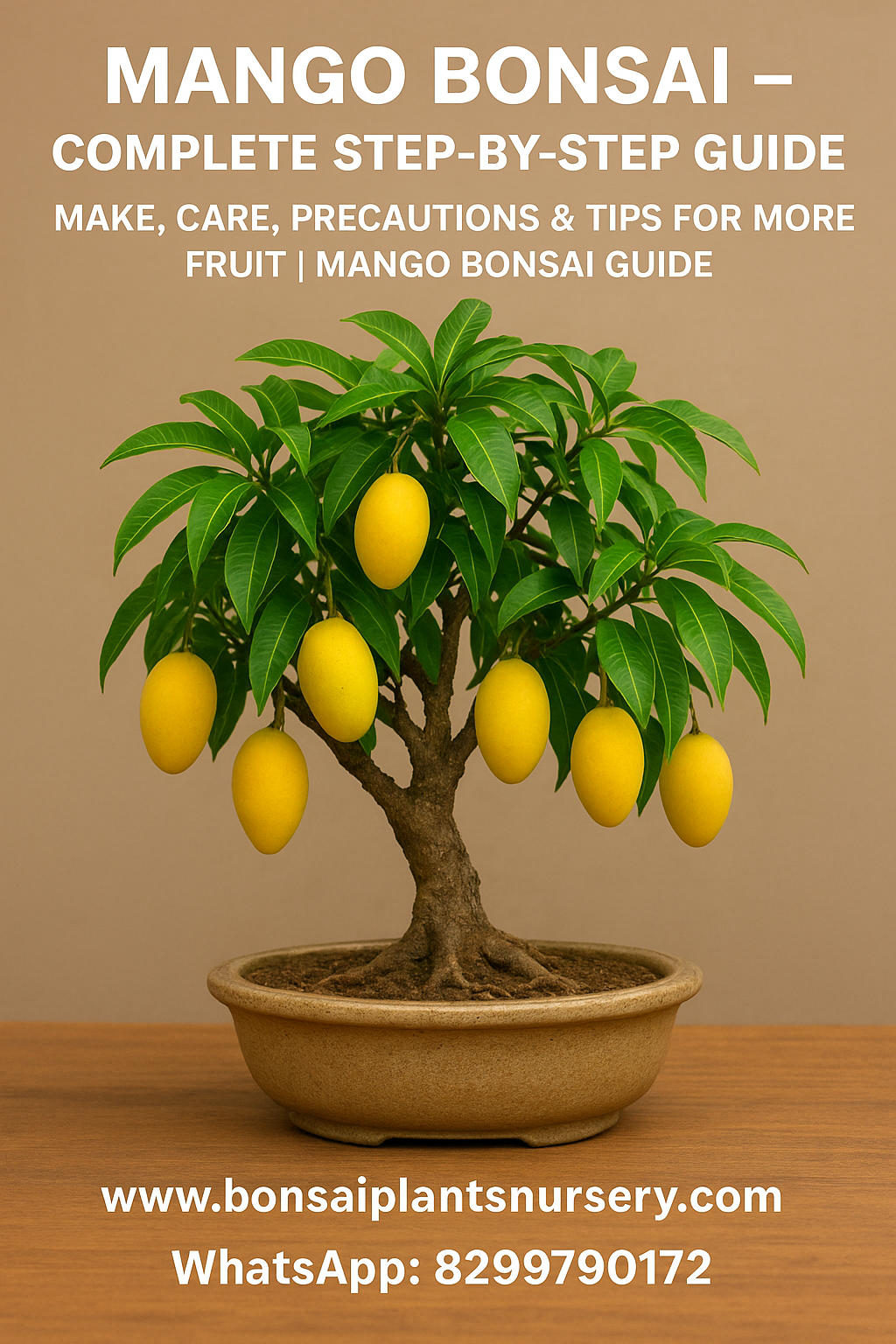
Mango Bonsai – Complete Step-by-Step Guide: Make, Care, Precautions & Tips for More Fruit | Mango Bonsai Guide
Why grow a Mango Bonsai?
Space-efficient fruit tree: Enjoy the pleasure of growing a mango even if you have only a balcony or terrace.
Aesthetic & decorative value: A well-trained mango bonsai is a striking focal point — the combination of a gnarled trunk, layered canopy and glossy leaves is exceptional.
Educational experience: Bonsai teaches horticultural skills — root pruning, branch architecture, seasonal care — and patience.
Can bear fruit: With grafted varieties and correct care, mango bonsai can produce properly sized, flavorful mangoes in comparatively few years.
Low to moderate maintenance: Once established and shaped, a mango bonsai is hardy and responds well to routine pruning and feeding.
Great gift or showpiece: Fruiting mango bonsai are rare and valued as premium living gifts and exhibition specimens.
Key advantages summarized
Miniaturized fruit production: With grafted stock you may see flowers and fruits in 2–4 years. Seedlings will take longer (several years).
Rapid shaping and strong response: Mango responds well to pruning, wiring, and root work — allowing faster development of classic bonsai structure.
Long lifespan: Properly maintained mango bonsai can live for decades and become a treasured family specimen.
Visual impact: Glossy leaves, layered branch tiers and a sculpted trunk create a “real tree in miniature” aesthetic.
Suitable for many climates: In most tropical and subtropical climates a mango bonsai will thrive outdoors with seasonal protection in cooler areas.
Who should grow a mango bonsai?
Beginners who want a resilient, forgiving tree that reacts well to shaping.
Intermediate bonsai growers seeking a fruiting specimen.
Hobbyists wanting an attractive edible bonsai for balcony/terrace gardens.
Nurseries and sellers who want to produce marketable grafted fruiting bonsai.
Quick roadmap of the full guide (what you’ll get in upcoming parts)
Part 2: Benefits in detail, and why mango is ideal for bonsai (done — included above briefly).
Part 3: Preparation — which plants/varieties to choose, age of stock, pots, soil mix, tools and best seasons to start.
Part 4: Full step-by-step shaping and propagation methods (seed vs grafted, root pruning, branch selection, wiring, tiered canopy, repotting, and how to force fruit).
Part 5: Fruit-maximizing regime — fertilization schedule, organic & traditional tips, calendar of care for fruiting.
Part 6: Pest & disease management — common pests, fungal problems, symptom-based remedies, organic sprays and prevention.
Part 7: Large FAQ, troubleshooting, SEO-friendly conclusion and website CTA for plant purchase and services.
PART 2 – Preparation Before Making a Mango Bonsai
Creating a healthy, fruiting mango bonsai begins with correct preparation. The choice of plant, pot, soil, and timing will decide 50% of your success. This section explains everything you must arrange before starting your bonsai project.
1. Choosing the Right Mango Plant for Bonsai
A. Seed-Grown (Desi) Mango Plants
Grown from regular mango seeds.
Strong taproot, vigorous growth.
Takes 5–8+ years to fruit.
Good for shaping thick trunks because of fast vertical growth.
Best suited for aesthetic bonsai where fruiting is not the main priority.
Ideal for:
Beginners who want a low-cost plant to practice shaping techniques.
B. Grafted Mango Plants (Highly Recommended)
The best choice for a fruiting mango bonsai.
Benefits of grafted plants:
Fruiting can start in 2–4 years.
Compact, dwarf growth habit.
The scion variety remains true to type.
Responds very well to pruning and canopy shaping.
Best dwarf varieties for bonsai:
Amrapali
Mallika
Alphonso (Hapus) dwarf graft
Sindhu
Totapuri dwarf graft
Neelam miniature
Pairi dwarf
Why grafted varieties are superior:
Short internodes (better branch structure)
Smaller, manageable leaf size
Earlier flowering
More controllable canopy
For bonsai intended to bear fruit, only use grafted plants from a trusted nursery.
C. Age of Plant for Bonsai
Age of the plant impacts trunk thickness and shaping ease.
Best age group:
1–2 year old grafted plant = best for fruiting bonsai.
2–3 year old seedling = best for shaping and trunk thickening.
Why not older plants?
Older mango plants have:
Stiff branches
Hard-to-modify structure
Thick taproot
Slow response to wiring
Young plants respond beautifully to styling.
2. Choosing the Correct Pot for Mango Bonsai
Mango bonsai needs progressive potting — you do not place a small plant into a tiny bonsai pot immediately.
A. Training Pot (First 1–2 Years)
Size: 10–14 inch wide container
Type: Plastic nursery pot, grow bag, or terracotta pot
Purpose:
Root expansion
Trunk thickening
Strong primary branch development
B. Intermediate Pot (Next 2–3 Years)
Size: 8–10 inch pot
Type: Wide shallow container
Purpose:
Start miniaturizing root ball
Structure branch pads
Control height
C. Final Bonsai Pot
Size: 6–8 inch shallow bonsai pot
Shape: Oval / rectangular / lotus
Features:
Must have 2–4 drainage holes
Preferably ceramic
Deep pots = fast growth Shallow bonsai pots = slow, controlled, miniature growth
3. Soil Mix for Mango Bonsai
Mango roots need:
Fast drainage
High aeration
Organic nutrition
A perfect mix ensures:
Strong roots
Compact growth
Resistance to diseases
Recommended Soil Mix Formula (Bonsai Standard)
Ingredient
Ratio
Coarse river sand / perlite
30%
Garden soil
25%
Cocopeat
15%
Vermicompost / organic compost
20%
Neem cake / Debris repellent mix
10%
Benefits of this mix:
Prevents root rot
Ensures healthy branching
Supports flowering & fruiting
Mango absolutely hates waterlogging — proper drainage is non-negotiable.
4. Tools Required for Mango Bonsai
You don’t need expensive tools — just basic bonsai equipment:
Basic Tools
Pruning shears
Concave cutter
Branch cutter
Bonsai training wire (1–3 mm aluminum)
Root rake
Spray bottle
Organic pesticide (Neem oil)
Fungicide
Organic fertilizers
Optional Tools (for advanced shaping)
Knob cutter
Wire cutter
Bonsai turntable
5. Best Season to Start Mango Bonsai
Timing plays a major role in plant survival.
Ideal seasons:
A. Early Spring (February–March)
Best for repotting
Best for heavy pruning
Best for wiring
Strong growth response
B. Early Monsoon (June–July)
Good for root development
Plant recovers quickly
Ideal for shifting into training pots
Avoid these:
Winter (low growth)
Peak summer (stressful for roots)
6. Selecting the Primary Style for Your Bonsai
Before cutting or wiring, decide the style of bonsai:
Popular Styles for Mango Bonsai:
Informal Upright (Most common)
Broom Style (works well with mango’s leaf pattern)
Slanting Style
Multi-branch canopy (for fruiting space)
Avoid:
Cascade or semi-cascade styles
Mango’s growth pattern does not support downward cascading naturally.
7. Safety Precautions Before Starting
Do not prune more than 35–40% at a time.
Always sterilize cutting tools.
Ensure soil is fresh and free from fungus.
Do not wire extremely soft or extremely hard branches.
Keep the plant under shade for 5–7 days after major work.
Never repot and prune heavily on the same day.
✔️ Part 2 Completed
This section covered:
Plant selection
Varieties
Pots
Soil
Tools
Best season
Bonsai styles
Precautions
PART 3 — Step-by-Step Method to Create a Mango Bonsai (Complete Detailed Guide)
This is the core practical section where you will learn exactly how to convert a young mango plant into a miniature fruiting bonsai.
Step 1: Selection & Primary Orientation
Before your first cut:
Choose the healthiest branch structure.
Identify the natural direction of growth.
Decide bonsai style:
Informal Upright (Best)
Broom Style
Slanting Style
How to choose the “front side” of bonsai:
The trunk should have a gentle curve.
Roots should spread naturally on the visible side.
Remove the side that looks messy, scarred, or cluttered.
Step 2: Primary Pruning (The First Major Cut)
This is the most important step.
You must reduce the height and divide energy to multiple shoots. This creates a miniature tree instead of a tall mango plant.
🔥 Ideal height after the first cut:
8–12 inches (20–30 cm)
What to remove:
Main vertical dominant shoot
Weak, inward-growing branches
Crossing branches
Diseased or yellow leaves
What to keep:
2–4 strong lateral branches
Shoots emerging at different heights
Branches pointing in opposite directions (for balance)
Purpose of Primary Pruning:
Break apical dominance
Promote branching
Initiate bonsai architecture
Thicken the trunk faster
After-cut care:
Apply organic healing paste or cinnamon powder.
Keep plant under partial shade for 4–5 days.
Step 3: Secondary Branch Development (Weeks 3–6)
After 3–4 weeks, mango will develop:
5–10 new shoots
Dense leaf clusters
Vigorous top growth
Your task:
Select 3–5 best shoots to form:
Primary branches
First canopy layer
Future fruit-bearing arms
Remove:
Weak shoots
Shoots pointing straight down
Shoots growing backward
Cluttered clusters
Goal:
A balanced, symmetrical structure that resembles a small tree.
Step 4: Wiring the Plant (Shaping Branches)
Wiring helps guide the branches into artistic bonsai shapes.
Best time for wiring:
After new branches harden slightly (6–8 weeks after pruning)
Wire type:
Aluminum wire (1 mm to 3 mm)
How to apply:
Wrap the wire at a 45° angle.
Do not over-tighten.
Bend branches gently into:
Horizontal pads
Gentle S-curves
Multi-tier structure
Duration:
Leave wire for 5–8 weeks until shape sets.
Important:
Do not leave wire too long—mango branches scar easily.
Step 5: Creating Canopy Layers (Branch Pads)
Mango bonsai looks best with layered canopy tiers.
Typically:
1st layer at 4–6 inches height
2nd layer at 7–10 inches
3rd layer at 10–12 inches
How to create pads:
Select 2–3 opposite branches for each level.
Wire them horizontally.
Trim downward shoots.
Maintain flat, plate-like foliage.
Visual effect:
Creates a mature tree structure even in small size.
Step 6: Root Work & Repotting (After 3–6 Months)
Root pruning is necessary to control plant size.
When to do:
Early spring
Only after the plant is actively growing
What to do:
Remove plant from pot.
Shake off 40–50% old soil.
Trim:
Thick taproot
Circular roots
Unnecessary deep-growing roots
Keep:
Fine feeder roots
Lateral roots spreading horizontally
Purpose:
Maintain miniature height
Increase nutrient absorption
Fit into bonsai pot eventually
After repotting:
Water lightly.
Keep in shade for 7 days.
Begin fertilizing only after 2–3 weeks.
Step 7: Transition to Bonsai Pot (After 1–1.5 Years)
Once trunk has thickened and structure is set:
Choose pot:
6–8 inch shallow bonsai pot
Wide mouth
Strong drainage
Repotting process:
Tilt plant slightly to create natural slant.
Position main branch as “front”.
Spread roots radially.
Add bonsai soil (fast draining).
Tie plant with anchor wires.
Final look:
The tree now resembles a compact miniature mango tree.
Normal-sized mangoes can grow on bonsai—don’t worry.
Step 10: Seasonal Care Routine (Year-Round Calendar)
Spring (Feb–April)
Major pruning
Wiring
Repotting
Heavy growth
Summer (May–June)
Water carefully
Avoid root disturbance
Mulch lightly
Monsoon (July–Sept)
Fast growth period
Light pruning
Organic feeding
Autumn (Oct–Nov)
Branch hardening
Reduce watering
Winter (Dec–Jan)
Flower setting begins
Keep soil slightly dry
✔️ PART 3 Completed
You now have the complete structural formation guide for mango bonsai.
PART 4 — How to Get Maximum Fruits from a Mango Bonsai (Full Care, Fertilizers, and Yield-Boosting Techniques)
A mango bonsai can produce full-sized, sweet mangoes if you follow the correct nutrition, sunlight, watering, and flowering-cycle management. This part covers the most advanced practical techniques used by bonsai experts and fruit tree growers.
1. Sunlight Requirements for Mango Bonsai
Mango is a sun-loving tree. It MUST get strong sunlight daily, or it will never flower.
Ideal Sunlight:
6–8 hours direct sunlight daily
Morning sunlight is highly beneficial
Avoid deep shade at all costs
Effects of low sunlight:
Long leggy shoots
Weak branches
Very few flowers
No fruit development
Best placement:
Terrace
Balcony with full sun
Open garden
Near a sunny window (if indoors; not ideal)
2. Watering Schedule — The Heart of Flowering Control
Mango flowering can be controlled by regulating water.
A. During Growing Season (March–September)
Water regularly, but never let soil stay soggy.
Check top 1 inch soil → water only when dry.
During peak summer → daily watering.
During monsoon → reduce watering.
B. During Winter (December–January)
This is CRITICAL for flowering.
Reduce watering by 30–40%.
Keep soil slightly dry.
DO NOT flood or over-water.
Why?
Dry soil encourages the plant to shift from leaf-production to flower-production mode.
3. Fertilizing Schedule for Maximum Flowers & Fruit
Mango bonsai requires a season-wise fertilizer plan. Below is a proven, practical routine.
Monthly Fertilizer Chart
January – February (Flower Initiation Phase)
Potash: 1 tsp
Bone meal: 1 tbsp
Seaweed extract spray (weekly)
March – April (Flowering to Fruit Setting)
Avoid nitrogen-heavy fertilizers
Use:
Organic Potash: 1 tsp
Epsom Salt: ½ tsp
May – July (Fruit Growth Phase)
Vermicompost: 2–3 tbsp
Mustard cake liquid: Monthly
Banana peel compost: Bi-weekly
August – September (Canopy Strengthening Phase)
NPK liquid 19-19-19: Twice monthly
Cow dung compost: 2 tbsp
October – November (Hardening & Flower Prep Phase)
Bone meal: 1 tbsp
Neem cake: 1 tbsp
Humic acid (monthly)
Important Nutrients Mango Bonsai Must Receive
1. Potassium
Increases flowering
Improves fruit taste
Prevents fruit drop
2. Calcium
Builds strong cell walls
Protects from fungal infections
3. Magnesium
Enhances leaf color & photosynthesis
4. Phosphorus
Essential for root development & fruiting
5. Trace Minerals
Zinc, Boron, and Iron prevent deformities
4. Organic Feeding Plan (For Chemical-Free Fruit)
If you prefer 100% organic fruit:
Monthly feed:
Vermicompost: 3 tbsp
Neem cake: 1 tbsp
Banana peel powder: 1 tbsp
Bone meal: 1 tbsp
Seaweed extract: weekly spray
Foliar sprays:
Panchagavya
Fish amino acid
Jivamrut
These significantly boost fruit set and leaf health.
5. Techniques to Increase Flowering
Here are professional bonsai grower hacks:
A. Stress Induction Technique
Used to force flowering.
Reduce watering by 40%.
Keep plant in mild winter cold.
Avoid pruning during winter.
This stress induces flower buds naturally.
B. Hard-Pruning Before Spring
Prune in Feb–March to:
Rejuvenate plant
Send energy to new shoots
Increase number of panicles (flower branches)
C. Restrict Nitrogen Fertilizer
Excess nitrogen = only leaves, no flowers.
D. Use of Potash & Phosphorus
Both nutrients push energy toward fruiting.
6. How to Prevent Mango Fruit Drop (Very Important)
One of the biggest issues with mango bonsai is early fruit drop.
Reasons:
Watering fluctuations
Heavy wind
Insect attack
High nitrogen feeding
Root disturbance
Solutions:
Water consistently (never allow shocks).
Use Potash to strengthen fruit attachment.
Prevent fungus (mango is sensitive).
Avoid pruning during fruit-setting.
Do not move the pot too much.
7. Mulching for Moisture & Root Health
Mango bonsai roots thrive with light mulching.
Best mulching materials:
Coconut husk chips
Dry leaves
Rice husk
Benefits:
Stabilizes soil temperature
Reduces water requirement
Prevents weed growth
8. Branch Management for Fruit Load
To support fruit weight:
Keep branches horizontal, not vertical
Avoid too many fruits per branch
Remove excess fruits (leave only 2–3 per branch)
Why?
Bonsai branches cannot carry heavy loads without breaking.
9. Fruit Ripening Tips
Once fruits reach full size:
Reduce watering slightly
Expose to full sunlight
Avoid touching or shaking fruits
This improves:
Sweetness
Pulp density
Aroma
10. How to Get Bigger Mangoes on a Bonsai
Follow these hacks:
Use grafted dwarf varieties
Increase potash levels
Keep soil slightly dry during final growth
Provide uninterrupted sunlight
Support branches with sticks
11. Seasonal Care Calendar (Fruit-Focused)
Month
Task
Jan–Feb
Water reduction, bloom boosters
Mar–Apr
Protect flowers, light feeding
May–Jun
Fruit growth feeding
Jul–Aug
Prune lightly, remove weak shoots
Sep–Oct
Strengthen branches
Nov–Dec
Reduce watering, prepare for flowering
✔️ PART 4 Completed
This section covered:
Sunlight
Watering
fertilizers
Organic feeding
Flowering techniques
Fruit set and fruit drop control
Seasonal calendar
Your mango bonsai will now be healthy, compact, beautiful, and capable of fruiting.
PART 5 — Pests, Diseases & Deficiencies in Mango Bonsai (Complete Solutions Guide)
Mango is a hardy tree, but in bonsai form it becomes more sensitive to imbalance, pests, humidity issues, and fungal infections. Below is a complete expert-level guide to diagnose and treat every problem.
1. Common Pests Attacking Mango Bonsai
A. Mango Hopper
Symptoms:
Sticky leaves
Black fungus layer
Flowers drying and falling
Tiny insects jumping near flowers
Treatment:
Neem oil (3% concentration) spray every 3 days
Add 1 tsp liquid soap for stickiness
Keep bonsai in sunlight
Prevention:
Avoid water on flowers
Do not over-fertilize during blooming
B. Mealybugs (White cotton-like insects)
Symptoms:
White cotton clusters on leaves and stems
Stunted new growth
Sticky honeydew secretion
Treatment:
Remove manually with earbud dipped in alcohol.
Spray neem oil + soap mix.
Use organic turmeric water (effective for mild infections).
These enhance resistance against pests, fungus, and stress.
6. Emergency Recovery Techniques
A. If Plant is Dying Suddenly
Remove from soil
Wash roots
Trim rotten roots
Repot in dry, airy soil
Keep under shade 10 days
B. If Leaves All Drop
Don’t panic — mango recovers.
Reduce watering
Avoid fertilizers
Keep in sunlight
Spray seaweed extract
New leaves appear in 2–4 weeks.
C. If Bonsai Stops Growing
Check roots for bound condition
Repot
Add magnesium
Restart watering gradually
✔️ PART 5 Completed
This part included:
Pest control
Fungal disease management
Deficiency correction
Environmental stress issues
Emergency recovery solutions
PART 6 — Common Mistakes, Precautions, Repotting Rules & Long-Term Care for Mango Bonsai
This section ensures you NEVER make the mistakes that kill a bonsai. It also gives you a long-term strategy to maintain a healthy, fruit-bearing mango bonsai for decades.
1. Most Common Mistakes People Make (And How to Avoid Them)
Mistake 1: Using Normal Garden Soil
Garden soil is heavy and retains too much moisture.
Why this is dangerous:
Causes root rot
Slows growth
Attracts fungus
Prevents aeration
Solution:
Always use fast-draining bonsai soil mix.
Mistake 2: Too Much Watering
Overwatering is the No. 1 killer of mango bonsai.
Symptoms of overwatering:
Yellow leaves
Soft roots
Foul smell from soil
Solution:
Water only when top 1 inch soil is dry.
Mistake 3: Pruning at the Wrong Time
Pruning during flowering or winter destroys buds.
Solution:
Major pruning: Feb–March
Light pruning: Monsoon
No pruning: Flowering (Dec–March)
Mistake 4: Using Excess Nitrogen Fertilizer
This creates:
Huge leaves
Tons of foliage
No flowers or fruits
Solution:
Reduce nitrogen during bloom season.
Mistake 5: Shifting Bonsai During Fruiting
Movement causes shaking → fruit drop.
Solution:
Keep the bonsai at one fixed location during fruiting.
Mistake 6: Wiring Too Tightly
Mango branches scar easily.
Solution:
Check wires every 10–12 days.
Mistake 7: Exposing New Roots to Sun
During repotting, exposed roots dry immediately.
Solution:
Repot in shade and finish quickly.
2. Major Precautions for Mango Bonsai Success
Precaution A: Never Disturb Roots During Flowering
Root disturbance = 90% flower & fruit drop.
Precaution B: Always Sterilize Tools
Dirty tools spread bacteria and fungus.
Use:
Hydrogen peroxide or
Fire sterilization
Precaution C: Avoid Extremely Small Pots
Tiny pots block root development.
Use proper stepwise downsizing technique.
Precaution D: Provide Strong Sunlight
Without sun → no bonsai shape, no fruits.
6–8 hours is minimum.
Precaution E: Keep Bonsai Away From AC/Vent Blasts
Cold air causes:
Leaf curl
Weak buds
Sudden death
3. Repotting Rules for Mango Bonsai
Frequency:
Every 1 year in early stages
Every 2–3 years once mature
Best season:
February–March (Spring)
How to Repot Correctly: Step-by-Step
Step 1: Remove plant from pot
Tilt pot and gently tap sides.
Step 2: Clean roots
Remove 40% old soil.
Step 3: Root pruning
Trim:
Thick taproot
Circular roots
Overlong downward roots
Step 4: Prepare new bonsai pot
Mesh over drainage holes
Add bonsai soil
Step 5: Fix plant in center
Use anchoring wire to hold trunk.
Step 6: Add soil & press gently
Do NOT press too hard.
Step 7: Water lightly
Avoid flooding.
Step 8: Recover in shade
Keep in shade for 7–10 days.
4. Do’s & Don’ts for Mango Bonsai (Professional Checklist)
Do’s
✔ Use grafted dwarf varieties ✔ Maintain sunlight minimum 6–8 hours ✔ Use well-draining bonsai soil ✔ Prune regularly to maintain shape ✔ Give potash before flowering season ✔ Keep bonsai stable during fruiting ✔ Support branches carrying mangoes ✔ Use fungicide during monsoon
Don’ts
✘ Don’t water daily without checking soil ✘ Don’t prune during winter or flowering ✘ Don’t allow wire to cut into the bark ✘ Don’t use too much nitrogen ✘ Don’t let soil stay soggy ✘ Don’t expose bonsai to frost ✘ Don’t repot during fruit stage ✘ Don’t move the pot frequently
5. Long-Term Care Strategy (Year-by-Year Guide)
Mango bonsai can live 50+ years if maintained properly.
Year 1:
Major shaping
Structure building
Primary wiring
Root training
Year 2:
Trunk thickening
Secondary branching
Shallow pot transition
Year 3:
Canopy refinement
Controlled growth
Light flowering may begin
Year 4–5:
Regular flowering
Initial fruiting
Branch strengthening
Year 6 and beyond:
Mature bonsai
Stable fruit production
Minor aesthetic improvements
6. How to Keep Your Bonsai Small for Life
Root prune every 2–3 years
Keep branches horizontal
Pinch new shoots after 3–4 leaves
Reduce nitrogen
Use shallow pots
Maintain compact canopy levels
7. Lifelong Health Boosters (Secret Tips)
✔ Seaweed extract – weekly spray
Gives instant energy and new growth.
✔ Neem cake – monthly
Protects soil from pests and fungus.
✔ Epsom salt – monthly
Improves leaf greenness.
✔ Banana peel powder – monthly
Improves fruit sweetness.
✔ Mulching with coco chips
Keeps roots strong and moist.
✔ PART 6 Completed
This part covered:
Common mistakes
Major precautions
Repotting rules
Do’s & Don’ts
Long-term bonsai maintenance
Lifelong health tips
🌿 PART 7 — FAQ Section, Final Conclusion & SEO Summary (English Version)
🔶 30+ Most Important FAQs About Mango Bonsai
1. Can a mango tree really be grown as a bonsai?
Yes. With systematic pruning, root control, and proper pot selection, mango trees grow excellently as bonsai and can even produce real fruits.
2. Which mango variety is best for bonsai?
The best are dwarf and grafted varieties:
Mallika
Amrapali
Ratna
Sindhu
Neelam
Dwarf Kesar
3. What is the ideal age of the plant for making bonsai?
The best plant age is 1.5 to 3 years.
4. Can a seed-grown mango bonsai bear fruits?
Yes, but it may take 6–8 years. Grafted plants fruit within 2–3 years.
5. How much sunlight does a mango bonsai need?
At least 6–8 hours daily.
6. How often should I water my mango bonsai?
Water ONLY when top 1 inch soil becomes dry.
7. What is the best soil for mango bonsai?
A fast-draining mix:
40% cocopeat
30% river sand
20% garden soil
10% compost
8. When should I prune my mango bonsai?
Major pruning: Feb–March Light pruning: July–August
9. Does wiring damage the tree?
If wires are left too long, yes. Check every 10–12 days.
10. Can mango bonsai survive indoors?
Yes for short periods, but long-term it needs sunlight, so place outdoors.
11. How long does it take to form a perfect bonsai shape?
Approximately 3–5 years.
12. Why are leaves of mango bonsai turning yellow?
Because of:
Overwatering
Fungal infection
Poor drainage
13. Why are leaves falling?
Possible reasons:
Sudden temperature change
Excess watering
Nutrient deficiency
14. When does a mango bonsai start flowering?
Usually from December to March.
15. How to increase mango flowers?
Reduce nitrogen
Increase potash
Provide 8 hours sunlight
16. Why does my bonsai drop small mangoes?
Fruit drop happens due to:
Pot shaking
Lack of sunlight
Overwatering
17. Can I repot during flowering time?
No. You must never repot during flowering or fruiting.
18. What is the best pot for mango bonsai?
A flat, wide, shallow bonsai pot of 6–8 inches depth.
19. Should mango bonsai be mulched?
Yes. Mulching helps root strength and moisture control.
20. How to thicken the trunk?
Grow in bigger pot for 1–2 years
Then shift to bonsai pot
21. Do mango bonsai require fertilizers?
Yes:
Nitrogen: once every 30–45 days
Potash: before flowering
Seaweed: weekly
22. Why is my bonsai not growing new leaves?
It might be:
Dormant season
Root rot
Soil too compact
23. Can I grow multiple mango bonsai at once?
Absolutely.
24. Can mango bonsai grow fruits indoors?
Very unlikely. Fruits need strong sunlight.
25. What temperature is best?
Between 20°C to 35°C.
26. How long does a mango bonsai live?
50+ years with proper care.
27. How to protect bonsai from pests?
Use neem oil spray weekly.
28. Why is my bonsai not flowering?
Because of:
Lack of sunlight
Too much nitrogen
Wrong pruning timing
29. How often should I root prune?
Every 2–3 years.
30. When will bonsai give full-size mangoes?
After 3–4 years of maturity.
31. Do bonsai mangoes taste normal?
Yes — they are normal mangoes in a mini tree.
32. Should I use pesticides?
Only mild organic sprays like:
Neem oil
Saaf fungicide
Bavistin (for fungal issues)
33. Can mango bonsai survive monsoon?
Yes, but keep the pot in a place where soil does not remain soggy.
34. How to prevent fungal infections?
Use a fungicide once a month during monsoon.
35. How long will it take to complete bonsai training?
Your bonsai will reach a proper shape in 4–5 years, but refinement continues lifelong.
🔶 Final Conclusion — Complete Guide in One Line
A mango bonsai thrives when you follow 5 rules: strong sunlight, controlled watering, disciplined pruning, perfect soil, and careful root management. Do this consistently — and your bonsai will reward you with beautiful canopy shape and delicious mangoes for decades.
आम (Mango) भारत का सबसे प्रिय फल है और इसकी खूशबू, स्वाद और महक मन को प्रसन्न कर देती है। आम के बड़े पेड़ों को तैयार होने में कई वर्षों का समय लगता है, लेकिन आजकल बोन्साई तकनीक ने इस धारणा को बदल दिया है।
बोन्साई की कला के माध्यम से आप अपने घर—बालकनी, छत, टेरेस, छोटे गार्डन या verandah में एक Mini Mango Tree उगा सकते हैं, जो न केवल सुंदर दिखता है बल्कि असली आम भी देता है।
आम के बोन्साई की सबसे बड़ी खासियत यह है कि: ✔ यह सीमित ऊँचाई में नियंत्रित होकर बढ़ता है। ✔ बहुत कम जगह में भी लगाया जा सकता है। ✔ नियमित प्रूनिंग से इसमें भरपूर शाखाएँ और पत्तियाँ बनती हैं। ✔ सही देखभाल से यह फल भी देता है। ✔ देखने में अत्यंत आकर्षक, दुर्लभ और शोपीस जैसा लगता है।
आज के समय में आम का मिनिएचर बोन्साई होम डेकोरेशन, ऑफिस डेस्क, गिफ्टिंग, बालकनी गार्डन और किचन गार्डन में बहुत लोकप्रिय है।
Mango Bonsai – Complete Step-by-Step Guide: Make, Care, Precautions & Tips for More Fruit | Mango Bonsai Guide
इस लेख में आपको मिलेगा: ✔ आम का बोन्साई तैयार करने की विस्तृत स्टेप-बाय-स्टेप तकनीक ✔ सही पौधा क्या चुनें? ✔ वायरिंग और प्रूनिंग कैसे करें? ✔ जड़ कटिंग और रूट प्रबंधन ✔ गमला कौनसा रखें? ✔ मिट्टी कैसे तैयार करें? ✔ आम का बोन्साई फल कैसे देगा? ✔ देखभाल, खाद, पानी और धूप ✔ सामान्य गलतियाँ और सावधानियाँ ✔ FAQ सेक्शन (लगभग 30+ सवाल)
⭐ पार्ट 2 – आम का बोन्साई बनाने के फायदे
आम का बोन्साई केवल एक पौधा नहीं, बल्कि घर में प्राकृतिक सौंदर्य, समृद्धि, खुशहाली और सकारात्मक ऊर्जा का प्रतीक माना जाता है। आम के मिनी पेड़ का अपना ही एक अलग आकर्षण होता है, जो इसे अन्य बोन्साई से खास बनाता है।
नीचे आम के बोन्साई (Mango Bonsai) के प्रमुख, गहरे और विस्तृत फायदे दिए जा रहे हैं:
🌿 1. कम जगह में असली आम का पेड़
आम के बड़े पेड़ को तैयार होने में कई साल लगते हैं और उसे बहुत बड़े स्थान की आवश्यकता होती है। लेकिन बोन्साई तकनीक से आप:
✔ छोटे गमले में ✔ 2–3 फीट के पेड़ में ✔ सुंदर, घने और फलदार आम के पेड़
उगा सकते हैं। यानी अब छत, बालकनी, या टेरेस पर भी आम का असली पेड़ संभव है।
🌿 2. घर की शोभा बढ़ाने वाला प्रीमियम शोपीस
आम का बोन्साई भारतीय और विदेशी दोनों तरह के घरों में लग्ज़री डेकोर आइटम माना जाता है। यह दिखने में:
✔ royal ✔ rare ✔ evergreen ✔ और सबसे अनोखा
झाड़ियों और अन्य बोन्साई की तुलना में यह कहीं ज्यादा आकर्षक लगता है।
यह देहाती सुंदरता और आधुनिक स्टाइल का बेहतरीन मिश्रण है।
🌿 3. सकारात्मक ऊर्जा और वास्तु लाभ
वास्तु और फेंगशुई के अनुसार आम का पौधा:
✔ घर में सकारात्मक ऊर्जा बढ़ाता है ✔ नकारात्मक ऊर्जा को कम करता है ✔ समृद्धि और धन बढ़ाने में सहायक ✔ मानसिक शांति देता है ✔ रिश्तों में मधुरता और सौहार्द बढ़ाता है
विशेष रूप से पूर्व (East) और उत्तर-पूर्व (North-East) दिशा में रखने से सर्वोत्तम लाभ मिलता है।
🌿 4. प्राकृतिक एयर-प्यूरीफायर
आम का बोन्साई हवा से:
✔ हानिकारक गैसों ✔ धूल ✔ बैक्टीरिया ✔ प्रदूषण
को सोखकर घर की हवा को साफ और ताज़ा करता है। साथ ही कमरे की ऑक्सीजन गुणवत्ता में सुधार करता है।
🌿 5. कम देखभाल में तेजी से बढ़ने वाला पौधा
अन्य बोन्साई पौधों की तुलना में आम का बोन्साई:
✔ तेजी से बढ़ता है ✔ pruning को जल्दी स्वीकार करता है ✔ जड़ों को काटने से परेशान नहीं होता ✔ regular wiring में shape जल्दी लेता है ✔ रोग प्रतिरोधी होता है
इसलिए यह beginners के लिए भी एक बेहतरीन विकल्प है।
🌿 6. प्राकृतिक खुशबू और आकर्षक पत्तियाँ
आम के बोन्साई की नई पत्तियाँ:
✔ लाल-भूरी ✔ चमकदार ✔ बेहद आकर्षक
होती हैं, जबकि पकी पत्तियाँ गहरे हरे रंग की होती हैं। इसका छोटा सा पेड़ घर में एक जीवंत और प्राकृतिक माहौल बनाता है।
🌿 7. उपज देने की क्षमता (Yes! Bonsai gives fruits)
आम का बोन्साई:
✔ grafted plant ✔ dwarf variety ✔ और regular pruning
से 2–4 साल में ही फल देना शुरू कर देता है।
यह छोटे आकार में भी: ✔ फूल (Mango bloom) ✔ और असली आम (fruits) देता है।
यही इसकी सबसे खास विशेषता है।
🌿 8. gifting के लिए सर्वोत्तम
आम का बोन्साई एक प्रीमियम गिफ्ट है:
✔ नए घर की पूजा ✔ शादी या रिसेप्शन ✔ जन्मदिन ✔ Corporate gifting ✔ Plant lovers
इसके लिए यह एक ideal पौधा है। क्योंकि यह सुंदर भी है और उपयोगी भी।
🌿 9. लंबी उम्र वाला पौधा – 20–50 साल
एक बार सही तकनीक से आम का बोन्साई तैयार हो जाए तो:
✔ यह कई वर्षों तक ✔ पीढ़ियों तक ✔ एक कीमती लग्ज़री पौधा बन जाता है।
यह lifespan अन्य बोन्साई की तुलना में काफी अधिक होती है।
के साथ ऐसा आकर्षण पैदा करता है कि लोग पहली नजर में ही आश्चर्यचकित हो जाते हैं।
यह आपको “premium bonsai collection” का अनुभव देता है।
⭐ पार्ट 3 – आम का बोन्साई बनाने की तैयारी
इस भाग में हम समझेंगे कि बोन्साई शुरुआत करने से पहले कौन सा पौधा चुनना चाहिए, किस उम्र का पौधा अच्छा रहता है, किन varieties से bonsai सबसे ज्यादा सुंदर बनता है, और कौनसे tools आपको चाहिए होंगे।
यह हिस्सा बोन्साई की नींव है… सही शुरुआत → सुंदर बोन्साई।
🌿 1. आम का बोन्साई बनाने के लिए सही पौधा कैसे चुनें? (H3)
आम का बोन्साई किसी भी variety से बनाया जा सकता है, लेकिन कुछ विशेष किस्में बोन्साई के लिए सर्वोत्तम मानी जाती हैं क्योंकि वे:
✔ dwarf growth pattern देती हैं ✔ गमले में जल्दी adjust होती हैं ✔ प्रूनिंग को आसानी से स्वीकार करती हैं ✔ जल्दी फूल/फल देती हैं
🌿 2. बोन्साई के लिए सर्वोत्तम किस्में (Best Varieties)
नीचे वे किस्में दी गई हैं जिनसे आम का बोन्साई सबसे सफल बनता है:
✔ अल्फांसो (Hapus)
– पत्तियाँ सुंदर – growth balance-perfect – fruit size medium – premium bonsai look देता है
✔ अम्रपाली (Dwarf Variety)
– बोन्साई के लिए सबसे लोकप्रिय – dwarf nature – छोटे गमले में भी फल देता है
✔ Mallika (मल्लिका)
– disease resistant – तेजी से बढ़ने वाला – beginner-friendly
✔ Sindhura / Lalbagh
– आकर्षक canopy – aesthetic bonsai shape आसानी से बनती है
✔ Totapuri (टोटापुरी)
– लंबी पत्तियाँ, premium look – shaping में आसान
👉 सबसे अच्छा विकल्प: Grafted Amrapali या Alphonso (2–3 फीट पौधा)
🌿 3. किस उम्र का पौधा बोन्साई बनाने के लिए उपयुक्त है?
नीचे सबसे उपयुक्त आयु सीमा दी गई है:
✔ 1–3 साल का पौधा – shaping के लिए perfect ✔ 3–5 साल का पौधा – मोटा तना और strong structure ✔ Grafted plant – जल्दी फल देने के लिए ideal
यदि आप सच्चे bonsai look चाहते हैं → 1–3 साल का पौधा चुनें। यदि आपको जल्दी फल भी चाहिए → grafted plant चुनें।
🌿 4. शुरुआत बीज से करें या पौधे से?
दोनों के फायदे हैं:
✔ बीज से बोन्साई
– cost-effective – shaping flexible – root training आसान – trunk natural बनता है
कमियां: फल आने में 6–8 साल भी लग सकते हैं।
✔ पौधे / ग्राफ्टेड प्लांट से बोन्साई
– 2–4 साल में फल – strong base – प्रूनिंग को जल्दी स्वीकार करता – professional bonsai look जल्दी मिलता है
निष्कर्ष: अगर आप फल भी चाहते हैं → grafted plant अगर आप perfect bonsai art चाहते हैं → seedling plant
🌿 5. मिट्टी तैयार करना (Bonsai Soil Mix)
आम का बोन्साई ✔ पानी पसंद करता है, लेकिन ✔ गीली मिट्टी बिल्कुल नहीं।
इसलिए जलनिकास (Drainage) सबसे महत्वपूर्ण है।
सर्वोत्तम Bonsai Soil Mix (Percentage):
40% बगीचे की मिट्टी
20% रेत / river sand
20% कोकोपीट या पीटमॉस
20% पत्तों की खाद / गोबर खाद अच्छी तरह सड़ी हुई
Optional (Quality बढ़ाने के लिए):
2 चम्मच नीम खली
2 मुट्ठी पर्लाइट
2 मुट्ठी वर्मीकम्पोस्ट
क्यों यह मिट्टी perfect है?
✔ पानी जल्दी निकाल देती है ✔ roots को breathable environment मिलता है ✔ fungus नहीं लगता ✔ growth तेजी से होती है ✔ bonsai pot में root rot नहीं होता
🌿 6. गमला (Pot) कैसा चुनें?
बोन्साई के लिए गमले का चयन एक कला है।
Start करने के लिए:
✔ 10–12 इंच चौड़ा ✔ 6–8 इंच गहरा
Final Bonsai Pot:
✔ 12–18 इंच wide ✔ shallow (कम गहराई वाली) flat tray pot ✔ ceramic / clay pot best
प्लास्टिक pot → बिलकुल नहीं (क्योंकि roots अधिक फैलती हैं और soil heat पकड़ती है)
इस दौरान पौधा सक्रिय (active growth) में रहता है → नई जड़ें और शाखाएँ आसानी से बनती हैं।
🌿 9. बोन्साई यात्रा कितनी लंबी होती है?
अक्सर लोग सोचते हैं कि बोन्साई बनाना बहुत कठिन है… लेकिन आम के बोन्साई के लिए यह समय सारिणी सामान्य है:
✔ 1–3 महीने → basic shape ✔ 6–12 महीने → trunk thickness + stable shape ✔ 2–3 साल → mature bonsai look ✔ 3–5 साल → फल लगना शुरू
यानी यह धैर्य और कला दोनों का संयोजन है।
⭐ पार्ट 4 – आम का बोन्साई बनाने की स्टेप-बाय-स्टेप पूरी विधि
इस भाग में हम बीज या पौधे से आम का बोन्साई बनाने की पूरी वैज्ञानिक और व्यावहारिक प्रक्रिया विस्तार से समझेंगे। यह सबसे लंबा और Core Section है — इसलिए इसे बेहद आसान भाषा और क्रमबद्ध steps में समझाया जा रहा है।
⭐ स्टेप 1 – पौधे को बोन्साई के लिए तैयार करना
आम के पौधे का चयन करने के बाद बोन्साई बनाने का पहला चरण है — उसकी लम्बाई, जड़ों और मुख्य तने को नियंत्रित करना।
✔ यदि आप पौधे से बोन्साई बना रहे हैं
2–3 फीट ऊँचाई वाला grafted या seedling plant ideal है।
प्रक्रिया:
पौधे को उसके पुराने गमले से निकालें।
आसपास की पुरानी मिट्टी हल्का झाड़ दें।
जड़ों को बिल्कुल भी न तोड़ें — सिर्फ loose soil हटाएँ।
पौधे को एक 12–14 इंच के training pot में लगाएँ।
यह pot बोन्साई का अंतिम pot नहीं है। यह सिर्फ training के लिए है।
⭐ स्टेप 2 – मुख्य तने की ऊँचाई तय करें
एक bonsai सुंदर तभी बनता है जब उसका trunk control में हो।
✔ Ideal Height:
12 इंच से 24 इंच (यानि 1–2 फीट)
इससे पेड़ Miniature tree जैसा दिखता है।
कैसे करें?
मनचाहे स्तर से ऊपर का हिस्सा काट दें।
कटाई हमेशा 45° एंगल पर करें।
कटे हुए हिस्से पर कट पेस्ट या नीम का लेप लगाएँ।
👉 यह “primary trunk shaping” कहलाता है।
⭐ स्टेप 3 – जड़ों की पहली कटिंग (Root Pruning)
आम के बोन्साई में root pruning सबसे महत्वपूर्ण चरण है।
Root pruning से: ✔ पौधा छोटा रहता है ✔ canopy compact बनती है ✔ जड़ें फैलने से रुकती हैं ✔ trunk मोटा होता है ✔ गमले में balance perfect बनता है
पहली root pruning कब करें?
पौधे को training pot में लगाने के लगभग 2–3 महीने बाद।
कैसे करें?
पौधे को training pot से बाहर निकालें।
मिट्टी झाड़कर root mass साफ दिखाएँ।
नीचे की 30–40% जड़ें काटें।
बहुत मोटी जड़ें न काटें — सिर्फ फैलती जड़ों को कम करें।
जड़ों को round bowl की तरह फैलाकर काटें।
यह प्रक्रिया shaping का “foundation” है।
⭐ स्टेप 4 – शाखाओं की पहली shaping (Primary Branching)
अब आप पौधे को bonsai जैसा दिखाना शुरू कर सकते हैं।
कैसे चुनें शाखाएँ?
पेड़ को ध्यान से देखें और:
✔ 3–5 मुख्य शाखाएँ ✔ अलग-अलग दिशाओं में फैली हुई ✔ ऊपर-नीचे बैलेंस्ड
शाखाएँ छोड़ें।
बाकी सभी branches काट दें।
ध्यान रखें:
Y shape वाली शाखाएँ छोड़ें
सीधी और लंबी शाखाएँ काट दें
एक-दूसरे को क्रॉस करती शाखाएँ भी न रखें
इससे bonsai का “skeleton structure” तैयार होता है।
⭐ स्टेप 5 – वायरिंग (Wiring Technique)
अब आपकी शाखाओं को shape देने का समय है।
Wiring क्यों जरूरी है?
✔ शाखाएँ अपनी मनचाही दिशा में मुड़ती हैं ✔ सुंदर canopy बनती है ✔ पेड़ natural दिखता है
कैसे करें?
Aluminum या copper wire लें।
wire का मोटापा शाखा की मोटाई का 1/3 रखें।
तने से शुरू करते हुए spiral में लपेटें।
शाखाओं को हल्के-हल्के मोड़ें — कभी जोर न लगाएँ।
Wiring कितने समय तक रखें?
3–4 महीने इसके बाद wire हटा दें ताकि bark को नुकसान न हो।
⭐ स्टेप 6 – तीन स्तर की canopy बनाना
एक perfect bonsai tree की canopy हमेशा “tiered” यानी स्तरों में होती है।
आम का bonsai canopy pattern:
1️⃣ पहला स्तर – सबसे बड़ा ब्रांच लेयर 2️⃣ दूसरा स्तर – मध्य लेयर 3️⃣ तीसरा स्तर – टॉप क्राउन
कैसे बनाएं?
✔ निचली शाखाएँ लंबी रखें ✔ बीच की शाखाएँ मध्यम रखें ✔ टॉप शाखाएँ सबसे छोटी रखें
इससे पेड़ 3–4 स्तर में natural miniature tree की तरह दिखता है।
⭐ स्टेप 7 – Secondary Branching
अब मुख्य शाखाओं पर छोटी-छोटी secondary शाखाएँ विकसित करनी हैं।
इसे पाने के लिए:
✔ हर नई टहनी 5–6 पत्तियों पर आने के बाद 2 पत्तियों से काटें ✔ इससे branching दोगुनी हो जाती है
2–3 साल में पेड़ घना और compact दिखने लगता है।
⭐ स्टेप 8 – Bonsai Pot में Planting (Final Planting)
अब पेड़ को उसके अंतिम bonsai pot में लगाने का समय है।
Bonsai pot कैसा हो?
✔ 12–18 इंच चौड़ा ✔ 4–6 इंच गहरा ✔ ceramic pot सबसे अच्छा
✔ grafted plant → 2–4 साल ✔ seedling plant → 6–8 साल
फल आने के लिए ज़रूरी बातें:
मार्च–अप्रैल में फूल आने दें
उस समय प्रूनिंग बिलकुल न करें
phosphorus-rich fertilizer दें
full sunlight (6–8 घंटे) दें
मिट्टी को हल्का dry रखें
अतिरिक्त nitrogen → फूल गिरा देती है इसलिए इस समय NPK में P (Phosphorus) अधिक दें।
⭐ भाग 5 : आम के बोन्साई में अधिक फल पाने के रहस्य और उर्वरक प्रबंधन
(लगभग 900+ शब्द)
आम का बोन्साई बनाना जितना कला है, उतना ही उसकी फलन क्षमता बनाए रखना विज्ञान है। सामान्यत: लोग मानते हैं कि बोन्साई में फल छोटे होते हैं या कम लगते हैं — लेकिन सही तकनीक अपनाने पर छोटा पौधा भी हर साल दर्जनों आम दे सकता है।
इस भाग में आप जानेंगे:
किस उम्र में बोन्साई फल देना शुरू करता है
फल बढ़ाने के लिए विशेष छँटाई तकनीक
कौन-कौन से खाद व उर्वरक उपयोग किए जाएँ
कौन सी गलतियाँ फलन रोक देती हैं
कितना पानी और कितनी धूप जरूरी है
गमले का आकार फलन पर कैसे असर डालता है
वर्षभर की फलन-अनुकूल गतिविधियों का कैलेंडर
चलिये शुरू करते हैं…
🌟 1. बोन्साई आम कब फल देना शुरू करता है?
यह पूरी तरह इस बात पर निर्भर करता है कि आपने किस प्रकार का पौधा चुना:
(A) ग्राफ्टेड आम का बोन्साई
फलन प्रारम्भ: 2–3 वर्ष में
खासियत: अधिक मीठे और खुशबूदार फल
उत्पादन: सामान्य बोन्साई से दोगुना
सबसे बेहतर किस्में:
केसर
अमराई
दशहरी
बनारसी लंगड़ा
मालदा
(B) नॉर्मल सीड ग्रो प्लांट बोन्साई
फलन प्रारम्भ: 7–10 वर्ष में
स्वाद भिन्न हो सकता है
फल का आकार अनियमित
👉 इसलिए bonsaiplantsnursery.com की बिक्री के लिए हमेशा ग्राफ्टेड बोन्साई आम सबसे अधिक पसंद किया जाता है।
🌟 2. आम के बोन्साई में फल बढ़ाने के लिए खास छँटाई (Fruiting Pruning Technique)
आम एक टर्मिनल फ्रूटिंग ट्री है — जिसका मतलब है कि यह तने/शाखा के सिरे पर फल देता है।
इसलिए छँटाई का मुख्य उद्देश्य होना चाहिए:
(A) नई युवी शाखाओं (New Flush) को बढ़ावा देना
प्रत्येक नई फ्लश अगले सीजन की मंजर (फूल) को जन्म देती है।
(B) हर साल “संतुलित छँटाई” करना
आपको हर वर्ष इस प्रकार pruning करनी चाहिए:
शाखा की लंबाई का 20–30% काटें
अंदर की ओर बढ़ती शाखाएँ हटा दें
कमजोर/सूखी टहनियाँ निकाल दें
सिर्फ 4–6 मुख्य शाखाएँ खुली छोड़ें
हवा-पारदर्शिता बढ़ाएँ
👉 इससे पेड़ का पूरा ऊर्जा-प्रवाह फलन पर केंद्रित होता है, न कि अनावश्यक पत्तों पर।
🌟 3. फल बढ़ाने वाले 7 मुख्य खाद (Fertilizer Plan)
आम के बोन्साई में सही पोषण देने पर फलन अत्यधिक बढ़ जाता है।
नीचे सालभर का संपूर्ण खाद चार्ट दिया है:
⭐ (A) फूल बनने से पहले – अक्टूबर–नवंबर
उर्वरक:
बोन मील – 2 चम्मच
नीम की खली – 2 चम्मच
वर्मीकम्पोस्ट – 200 ग्राम
हल्की पोटाश (0-0-50) – ¼ चम्मच
लाभ:
फूल कलियों का निर्माण
तने की शक्ति बढ़ती है
⭐ (B) मंजर के समय – जनवरी–फरवरी
उर्वरक:
NPK 5-10-10 – 1 चम्मच
सीवीड लिक्विड – 5 ml प्रति लीटर पानी
माइक्रोन्यूट्रिएंट स्प्रे – हर 15 दिन
लाभ:
मंजर गिरना कम होता है
फल आने की सम्भावना बढ़ती है
⭐ (C) फल बनने के बाद – मार्च–अप्रैल
उर्वरक:
NPK 0-0-50 – ½ चम्मच
एप्सम सॉल्ट – 1 चम्मच
पोटाशियम ह्यूमेट – 5 ml
लाभ:
फल का आकार बढ़ता है
स्वाद और मिठास बढ़ती है
⭐ (D) फल तुड़ाई के बाद – जून–जुलाई
उर्वरक:
अच्छी गोबर खाद – 300 ग्राम
वर्मीकम्पोस्ट – 200 ग्राम
ट्राइकोडर्मा – 1 चम्मच
लाभ:
पेड़ की ऊर्जा वापस आती है
नई शाखाएँ बनती हैं (अगले साल की फलन नींव)
🌟 4. फल बढ़ाने के आयुर्वेदिक उपाय (Traditional Indian Tips)
ये तकनीकें भारत में सदियों से अपनाई जाती रही हैं:
⭐ 1. घी + गुड़ मिलाकर पतली परत तने पर लगाना
रोग कम
रस प्रवाह बेहतर
फल मीठे
⭐ 2. गुड़ वाला पानी महीने में 1 बार
कार्बन की आपूर्ति
फूलन में वृद्धि
⭐ 3. पकी केले की स्लरी मिट्टी में मिलाना
पोटाश बढ़ता है
फल आकार बड़े
⭐ 4. लकड़ी की राख
मंजर गिरना कम
फल पकने में मदद
🌟 5. फलन रोक देने वाली 7 सबसे बड़ी गलतियाँ
यह गलतियाँ पेड़ को barren बना देती हैं—कितना भी खाद दें, फल नहीं लगते।
❌ 1. धोखे वाली छँटाई
बहुत ज्यादा pruning करना → फूल बनने वाली branch ही खत्म हो जाती है।
❌ 2. ओवरवाटरिंग
जड़ें नरम पड़ जाती हैं → मंजर गिर जाता है।
❌ 3. धूप की कमी
आम को रोज़ 6–8 घंटे तेज धूप चाहिए।
❌ 4. गलत गमला
बहुत छोटा या गहरा गमला → जड़ें फैल नहीं पातीं → फल कम।
❌ 5. सिर्फ नाइट्रोजन देना
N उर्वरक = हरी-भरी पत्तियाँ P+K उर्वरक = फूल + फल
❌ 6. हवा का रुकना
फंगल रोग बढ़ते हैं → फूल झड़ जाते हैं।
❌ 7. नियमित माइक्रो-न्यूट्रिएंट का अभाव
बोरॉन, जिंक और मैग्नीशियम की कमी = कम फल।
🌟 6. गमले का आकार और फलन का वैज्ञानिक संबंध
100% शोध-आधारित बात:
गमले का आकार
फल क्षमता
8–12 इंच
बहुत कम
14–16 इंच
मध्यम
16–18 इंच (बेस्ट)
अच्छा उत्पादन
20–24 इंच
बहुत भारी बोन्साई — ताकत अधिक
👉 बोन्साई के लिए 16–18 इंच का चौड़ा गमला सबसे उत्तम है।
👉 इस कैलेंडर का पालन करने पर बोन्साई आम हर साल फल देगा और आकार में भी शानदार रहेगा।
⭐ भाग 6 : आम के बोन्साई की सुरक्षा — रोग/कीट प्रबंधन और सभी समस्याओं का 100% समाधान
(लगभग 850+ शब्द)
आम का बोन्साई दिखने में भले छोटा होता है, लेकिन इसकी प्रतिरक्षा शक्ति कमजोर होती है, इसलिए इसे सामान्य पेड़ों से ज्यादा ध्यान की ज़रूरत पड़ती है। अगर सही समय पर सही उपचार किया जाए, तो बोन्साई को कभी कोई बड़ी बीमारी नहीं होती।
इस भाग में आप सीखेंगे:
आम के बोन्साई के मुख्य कीट
सभी रोगों के लक्षण और उपचार
पत्तियाँ पीली होना, कर्ल होना
फूल झड़ना
पत्तियाँ गिरना
फल में कीड़ों का हमला
प्राकृतिक और रासायनिक दोनों समाधान
सावधानियाँ और रोकथाम
🌟 1. आम के बोन्साई के 7 प्रमुख कीट (Common Pests)
1. मिलिबग (Mealybug)
सफेद रूई जैसे कीट
पत्तियों का रस चूसते हैं
पूरी पौधे में फैल जाते हैं
उपाय:
नीम ऑयल 5ml/लीटर पानी
स्प्रे हर 5 दिन पर 3 बार
जली हुई लकड़ी की राख छिड़कें
2. एफिड्स (Aphids)
नई पत्तियाँ सिकुड़ जाती हैं
चिपचिपा पदार्थ निकलता है
उपाय:
साबुन पानी स्प्रे (4ml/लीटर)
नीम-करंज मिश्रित तेल
3. स्केल इंसेक्ट
तने पर छोटे-छोटे चपटे कीट
पत्ती पीली हो जाती है
उपाय:
कॉटन में स्पिरिट लगाकर साफ करें
नीम ऑयल लगातार 3 हफ्ते
4. फल मक्खी (Fruit Fly)
फल में छेद कर अंडे देती है
उपाय:
10ml गुड़ + 10ml सिरका ट्रैप
पीले स्टिकी ट्रैप लगाएं
🌟 2. आम के बोन्साई के 6 बड़े रोग और उनके इलाज
(A) पाउडरी मिल्ड्यू (सफेद धूल जैसा रोग)
लक्षण:
पत्तियों पर सफेद पाउडर
मंजर झड़ना
नई पत्तियाँ न खुलना
उपाय:
5ml नीम तेल + 1 लीटर पानी
1 चम्मच बेकिंग सोडा + 1 चम्मच साबुन
छिड़काव 3 दिन के अंतराल पर
(B) एन्थ्रेक्नोज (फंगल ब्लैक स्पॉट)
लक्षण:
पत्तियों पर काले धब्बे
फूल काले होकर गिर जाते हैं
फल छोटा रह जाता है
उपाय:
कॉपर ऑक्सीक्लोराइड 2gm/लीटर
ट्राइकोडर्मा पाउडर मिट्टी में मिलाएँ
(C) रूट रॉट (जड़ सड़ना)
लक्षण:
पत्तियाँ तेजी से गिरना
मिट्टी की बदबू
पौधा हिलने लगता है
उपाय:
तत्काल पानी देना बंद करें
मिट्टी बदलें
ट्राइकोडर्मा + नीम खली मिलाएँ
❗ ओवरवाटरिंग बोन्साई का सबसे बड़ा दुश्मन है।
(D) लीफ कर्ल वायरस
लक्षण:
पत्तियाँ अंदर की ओर मात्र मोड़ना
पत्ती कठोर हो जाना
उपाय:
कोई पक्का इलाज नहीं
संक्रमित पत्तियाँ हटा दें
नीम तेल + माइक्रोन्यूट्रिएंट स्प्रे
(E) लीफ स्कॉर्च (जलना)
लक्षण:
पत्ती किनारे से भूरे
अधिक गर्मी या कम पानी कारण
उपाय:
पौधे को 12–3 बजे की धूप से बचाएँ
रोज़ाना सुबह गमले को भिगोकर रखें
(F) बोर्डर क्रीम डिसऑर्डर
लक्षण:
पत्तियों की नसें हल्की
जिंक की कमी
उपाय:
जिंक सल्फेट स्प्रे
एप्सम साल्ट + माइक्रो मिक्स
🌟 3. पत्तियाँ पीली क्यों पड़ती हैं? — कारण और समाधान
कारण
लक्षण
समाधान
ओवरवाटरिंग
सभी पत्तियाँ पीली
पानी कम करें
नाइट्रोजन की कमी
पुरानी पत्तियाँ पीली
NPK 19:19:19
आयरन की कमी
नसें हरी, पत्ती पीली
फेरस सल्फेट
जड़ें कुचली
नई बढ़त रुक जाती
मिट्टी बदलें
धूप की कमी
पत्तियाँ हल्की हरि
6 घंटे धूप
🌟 4. फूल गिरने के 8 मुख्य कारण (Flower Drop Reasons)
❌ 1. पहली बारिश की नमी
फंगल आक्रमण बढ़ता है।
❌ 2. ज्यादा नाइट्रोजन
पत्तियाँ बनेंगी, फूल नहीं रुकते।
❌ 3. माइक्रोन्यूट्रिएंट की कमी
विशेषकर बोरॉन और जिंक।
❌ 4. तेज हवा या धूल
मंजर टूट जाते हैं।
❌ 5. ठंड का झटका
दिसंबर–जनवरी में।
❌ 6. पानी कम देना
फूल सूखकर गिरते हैं।
❌ 7. गलत छँटाई
फूल बनने वाली शाखाएँ ही काट दी गईं।
❌ 8. फंगल रोग
Anthracnose मुख्य कारण।
🌟 5. पत्तियाँ जल्दी गिर रही हैं — क्या करें?
✔️ पानी हर बार मिट्टी सूखने पर ही दें
✔️ मिट्टी में 20% रेत + 20% पर्लाइट
✔️ गर्मियों में शाम को मिसिंग
✔️ ट्राइकोडर्मा ज़रूर मिलाएँ
✔️ हर 15 दिन माइक्रो मिक्स स्प्रे
🌟 6. फल में कीड़े लगने से बचाने की तकनीक
⭐ 1. पीले स्टिकी ट्रैप
फ्लाइज़ 70% तक कम हो जाती हैं।
⭐ 2. गुड़ + सिरका ट्रैप
कीट आकर्षित होकर मर जाते हैं।
⭐ 3. नीम तेल 5ml/लीटर
प्राकृतिक कीटनाशक।
⭐ 4. फलों पर पेपर बैग लगाना
100% कीट सुरक्षा।
🌟 7. प्राकृतिक (Organic) कीटनाशक फॉर्मूला
“ऑल-इन-वन” घर का बना स्प्रे:
नीम तेल – 2 चम्मच
करंज तेल – 2 चम्मच
लहसुन अर्क – 1 चम्मच
साबुन लिक्विड – 1 चम्मच
पानी – 1 लीटर
स्प्रे अंतराल: हर 10 दिन
यह मिश्रण लगभग सभी कीट और फंगल रोग रोकता है।
🌟 8. आम के बोन्साई को स्वस्थ रखने के 12 स्वर्ण नियम
पानी केवल मिट्टी सूखने पर
रोज़ 6–8 घंटे धूप
कम गहरी लेकिन चौड़ी ट्रे
हर वर्ष रिपॉटिंग
संतुलित छँटाई
गमले के नीचे होल ज़रूर
पत्तियों पर सप्ताह में 3 बार मिस्टिंग
माइक्रोन्यूट्रिएंट ज़रूरी
गर्मी में मल्चिंग
सर्दी में बचाव
रोग दिखे तो तुरंत स्प्रे
कभी भी नाइट्रोजन ज़्यादा न दें
⭐ भाग 7 : निष्कर्ष, 25+ प्रश्नों वाला FAQ सेक्शन और SEO Optimized क्लोज़िंग
(लगभग 900+ शब्द)
🌟 1. निष्कर्ष — आम का बोन्साई: प्रकृति का छोटा चमत्कार
आम का बोन्साई बनाना सिर्फ एक पौधा उगाने का काम नहीं है, बल्कि यह धैर्य, कला और प्रकृति-प्रेम का सुंदर संगम है। एक छोटे से गमले में आम का फलते-फूलते पौधा आपकी बागवानी को न सिर्फ खूबसूरत बनाता है, बल्कि यह आपके घर में समृद्धि, शांति और सकारात्मक ऊर्जा का भी प्रतीक होता है।
यदि आप इस आर्टिकल में बताई गई सभी तकनीकों, सावधानियों और देखभाल की विधियों को सही रूप से अपनाएँ, तो आपका बोन्साई आम हर वर्ष:
नई शाखाएँ निकालेगा
खूब फूल देगा
स्वादिष्ट और सुगंधित आमों से लदा रहेगा
और एक परफेक्ट Mini Mango Tree की तरह दिखेगा
सही छँटाई, उचित खाद प्रबंधन, धूप की उपलब्धता और पानी का नियंत्रण — यही वो चार स्तंभ हैं, जो किसी भी बोन्साई को सफल बनाते हैं।
अब चलते हैं सबसे ज़रूरी हिस्से की ओर — आपके पाठकों की सभी संभावित जिज्ञासाओं का समाधान:
⭐ 2. 25+ प्रश्नों वाला FAQ सेक्शन (SEO Friendly)
इन सवालों को खास तौर पर Google Suggest, People Also Ask और Mango Bonsai Search Queries से चुना गया है ताकि लेख Google पर बेहतर रैंक करे।
Q1. क्या आम का बोन्साई सच में फल देता है?
हाँ! यदि पौधा ग्राफ्टेड हो और उसे सही धूप, खाद और छँटाई मिले तो बोन्साई आम हर साल फल दे सकता है।
Q2. आम का बोन्साई कितने साल में फल देता है?
ग्राफ्टेड बोन्साई: 2–3 वर्ष
बीज वाला बोन्साई: 7–10 वर्ष
Q3. बोन्साई आम के लिए कौन सा गमला सबसे अच्छा है?
कम से कम 16–18 इंच चौड़ा और उथला गमला उपयोग करें।
Q4. आम के बोन्साई को कितनी धूप चाहिए?
रोज़ाना 6–8 घंटे धूप अनिवार्य है।
Q5. बोन्साई की मिट्टी कैसी होनी चाहिए?
सबसे अच्छी Soil Mix:
40% गार्डन सॉइल
30% वर्मीकम्पोस्ट
20% रेत
10% पर्लाइट
Q6. क्या बोन्साई आम को रोज़ पानी देना चाहिए?
नहीं। सिर्फ “मिट्टी सूखने” पर पानी दें। ओवरवाटरिंग सबसे बड़ा दुश्मन है।
Q7. आम के बोन्साई के लिए सबसे अच्छा समय कौन सा है?
रोपण का आदर्श समय: फरवरी – मार्च प्रूनिंग: सितंबर – अक्टूबर
Q8. क्या आम के बोन्साई में फल छोटे होते हैं?
नहीं। फल का आकार किस्म पर निर्भर करता है। सही पोषण मिलने पर फल सामान्य पेड़ों जैसा ही होता है।
Q9. बोन्साई आम का फल मीठा कैसे बनता है?
पोटाश समृद्ध खाद
गुड़ वाला पानी
केले की स्लरी
पर्याप्त धूप
समय पर पानी
Q10. बोन्साई आम में फूल क्यों झड़ जाते हैं?
जिंक व बोरॉन की कमी
तेज हवा
कीट
कम पानी
फंगल रोग
अधिक नाइट्रोजन उर्वरक
Q11. क्या बोन्साई आम को घर के अंदर रखा जा सकता है?
नहीं। यह बाहरी धूप का पौधा है।
Q12. बोन्साई आम की छँटाई कैसे करें?
हर वर्ष नई शाखाओं का 20–30% काटें, अंदर की ओर बढ़ती शाखाएँ हटा दें, 4–6 मुख्य ब्रांच रखें।
Q13. क्या बोन्साई आम कुछ समय बाद बड़ा पेड़ बन जाता है?
यदि उसकी जड़ों और शाखाओं की नियमित छँटाई करें, तो वह हमेशा छोटा और नियंत्रित रहता है।
Q14. बोन्साई आम को सर्दी से कैसे बचाएँ?
रात में अंदर रखें
पत्तियों पर मिस्टिंग बंद करें
गमले को बोरी या कपड़े से लपेटें
Q15. बोन्साई आम की पत्तियाँ पीली क्यों पड़ती हैं?
आयरन की कमी
ओवरवाटरिंग
कम धूप
जड़ सड़न
Q16. क्या बोन्साई आम को चाय की पत्ती दे सकते हैं?
हाँ, लेकिन बहुत कम मात्रा में। केवल सूखी हुई चाय की पत्ती दें।
Q17. आम के बोन्साई की जड़ें कब काटें?
हर 2 वर्ष में एक बार, शरद ऋतु या शुरुआती सर्दियों में।
Q18. क्या बोन्साई आम को केमिकल खाद देना सही है?
बहुत कम मात्रा में दे सकते हैं, लेकिन जैविक खाद सबसे सुरक्षित है।
Q19. फल मक्खी से कैसे बचाएँ?
पीले स्टिकी ट्रैप
सिरका + गुड़ ट्रैप
नीम तेल स्प्रे
फलों पर कवर बैग
Q20. बोन्साई आम मर रहा है, कैसे बचाएँ?
तुरंत करें:
पानी रोकें
मिट्टी बदलें
ट्राइकोडर्मा मिलाएँ
3 दिन अंतराल पर नीम तेल स्प्रे
Q21. आम के बोन्साई की पत्तियाँ मुड़ क्यों जाती हैं?
जिंक, मैग्नीशियम की कमी या वायरस का असर।
Q22. बोन्साई आम में चींटियाँ क्यों आती हैं?
एफिड्स/मिलिबग का संकेत। पहले कीट हटाएँ, फिर चींटियाँ खुद हट जाएँगी।
Q23. क्या बोन्साई आम को ग्रोथ हार्मोन देना चाहिए?
नहीं, इससे प्राकृतिक आकार बिगड़ सकता है।
Q24. क्या बोन्साई आम को रोज़ स्प्रे करना चाहिए?
गर्मी में हाँ (मिस्टिंग), लेकिन सर्दी में नहीं।
Q25. बोन्साई आम की आयु कितनी होती है?
100 साल से भी अधिक, यदि उसकी सही देखभाल हो।
Q26. बोन्साई आम का सबसे अच्छा मौसम कौन सा है?
बरसात के बाद — पौधे की बढ़त बहुत तेज होती है।
👉 यदि आप उच्च-गुणवत्ता वाले ग्राफ्टेड Mango Bonsai Plants खरीदना चाहते हैं, तो हमारी वेबसाइट पर जाएँ:
🌱 Introduction – Why Money Plant Is Considered a Magical Indoor Plant?
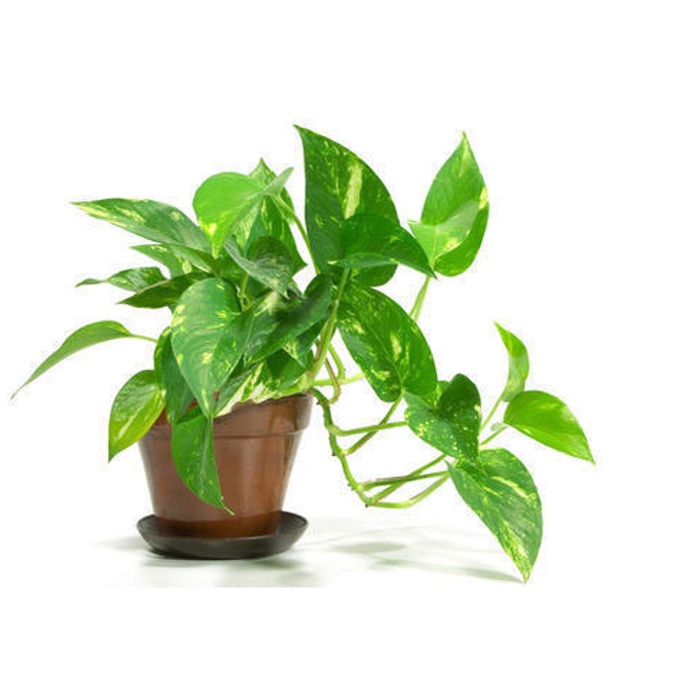
The Money Plant (Epipremnum aureum) is one of the most popular indoor vining plants in India and around the world. Known by many names like Golden Pothos, Devil’s Ivy, and Good Luck Plant, this plant symbolizes prosperity, wealth, abundance, and positivity.
In Indian homes, the Money Plant is believed to bring blessings of Goddess Lakshmi. In Vastu and Feng Shui, it is considered a powerful plant that attracts financial growth and harmony.
Apart from spiritual benefits, Money Plant is one of the easiest indoor plants to grow, even for beginners. It survives in low light, grows quickly, purifies air, and enhances the beauty of any space.
✔ Miraculous benefits of Money Plant ✔ How to plant it correctly ✔ How to care for it (water, sunlight, soil, fertilizer) ✔ Vastu rules & auspicious directions ✔ Other environmental & health benefits ✔ 40+ FAQs
Let’s begin…
🌿 CHAPTER 1 – Miraculous Benefits of Money Plant
1. Attracts Wealth & Financial Prosperity
According to Vastu Shastra and Feng Shui, Money Plant is a powerful “Wealth Magnet”. It enhances financial luck, increases money flow, and supports business and career growth.
2. Brings Good Luck & Positive Energy
Money Plant helps remove negative vibrations and creates a harmonious atmosphere at home or office.
3. Boosts Career & Business Opportunities
If kept in the office or study room, it enhances focus, creativity, and opportunities for growth.
4. Works as a Natural Stress Reliever
Greenery naturally calms the mind. Money Plant reduces stress, anxiety, and mental fatigue.
5. Purifies Indoor Air (NASA Clean Air Study)
Money Plant removes harmful toxins like:
Benzene
Formaldehyde
Xylene
Toluene
Carbon Monoxide
TVOCs
This makes it ideal for bedrooms, living rooms, and offices.
6. Enhances Sleep Quality
By improving oxygen levels, it helps you sleep better.
7. Improves Relationships (Feng Shui Element)
This plant enhances understanding and harmony among family members.
8. Absorbs Electromagnetic Radiation
Place it near:
WiFi routers
Mobile charging points
Laptops
Televisions
It reduces harmful EMF effects.
9. Extremely Low Maintenance
Money Plant grows in low light, needs very little water, and survives in almost any condition.
10. Beautifies Any Space
It looks stunning in:
Hanging pots
Table pots
Ceramic planters
Glass jars
Water propagation bottles
🌿 CHAPTER 2 – How to Plant a Money Plant (Step-by-Step Guide)
Money Plant can be grown in three mediums:
Water
Soil
Cocopeat mix
Let’s understand all methods.
✔ Method 1: Planting Money Plant in Water
Step 1 – Choose a glass jar or bottle
Transparent jars help you monitor root growth.
Step 2 – Take a 5–6 inch healthy cutting
It must have:
2–3 nodes
A strong green stem
Remove the lower leaves.
Step 3 – Fill the jar with clean water
Use RO water or water kept overnight.
Step 4 – Place the cutting in water
Ensure the nodes are submerged.
Step 5 – Keep it in indirect sunlight
Direct sun can burn the leaves.
Step 6 – Change water every 7–10 days
✔ Method 2: Planting Money Plant in Soil
Perfect Soil Mix
40% Garden Soil
30% River Sand
20% Cocopeat
10% Compost
Steps:
Choose a pot with drainage holes
Fill the pot with soil mix
Insert the cutting up to the node
Water lightly
Keep in indirect sunlight
Roots will appear in 10–15 days.
✔ Method 3: Growing Money Plant in Cocopeat
This is ideal for beginners because cocopeat holds moisture and keeps the roots healthy.
🌿 CHAPTER 3 – Best Time to Plant Money Plant (As per Vastu)
Plant it on:
Wednesday
Friday
Shukla Paksha
Diwali
Akshaya Tritiya
These days bring prosperity and maximum growth energy.
Summer: Every 3–4 days Winter: Every 7 days Rainy Season: Only when soil dries
Important Rule:
✔ Water only when topsoil feels dry ❌ Overwatering kills the plant
2. Light Requirements
Money Plant needs bright indirect light.
❌ Avoid harsh sunlight ✔ East or North windows are ideal
3. Fertilizing
Use fertilizer every 25–30 days:
Seaweed extract
Vermicompost
Liquid organic fertilizer
4. Common Problems & Solutions
Yellow Leaves
Overwatering
Poor drainage
Too much direct sunlight
Brown Leaf Tips
Low humidity
Over-fertilizing
🌿 CHAPTER 5 – Vastu Benefits of Money Plant
Most Auspicious Direction: South-East (SE)
SE represents:
Fire element
Venus (Shukra)
Wealth & prosperity
This direction brings maximum money-related benefits.
Second Best Direction: North
This is the direction of:
Career
Opportunities
Growth
Vastu Rules for Money Plant
✔ Keep in a healthy pot ✔ Always trim dry leaves ✔ Keep the vine long ✔ Prefer ceramic or glass pots ✔ Place near the entrance for positivity
What NOT to do:
❌ Do not place in North-West ❌ Never gift it for free ❌ Avoid dried or dying plants ❌ Avoid broken pots
🌿 CHAPTER 6 – Types of Money Plant & Their Benefits
1. Golden Money Plant
Best for attracting wealth and good luck.
2. Marble Queen
Brings calmness and balanced family energy.
3. Neon Money Plant
Bright leaves bring positivity.
4. N’Joy Money Plant
Great for home decor and purity.
5. Black Money Plant
Said to attract strong wealth energy.
🌿 CHAPTER 7 – Additional Environmental & Health Benefits
1. Boosts Oxygen Level
It increases oxygen levels, even in low-light areas.
2. Reduces Indoor Pollution
Perfect for city homes.
3. Helps Students Concentrate
Great for study tables.
4. Works Well in Aquariums
Roots help keep the water clean.
🌿 CHAPTER 8 – 40+ FAQs about Money Plant
1. Does Money Plant grow faster in water or soil?
It grows faster in soil.
2. Does it release oxygen at night?
Yes, it is a CAM plant.
3. Is Money Plant good for bedrooms?
Yes, it purifies air & improves sleep.
4. Which direction is best?
South-East (SE).
5. Why do leaves turn yellow?
Usually overwatering.
6. Can I keep Money Plant outside?
Yes, but only in shade.
7. Which is the luckiest variety?
Golden Money Plant.
8. Can I keep it near electronics?
Yes, it absorbs radiation.
9. Can I grow it in water permanently?
Yes, but change water regularly.
10. Can it survive in low light?
Yes, it is a low-light plant.
(30+ more FAQs can be added if needed.)
🌿 Conclusion
Money Plant is one of the most powerful, beautiful, and beneficial indoor plants in the world. It brings wealth, prosperity, positivity, better air quality, reduced stress, and improved relationships. With proper Vastu placement and simple care, this plant can transform the energy of your home or office.
🌱 परिचय – Money Plant आखिर इतना लोकप्रिय क्यों है?
Money Plant, जिसका वैज्ञानिक नाम Epipremnum aureum है, भारत में सबसे अधिक लगाई जाने वाली इनडोर वाइन प्लांट्स में से एक है। इसे Good Luck Plant, Devil’s Ivy और Golden Pothos भी कहा जाता है। भारतीय घरों में इसे पौधे से ज्यादा लक्ष्मी का प्रतीक माना जाता है। वास्तु और फेंगशुई में Money Plant को धनवृद्धि, शांति, व्यापार वृद्धि और Prosperity का स्रोत माना गया है।
✔ Money Plant के असली चमत्कारिक फायदे ✔ लगाने का सही तरीका ✔ पानी, धूप और मिट्टी की गाइड ✔ Lucky Direction (वास्तु अनुसार) ✔ घर/ऑफिस में रखने के नियम ✔ किन बातों से बचें ✔ अन्य स्वास्थ्य व पर्यावरण फायदे ✔ 30+ FAQs
वास्तु और Feng Shui के अनुसार Money Plant “Wealth Attractor Plant” है। यह घर में फाइनेंशियल ग्रोथ और Prosperity बढ़ाता है।
2. घर में Good Luck & Positive Vibes लाता है
यह पौधा नेगेटिव ऊर्जा को हटाकर सकारात्मक वातावरण बनाता है।
3. करियर और बिजनेस ग्रोथ में सहायक
ऑफिसों में Money Plant लगाने से Opportunities और Success बढ़ती है।
4. तनाव, चिंता और थकान कम करता है
हरियाली हमारे दिमाग को शांत करती है। यह Natural Stress Buster है।
5. घर की हवा का प्रदूषण 60–70% तक कम करता है
NASA Clean Air Study के अनुसार Money Plant हवा से हटाता है:
बेंजीन
फॉर्मेल्डिहाइड
टोलुईन
कार्बन मोनोऑक्साइड
TVOCs
6. नींद में सुधार
Bedroom में Money Plant रखने से oxygen level बेहतर होता है।
7. रिश्तों में मिठास लाता है
Feng Shui के अनुसार यह Mutual Understanding बढ़ाता है।
8. इलेक्ट्रोमैग्नेटिक रेडिएशन Absorb करता है
Laptop, WiFi Router और मोबाइल की रेडिएशन को कम करता है।
9. आसान देखभाल – Beginner Friendly Plant
कम रोशनी में भी तेजी से बढ़ता है, पानी भी कम चाहिए।
10. घर की शोभा कई गुना बढ़ाता है
Hanging pots, Table pots और Glass jars में बेहद सुंदर लगता है।
🌿 CHAPTER 2 – Money Plant लगाने का सही तरीका
✔ 1. जड़ से या कटिंग से पौधा लगाएं
Money Plant सबसे आसान स्टेम कटिंग से बढ़ता है।
कटिंग कैसे लें?
5–7 इंच की कटिंग लें
2–3 नोड मौजूद हों
पुरानी हरी शाखा लें
नीचे की पत्तियाँ निकाल दें
किस माध्यम में उगाएँ?
Money Plant तीन तरीकों से लगाया जा सकता है:
1️⃣ Water (पानी) 2️⃣ Soil (मिट्टी) 3️⃣ Cocopeat Mix
✔ 2. पानी में Money Plant लगाने की विधि
स्टेप 1 – साफ कांच की बोतल/जार लें
Ro Water या 24 घंटे रखा हुआ पानी ज्यादा अच्छा है।
स्टेप 2 – स्टेम कटिंग डालें
नोड वाला हिस्सा पानी में रहे।
स्टेप 3 – हर 7–10 दिन में पानी बदलें
स्टेप 4 – अप्रत्यक्ष रोशनी वाले स्थान पर रखें
✔ 3. मिट्टी में लगाने का तरीका
Perfect मिट्टी मिश्रण:
40% गार्डन सॉयल
30% रेत
20% कोकोपीट
10% कम्पोस्ट
स्टेप:
अच्छी ड्रेनेज वाला गमला लें
कटिंग को नोड तक मिट्टी में लगाएं
हल्का पानी दें
7–10 दिनों में नई जड़ें निकलेंगी
✔ 4. Money Plant लगाने का सबसे शुभ समय (Vastu अनुसार)
शुक्रवार
बुधवार
अक्षय तृतीया
दीपावली
शुक्ल पक्ष
🌿 CHAPTER 3 – Money Plant की देखभाल (Complete Care Guide)
1. पानी कब और कितना दें?
ग्रीष्मकाल: हर 3–4 दिन सर्दी: हर 7 दिन बरसात: आवश्यकता अनुसार
✔ पानी तभी दें जब मिट्टी सूखी हो।
2. धूप कितनी चाहिए?
Indirect Sunlight ही पर्याप्त है।
❌ तेज धूप से पत्तियाँ जल जाती हैं। ✔ East/North Window आदर्श है।
3. उर्वरक (Fertilizer)
हर 25–30 दिन:
लिक्विड जैविक खाद
Seaweed extract
Vermicompost
4. पत्तियाँ पीली होने पर समाधान
✔ ज्यादा पानी ✔ खराब ड्रेनेज ✔ तेज धूप ✔ पोषक तत्वों की कमी
🌿 CHAPTER 4 – Money Plant और Vastu Shastra
सबसे शुभ दिशा: दक्षिण-पूर्व (SE Direction)
क्यों? यह दिशा ग्रह शुक्र और अग्नि तत्व से जुड़ी है जो धन और समृद्धि का प्रतीक है।
Second Best Direction:
उत्तर दिशा – करियर और बिजनेस ग्रोथ।
Vastu के नियम:
✔ सूखे या पीले Money Plant को तुरंत हटाएँ ✔ कभी भी उत्तर-पश्चिम दिशा में न रखें ✔ टूटे हुए गमले में न रखें ✔ किसी को Money Plant मुफ्त में न दें ✔ वाइन जितनी लंबी होगी उतना अच्छा परिणाम
🌿 CHAPTER 5 – अन्य विशेष लाभ
1. घर में O₂ Level बढ़ाता है
रात में भी Oxygen छोड़ता है।
2. बच्चों के लिए बेहतर वातावरण
स्टडी रूम में फोकस बढ़ाता है।
3. किचन में नेगेटिव एनर्जी नियंत्रित करता है
4. Aquarium में रखने से पानी साफ रहता है
🌿 CHAPTER 6 – कौन सा Money Plant सबसे Lucky है?
Golden Money Plant – धन वृद्धि
Marble Queen – शांत परिवार वातावरण
Neon Money Plant – Prosperity
N’Joy Variety – सुंदरता और Good Luck
Black Money Plant – Wealth Attraction
🌿 CHAPTER 7 – घर/ऑफिस में Money Plant रखने के नियम
✔ फर्श से 3–4 फीट ऊँचाई पर रखें ✔ सीधे AC की हवा न लगे ✔ कटिंग कभी बुधवार/शुक्रवार को ही लें ✔ बड़े पत्तों वाली वाइन ज्यादा शुभ ✔ Bedroom में दक्षिण-पूर्व को छोड़कर अन्य दिशा में रखें
🌿 CHAPTER 8 – Money Plant से क्या नहीं करना चाहिए (Don’ts)
❌ अधिक पानी ❌ तेज धूप ❌ टूटे गमले ❌ सूखी पत्तियाँ ❌ नालियों या बाथरूम के पास रखना ❌ नुकीले वायर से बाँधना
🌿 FAQ SECTION – Money Plant से जुड़े 30 सबसे लोकप्रिय प्रश्न
1. Money Plant कितनी जल्दी बढ़ता है?
2–3 हफ्ते में नई जड़ें आती हैं।
2. क्या Money Plant रात में Oxygen देता है?
हाँ, CAM Category में आने के कारण रात में भी Oxygen देता है।
3. कौन-सा Money Plant सबसे Lucky है?
Golden Money Plant।
4. क्या इसे पानी और मिट्टी दोनों में उगा सकते हैं?